Henry — Head of Marketing · Reviewed by Austin, Product Manager
August 29, 2026 · 12 min read
Nobody can quote you a paper cup price from the words “paper cup”. The same 12oz cup can differ by a wide margin between two honest quotes, and almost none of that gap is margin.
What follows is what actually sits inside the number, in the order it matters. If you are comparing two quotes right now, this is the list to check them against.
The Six Things That Move the Price
| Lever | How much it moves | Who controls it |
|---|---|---|
| Board weight | The largest single factor | You, via specification |
| Coating | PE baseline; PLA plus 8 to 15%; aqueous around plus 15% | You |
| Print colours | A plate per colour, fixed per run | You |
| Order quantity | Per size, tiered | You |
| Cup size | More board, more cup | Your menu |
| Freight and duty | Varies by route and destination | Neither of you |
Everything else is noise by comparison. If a quote is 20% below the others and the specification looks identical, one of the first three has been changed and not mentioned.
Board Weight: Where the Cheap Quote Hides
This is the one to check first, every time.
Paperboard is the bulk of what you are buying. Take grams out of the board and the price drops immediately, and the cup still looks the same in a photograph. It does not behave the same in a hand: a cup on thin board feels flimsy, deforms when someone grips it, and is more likely to fail at the seam under a hot fill.
The number is quoted in g/m² and it should be on the quotation. If it is not, that is the question to ask before anything else. Two quotes without board weights are not comparable, and asking for it costs you one email.
Pay particular attention when a quote comes in well under market. That money comes out of somewhere, and the paperboard is the easiest place to take it from without the sample looking wrong.
Coating: The Second-Biggest Lever, and the Most Confused
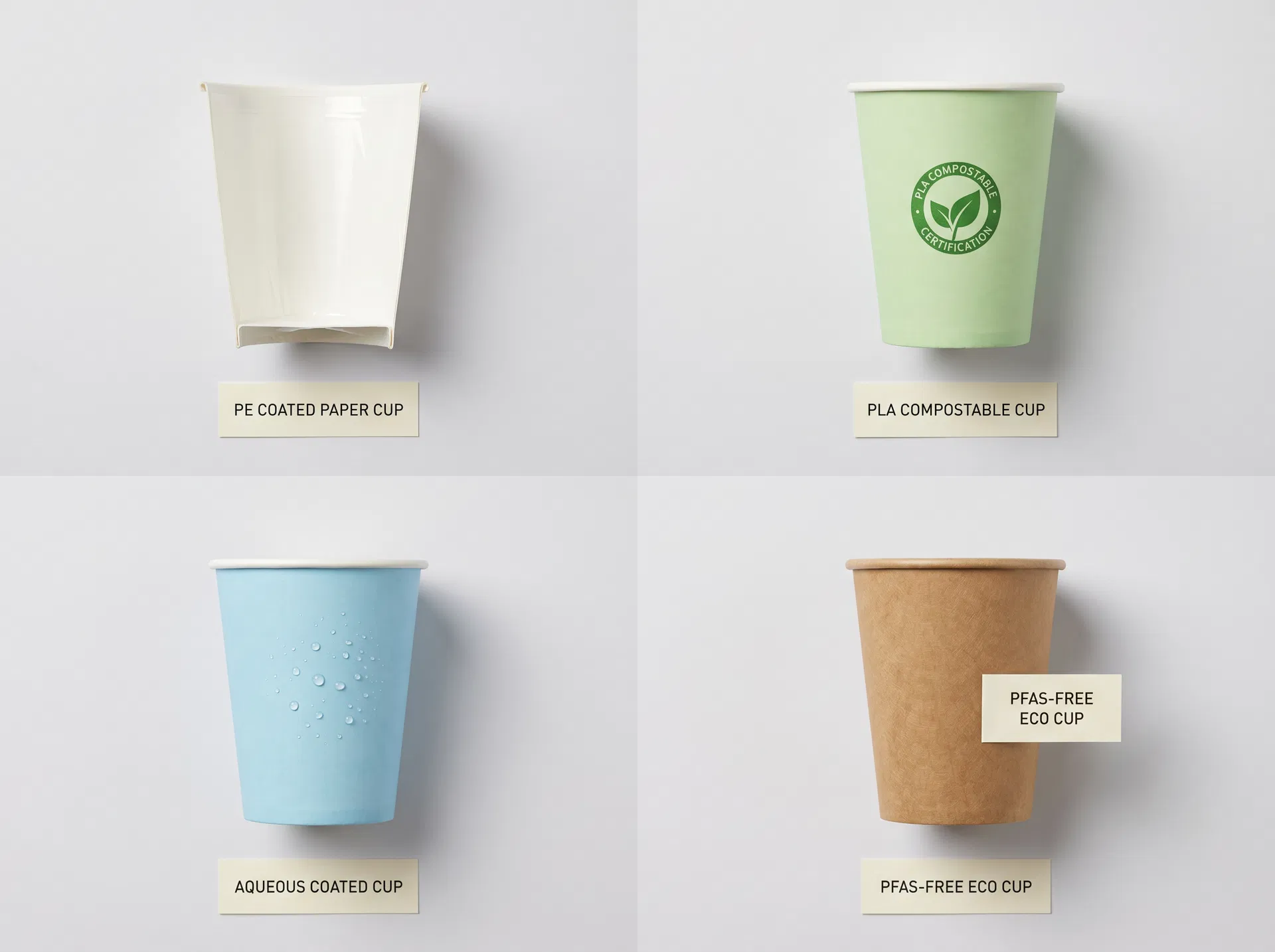
Three coatings cover the range, and the price steps are reasonably predictable.
PE is the baseline. It is the standard, it is the cheapest, and most quotes assume it unless told otherwise.
PLA runs roughly 8 to 15% above the PE equivalent. Plant-based, industrially compostable, and it softens above about 55°C, so standard PLA belongs on cold drinks and CPLA is the version for hot.
Aqueous dispersion runs around 15% above a like-for-like PE cup. A water-based coating rather than a laminated film.
Two things buyers regularly get wrong here.
The coating does not change the tooling. The full coating comparison sets out what each one buys you. PE, PLA and aqueous cups share the same dimensions and the same dielines. Switching coating does not mean new tooling or a new size, which is why a coating change mid-programme is far less disruptive than buyers expect.
Coat weight figures floating around online are unreliable. You will see specific g/m² coating numbers quoted confidently in a lot of places. Treat them with suspicion, ask your supplier for the actual specification for the article you are buying, and do not build a comparison on a figure from a blog.
Print Colours: A Fixed Cost Pretending to Be a Variable One
Flexographic printing uses a plate per colour. Each plate is made once and paid for once, then that cost divides across however many cups you run.
This is why colour count matters more on small orders than large ones. A two-colour logo on 20,000 cups spreads two plates across 20,000 units. A seven-colour photographic design on the same 20,000 spreads seven plates across the same 20,000, and the plates start to rival the cups.
Practical consequences:
- Under 50,000, keep the colour count down. Two to four colours is where most brands land and it is rarely a visible compromise.
- Seven colours is for programmes with volume behind them, where the plate cost disappears into the run.
- Reorders skip the plate cost entirely if the artwork and specification are unchanged. This is the single largest saving available to a repeat buyer and it is the reason to get the first specification right rather than treating it as a draft.
- Digital proofs are not printed proofs. Approving on screen and discovering the colour on brown board is different is a costly way to learn that a printed sample was worth waiting for.
Quantity: The Tiers That Actually Exist
Minimums are per size, not per order, and that catches people out more than the numbers themselves.
| What you are ordering | Minimum |
|---|---|
| Standard cup | 20,000 pcs/size |
| Aqueous coating | 30,000 pcs/size |
| Custom size, new tooling | 50,000 pcs/size |
| Lids | 10,000 pcs/size |
Two sizes is two lots. A programme of 8oz, 12oz and 16oz is three lots of the minimum, not one order that averages out.
Above the minimum, pricing improves with volume in the way you would expect. The steps are not dramatic between adjacent tiers, which means stretching an order by 20% to reach the next break is rarely worth the working capital. Doubling it sometimes is.
Cup Size, and Why the Steps Are Not Even
A 16oz cup uses more board than an 8oz, so it costs more. That much is obvious. What is less obvious is that the price steps between sizes are not proportional to volume.
A cup’s material cost tracks its surface area rather than what it holds. The paper cup size chart gives the dimensions behind that, size by size. Doubling the capacity does not double the board. It also does not halve it, which is why buyers who consolidate down to one large size to simplify ordering sometimes find the savings smaller than expected, and end up paying for headroom nobody uses.
The related trap: over-sizing. A drink served in a cup one size too large costs more per serve in board, and in most menus it also costs more in product. That gap compounds across a year in a way a single unit price never reveals.
Freight, Duty and the Landed Number
The unit price is not the landed cost, and this is where cross-border comparisons go wrong.
Freight is charged on volume as much as weight for a product like this. Cups nest, which helps, but a container of cups is a container of mostly air by weight. Sea freight is the norm; air is available and is rarely economic for a standard programme.
Duty depends on the destination country and on current trade policy. This is the part to get right rather than guess. US buyers importing from China should assume the headline tariff line understates the real cost, because base rates are only the starting line and additional trade measures sit on top of them.
The only sound way to compare an import quote against a domestic one is to get the landed figure from a customs broker for your destination, on your specification, at your volume. Anyone giving you a confident landed number without knowing your destination is guessing, and any supplier telling you their product imports free of duty is telling you something you should check yourself.
Where Buyers Overspend
Five patterns, all common, all avoidable.
Buying board weight nobody feels. Heavier is not automatically better. Match the board to the drink and the hold, not to a general sense that thicker means quality.
Paying for colours the design does not need. A brand mark that reads perfectly in two colours does not get better in five, and on a small run the extra plates are pure cost.
Specifying a custom size to save a fraction on fill. Custom tooling starts at a 50,000 minimum per size. Unless the volume is genuinely there, the nearest standard size almost always wins on total cost.
Ordering cups and lids at a 1:1 ratio out of habit. Many operations serve a portion of their volume without a lid. Quote the real ratio.
Treating the first order as a trial. Plates are made, proofs are approved, and a revised specification on the second order throws that away. Spend the time before the first run instead.
The Cost of the Things That Are Not the Cup
Buyers price the cup and then discover the programme costs more than the cup did. Four line items sit alongside it and they are worth budgeting for at the same time.
Lids. Quoted separately, from 10,000 per size, and ordered against rim diameter rather than cup size. Material choice moves the number too, and the paper lid options come in two builds that price differently. A lid is a meaningful fraction of the cup price, not a rounding error, and the ratio you actually need is usually below one to one.
Sleeves. Roughly a cent to four cents apiece depending on construction and volume, and covered in full on the cup sleeves page. Corrugated buys insulation, flat paper buys print area. Worth noting: the labour of sleeving is low because it is largely machine work, so nobody should be selling you a sleeve on a labour-saving argument.
Freight inside the destination. The number that surprises first-time importers. Getting a container to the port is one cost; getting it from the port to your warehouse, and off the truck, is another, and it is quoted by different people.
Storage. A minimum order across three sizes is a lot of cartons. If you are paying for warehouse space, that is a real carrying cost against the saving you made by ordering more at once.
Add these before you compare an import programme against buying locally by the case. The unit price gap is usually much larger than the total cost gap.
What a Reorder Should Cost, and Why It Is Different
The second order is where production-direct buying earns its keep, and it is the part most first-time buyers do not price in.
On a repeat run with unchanged artwork and specification, three costs disappear: the plates are already made, the proofing cycle is already done, and the specification does not need re-establishing. What remains is board, coating, machine time and freight.
That has two implications worth planning around.
Get the first specification right rather than fast. Everything you approve on the first order becomes the cheap baseline for every order after it. A specification you intend to revise is a specification you will pay to revise.
Changing anything resets part of the saving. New artwork means new plates. A new size means the size minimum again, and if it is a non-standard size, tooling. A coating change is the cheap exception, since coatings share tooling and dielines.
The blunt version: the first order carries the setup, the second order shows you the real price. Judge a supplier on the second number, not the first.
What “Cheap” Usually Means
Three things, in order of how often they turn out to be the answer.
Lighter board. Covered above, and by far the most common. Ask for g/m².
A different coating than you think you are getting. If a quote for a compostable programme comes back at PE money, check what is actually being quoted.
A specification that is not yours. The nearest standard size instead of the size you asked for, a shorter cup at the same nominal capacity, a different rim that will not take your existing lids. All of these produce a lower number against a product that is not the one you specified.
None of this makes a low quote dishonest. Suppliers quote what they think you want, and the cheapest configuration is a reasonable default when nobody has said otherwise. It becomes a problem only when the differences are not written down, which is why the six-line comparison above matters more than any negotiation.
How to Compare Two Quotes Properly
Put both on the same page against these six lines. If a supplier will not fill one in, that is your answer.
- Board weight in g/m², per size
- Coating type, named, not described as “eco”
- Print process and colour count, and whether plates are included or separate
- Minimum per size, and whether mixed sizes can be combined toward a container
- What documentation comes with the order, and for which article specifically
- Incoterm, so you know where the supplier’s responsibility ends and yours starts
Two quotes with all six filled in are comparable. Two quotes with a unit price and nothing else are not, however tempting the lower number looks.
Frequently Asked Questions
Why do paper cup prices vary so much between suppliers?
Mostly board weight, coating and print colours, in that order. A cup on lighter board with a PE coating and two print colours will always quote below one on heavier board with an aqueous coating and five colours, and photographs will not show you the difference. Ask for board weight in g/m² before comparing anything else.
How much more does a compostable or aqueous cup cost?
PLA runs roughly 8 to 15% above the PE equivalent. Aqueous dispersion runs around 15% above a like-for-like PE cup. Neither requires different tooling, because all three coatings share the same dimensions and dielines, so a coating change does not carry a tooling cost.
Does printing more colours cost a lot more?
It depends entirely on your quantity. Each colour needs its own plate, which is a fixed cost divided across the run. On 20,000 cups a seven-colour design carries a meaningful plate cost per unit; on a much larger programme the same plates barely register. Under 50,000, keep the count down.
What is the minimum order for custom printed paper cups?
20,000 pieces per size for a standard cup, 30,000 for aqueous coating, and 50,000 for a custom size that needs new tooling. Lids run from 10,000. The minimum applies per size, so a three-size lineup is three lots.
Do I pay import duty on paper cups?
Yes, in most cases, and be careful with any supplier who tells you otherwise. Duty depends on the destination country and on current trade policy, and headline tariff lines frequently understate what actually lands. Get the figure from a customs broker for your destination and your specification before you compare an import quote against a domestic one.
Is it cheaper to order one large size instead of several?
Sometimes, but less often than expected. Material cost tracks surface area rather than capacity, so a larger cup does not cost proportionally more, and serving a drink in a cup a size too big costs you on both board and product on every serve. Consolidate where the menu genuinely allows it, not as a purchasing shortcut.
Comparing quotes and not sure what the gap is? Send us both specifications with the board weights on them and we will tell you what is actually different, including when the other quote is the better one. Free stock samples ship in 3 to 5 business days, and the full range is on the paper cups hub.
Ready to Source Eco-Friendly Paper Cups?
Request a free sample pack or get a wholesale quote tailored to your requirements.