
Austin — Product Manager · Reviewed by Henry, Head of Marketing
August 28, 2026 · 12 min read
There is no such thing as “a paper lid”. There are two of them, they behave differently, and the difference decides whether the lid counts as a single-use plastic product.
Uncoated is plain board with no plastic in it. Coated is board with a moisture barrier on it, and that barrier is plastic. Both get sold as “paper lids”, often on the same page, and a lot of buyers switch off plastic lids on the assumption that the switch does something it may not have done.
This is what separates them, what each one is actually good at, and the questions that decide which one belongs on your cup.
The Two Builds, Side by Side
| Uncoated paper lid | Coated paper lid | |
|---|---|---|
| What it is | Plain paperboard, no barrier layer | Paperboard with a moisture-resistant coating |
| Plastic content | None | Yes, in the coating |
| Moisture resistance | Limited. Softens with prolonged contact and steam | Good. Built for it |
| Best for | Cold drinks, short hold, dry service | Hot drinks, long hold, condensation |
| Disposal | Goes with paper | Depends on the coating and the local programme |
| Regulatory status | Not a single-use plastic product | Not automatically out of scope, needs checking |
That last row is the one that moves money, and it is the one almost nobody writes down.
Why the Coating Decides the Legal Answer, Not the Word “Paper”
A lid with no plastic in it is not a single-use plastic product. That is the whole mechanism, and it follows from how the rules define the category rather than from what the item is called.
The practical consequence in the EU: the marking requirement under Implementing Regulation (EU) 2020/2151 attaches to plastic-containing builds. A genuinely uncoated board lid sits outside it. A coated one does not automatically, and needs a check against the specific coating before anyone prints a claim on a carton.
Two cautions, because this is where suppliers overreach.
Do not let “paper” do the work of “uncoated”. Sellers routinely list a coated lid under a heading that implies no plastic. If the product page does not say uncoated, assume it is coated and ask.
The marking side and the levy side are not the same question. Marking rules are documented and specific. Levy schemes are administered nationally and the treatment of lids specifically is not always spelled out. Get the marking answer in writing and treat the levy answer as a per-project check with whoever handles your registration.
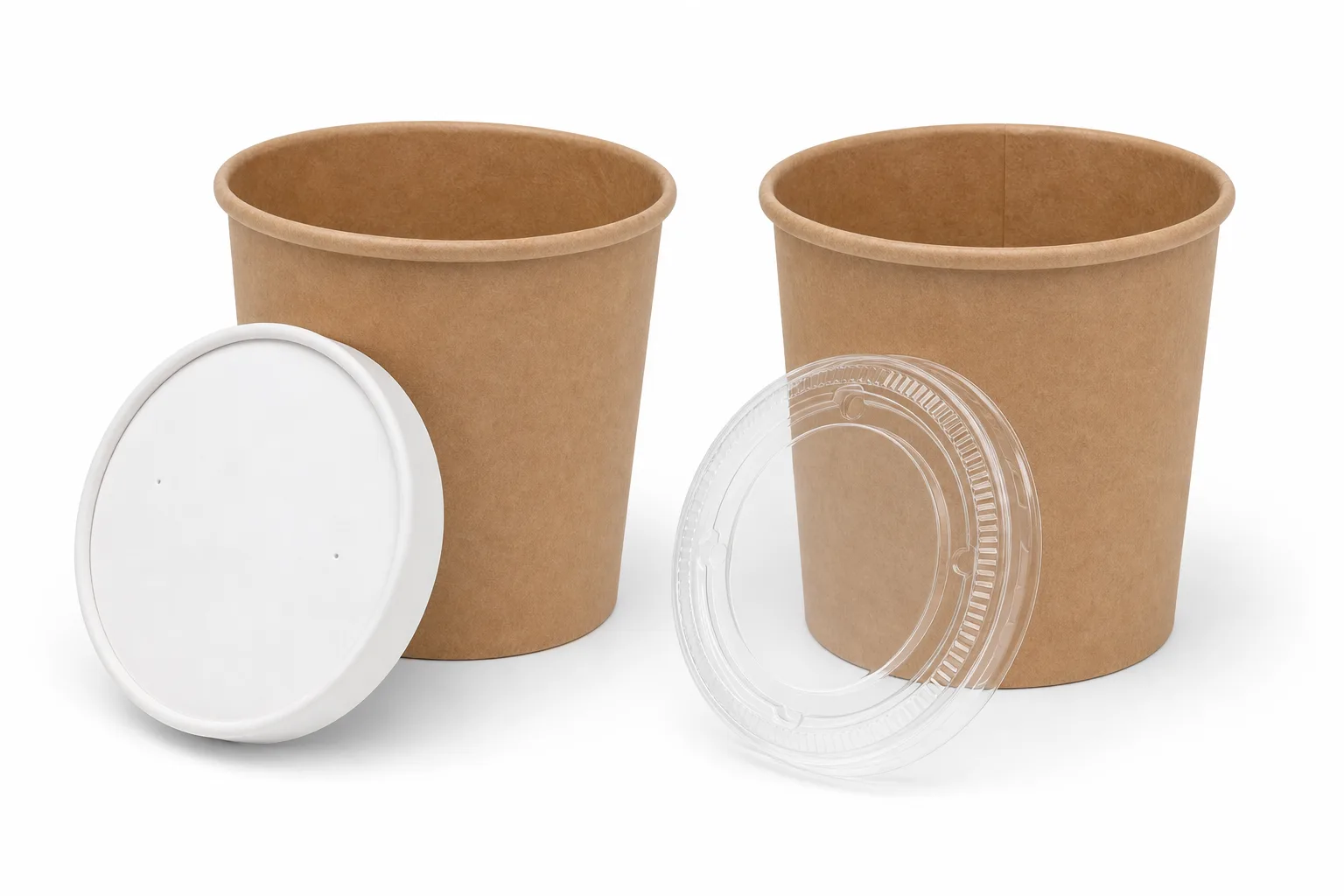
What an Uncoated Lid Is Actually Good At
Uncoated board lids work, within limits that are easy to design around and easy to get wrong.
They are good where contact is short and dry-ish. A cold drink handed over a counter and finished in twenty minutes. A lid that covers a display rather than seals a journey. Anywhere the lid’s job is mostly to keep dust out and hands off.
Where they struggle is steam and time. A hot drink under a lid produces continuous condensation on the underside, and plain board absorbs it. This is the same mechanism that decides whether a paper cup survives a microwave: moisture plus heat, working on a material that was specified for neither. Over a long hold the lid loses stiffness around the centre, which is exactly where a drinking aperture would sit. That is not a defect. It is the material doing what uncoated board does.
The blunt verdict: uncoated is a genuine plastic-free option and a poor hot-drink lid. If a supplier is selling it to you for a hot programme without raising the condensation question, they are selling you the claim rather than the product.
What a Coated Lid Buys You, and What It Costs You
The coated build is the one that behaves like the plastic lid you are replacing. It holds shape under steam, it survives a long hold, and it does not go soft at the centre.
What it costs you is the claim. There is plastic in the coating, so this build cannot be described as plastic-free, and its status under marking rules needs to be established rather than assumed.
That is not an argument against it. For a hot programme it is very often the right answer. It is an argument against the marketing that puts both builds behind one word and lets the buyer assume the better claim applies to the one that performs.
Where Paper Lids Sit Against the Rest of the Programme
Paper is one of five lid materials, and it is not automatically the right one. The full lid programme runs PS, PP, rPET, PLA/CPLA and paper.
- PS is the low-cost default across much of the market and the one most programmes are moving off.
- PP takes heat well and is the material with a food-contact test report on file in our own documentation.
- rPET carries recycled content, which is the point of specifying it.
- PLA and CPLA are plant-based; CPLA is the version made for hot service, standard PLA is not.
- Paper, in the two builds above.
Switching material is not a like-for-like swap on fit, either. Rim diameters are Φ80 mm and Φ90 mm across most of the range, with Φ73 mm on small cups, and a lid is ordered against the rim rather than against the ounce label on the cup. The full lid material comparison goes through each one; single wall cup sizes lists which rim comes with which capacity.
Documentation: What Exists and What Does Not
Worth being exact about, because “food safe” gets said a lot more often than it gets evidenced.
We hold a food-contact test report for a PP lid (SGS-CSTC Ningbo, issued May 2025). For paper, PET, PS, rPET and PLA lids, we do not currently hold lid-specific reports, and we would rather tell you that than let a cup report stand in for a lid one. Documents that exist are available on request; where a report does not exist for the exact article, we say so.
If a supplier hands you a certificate when you ask about a lid, read what was actually tested. Cup reports frequently list lids as reference items that were not themselves tested, and that distinction matters the moment a customer’s own audit asks the question.

What Shapes Board Can Actually Hold
Board is not plastic, and it does not do everything plastic does. This is the part that catches operators who expect a like-for-like swap.
A thermoformed plastic lid is made by heating a sheet and pulling it into a mould, so it will hold deep draws, undercuts and a tight sealing ridge. A board lid is pressed, and pressed fibre has limits on how far it will move before it cracks or wrinkles at the rim.
What that means in practice:
Flat lids are the natural fit. The shape asks least of the material and it is where board performs closest to plastic.
Dome lids are harder. A deep dome is a big draw. Where board domes exist they tend to be shallower than the plastic profile they replace, which matters if the point of the dome was whipped cream or a topping with height.
The drinking aperture is the weak spot. On a sip-through lid the opening removes material from exactly the area that takes the most handling, and on an uncoated build it is also the area getting the most steam. If you are trialling uncoated on a hot drink, this is the point that fails first.
The sealing ridge is shallower. Board will not hold as aggressive a snap profile as plastic, so the fit is generally more secure-feeling on plastic. Whether that matters depends entirely on whether the cup travels.
None of this rules board out. It rules out assuming the switch is invisible to the person holding the cup.
What Changes on the Counter
The specification is only half of it. A lid change lands on staff, and the operational side gets tested less often than the material side.
Stacking and dispensing. Board lids nest differently from plastic and are usually thicker per unit, so a dispenser tube that held 100 plastic lids will hold fewer. If your counter runs a fixed dispenser, measure before you commit rather than after.
Feel at speed. A plastic lid snaps on with a click that tells the barista it is seated. A board lid gives less feedback. Staff adapt quickly, but the first week produces more badly-seated lids than usual, which shows up as complaints that read like a quality problem and are actually a training problem.
Moisture on the underside. With uncoated board on a hot drink, the underside will show condensation. Customers occasionally read that as the lid failing when it is behaving normally. If the switch is a visible sustainability move, saying so on your signage costs nothing.
Sorting. If disposal is the reason for the switch, the bin arrangement has to match, or an uncoated board lid ends up in the same stream as the plastic one it replaced and the change achieves nothing.
The Mistakes Buyers Make Most Often
Four of these come up repeatedly, and all four are avoidable.
Ordering by cup size instead of rim diameter. The most common and the most expensive. Two cups with different capacities frequently share a rim, and two cups with the same nominal capacity from different suppliers frequently do not. The rim is the specification. The ounce label is a description.
Assuming paper means compostable. These are separate properties. An uncoated board lid has no plastic in it, which is a claim about content, not about how it breaks down in any particular facility. If a compostability claim is what your programme needs, that requires its own certification and its own conversation.
Trialling with the wrong drink. Testing an uncoated lid on an iced americano proves nothing about how it behaves on a flat white held for forty minutes. Test the worst case in your menu, not the easiest.
Taking the claim from the category page. Sellers commonly put both builds under one heading and let the better claim rub off on the whole listing. If the page does not distinguish coated from uncoated, the answer to which one you are buying is not on the page.
The Questions That Decide the Build
Five questions settle this, and they take one email.
- Hot or cold, and for how long? Anything hot with a hold longer than about twenty minutes points to coated.
- Is the claim or the performance the priority? If the plastic-free claim is the reason for the switch, uncoated is the only build that supports it.
- What is the rim diameter? Not the cup size. Φ73, Φ80 or Φ90.
- Which markets does this ship to? Marking rules differ, and the answer changes what has to go on the artwork.
- What documentation exists for this exact lid? Not for the cup. For the lid.
Ask all five and the answer usually picks itself. Ask only the first and you will end up with whichever build the supplier had in stock.
What to Expect on Quantity and Lead Time
Lids run from 10,000 pieces per size, which is lower than the cup minimum and often surprises buyers who assume the lid is the harder line to fill. Where the lid sits in the total is covered in the paper cup cost breakdown.
Order lids and cups together where you can. Rim profiles vary between suppliers even when the nominal diameter matches, and a lid that fits your current cup is not guaranteed to fit the next one. This is the single most common cause of a delivery that “does not fit” when nothing on either spec sheet looks wrong.
Free stock samples are the cheap way to settle it. Test the snap with your own cup, under your own hold time, with a hot drink in it if that is the application.
What the Switch Costs, and Where the Money Actually Goes
Board lids generally sit above the PS lid they replace. That is the honest starting point, and any supplier presenting the switch as cost-neutral is either absorbing something or leaving something out.
The unit price is not usually where the real cost sits, though. Four other things move more money than the lid itself.
The trial you did not run. A lid that softens in service generates remakes, and a remade drink costs several times the lid. Two weeks of testing on the worst drink on your menu is cheaper than one week of complaints.
Carrying both builds. Operations that switch partially often end up stocking an uncoated lid for cold and a coated or plastic lid for hot. That is two SKUs where there was one, plus the risk of staff grabbing the wrong one at peak.
Dispenser changes. If board lids do not fit your existing dispensers, that is a capital item nobody budgeted, and it turns up after the first delivery rather than before.
The claim you cannot use. If the switch was justified internally on a plastic-free basis and the build that actually performs is the coated one, the business case does not survive the substitution. Better to find that out at the quoting stage than in a sustainability report.
On quantity, lids run from 10,000 pieces per size. Splitting a trial across two builds means two lots, so decide which build you are actually testing before you place it rather than hedging across both.
The blunt verdict: switch on the cold line first. It is where uncoated board performs, where the claim holds, and where a failure costs you a lid rather than a drink.
Frequently Asked Questions
Are paper cup lids plastic-free?
Only the uncoated build. An uncoated paper lid is plain board with no plastic in it. A coated paper lid has a moisture barrier on it and that barrier is plastic, so it cannot be described as plastic-free. Both are commonly sold as “paper lids”, so ask which build you are being quoted.
Do paper lids work on hot drinks?
Coated ones do. Uncoated ones struggle, because a hot drink produces continuous condensation under the lid and plain board absorbs it, softening the centre over a long hold. For hot service with a long hold, specify the coated build or a different material.
Do paper lids avoid single-use plastic marking?
An uncoated lid with no plastic in it is not a single-use plastic product, so the marking requirement does not attach to it. A coated lid is not automatically outside it and needs checking against the specific coating. Get that answer in writing before it goes on artwork.
What size lid fits my cup?
Order by rim diameter, not by the ounce label. Most of the range runs Φ80 mm and Φ90 mm, with Φ73 mm on small cups. Two cups with different capacities can share a rim and therefore share a lid.
Are paper lids recyclable?
An uncoated board lid goes with paper. A coated one depends on the coating and on what the local programme accepts, which varies more than most sustainability copy admits. If disposal is the reason for the switch, ask what the coating is before you assume the outcome.
Do you have test reports for paper lids?
Not currently. We hold a food-contact test report for a PP lid and we will send it on request. For paper, PET, PS, rPET and PLA lids we do not hold lid-specific reports at the moment, and we will tell you that rather than supply a cup report in its place.
Switching off plastic lids and not sure which build survives your service time? Tell us the drink, the hold time and the rim diameter, and we will tell you which build fits, including when the honest answer is that the plastic-free claim and your hot programme do not go together. Free stock samples ship in 3 to 5 business days so you can test the snap on your own cups.
Ready to Source Eco-Friendly Paper Cups?
Request a free sample pack or get a wholesale quote tailored to your requirements.