
Henry — Head of Marketing · Reviewed by Austin, Product Manager
July 16, 2026 · 12 min read · Updated July 25, 2026
Should you move your cup program from PE to aqueous coated paper cups? Yes, if your cups sell into markets with real paper recycling and your drinks are served hot up to 80°C for normal drink-and-go times. No, if your program depends on long hold times, very hot or high-fat contents, or warehouses where stock sits beyond 18 months. This guide covers the switching decision itself: what changes in cost, which recyclability claims you can defend, how printing behaves, and the cases where staying on PE is the smarter call.
If you first want the chemistry, read the explainer on what aqueous coating actually is and how a water-based dispersion replaces a plastic film. This article assumes you already know, and are deciding whether to buy.
What do aqueous coated paper cups cost vs PE?
The short answer: aqueous typically runs about 15% over a like-for-like PE cup. PE is the cheapest coating on the market and will stay that way; PLA lands in the same premium band at +8-15%.
That premium is smaller than most buyers expect, for a structural reason. The coating is a fraction of the cup’s cost. Paperboard, printing, forming, and freight dominate the invoice, so you are paying about 15% for the one layer that changes your cup’s entire end-of-life story.
What does not change when you switch:
- MOQ: custom-printed aqueous cups start at the same 20,000 pcs per size as PE cups
- Plate costs: flexo plates are priced per color regardless of coating; your existing artwork carries over
- Lead time: production scheduling for aqueous runs matches standard lines
- Sizes: single wall paper cups run 3oz to 32oz across all three coatings, so a mixed-size program converts without gaps
What does change is where the money goes. Buyers who switch usually recover part of the premium in two places. First, packaging waste fees: several European markets charge brands less for packaging that recycles in a standard stream than for plastic-laminated board. Second, the shelf edge: a defensible “no plastic film, recyclable with paper” story is worth more in marketing than the same dollars spent on a thicker sleeve.
One honest warning from across hundreds of client orders: do not price-shop aqueous cups on unit cost alone. The dispersion layer is a specification, not a commodity, and a quote 15-20% under market usually means less coating on the board. The cup will pass a water test at the sample stage and fail with hot milk-based drinks three months into your program. Compare quotes on specification (tested temperature rating, documented food-contact compliance) before comparing them on price. If you want a like-for-like number against your current PE program, request a quote with your existing cup spec and volumes; pricing comes back within 24 hours.
What recyclability claims can you actually make?
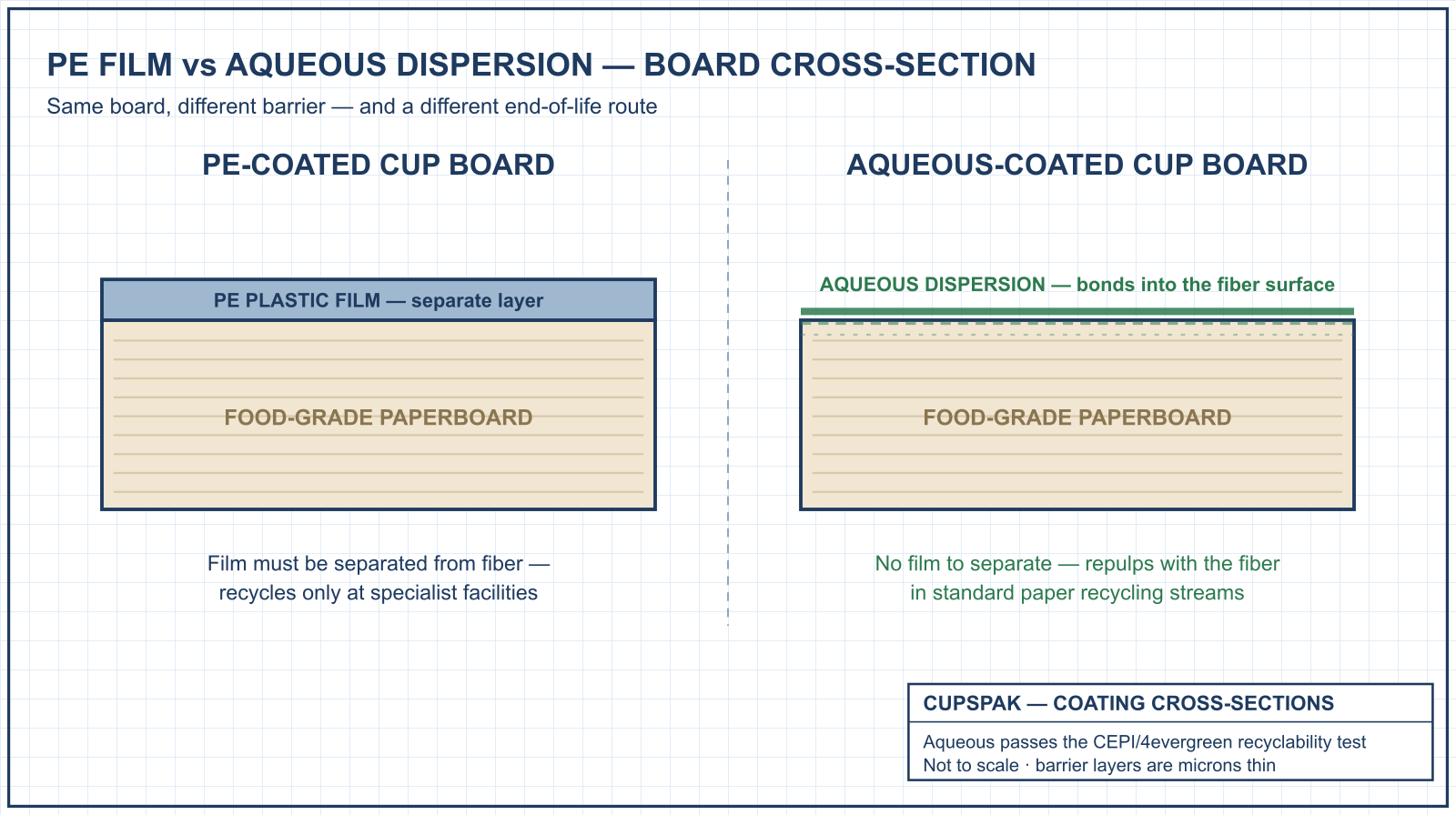
Defensible claims are the main reason programs switch, so precision matters. Here is what you can print on the cup and what you can’t.
Claims you can make with aqueous coated paper cups:
- “Recyclable in standard paper streams.” The coating is a water-based dispersion with no plastic film, so the cup repulps like coated printing paper. No specialist cup-collection scheme required.
- Recyclability backed by the CEPI/4evergreen recyclability test. This is the industry’s standard repulpability assessment, and passing it is the difference between a marketing sentence and a defensible one. Ask any supplier for the test result in writing. Aqueous cups supplied through CupsPak pass it.
- “No plastic film.” True, defensible, and the reason the cup repulps. Word it exactly that way; see below for why the shorter version fails.
- “PFAS-free,” worded correctly. PFAS-free status is verified by an independent 106-substance laboratory screening, and the correct wording is “verified by third-party testing, test reports available on request.” It is a test report, not a certification. Never print “PFAS-free certified”: there is no such certificate, and a competitor or regulator will call it out.
Claims you cannot make:
- “Plastic-free.” The dispersion that replaces the film is itself a polymer; a typical aqueous cup still contains under 5% plastic by weight. An absolute plastic-free claim is challengeable in a lab, and in the EU the cup still requires the Single-Use Plastics “turtle” marking, exactly like a PE cup. Say “no plastic film”; don’t say “no plastic.”
- “Compostable,” worded beyond the certificate’s scope. Aqueous tableware now carries BPI certification for commercial compostability (US scheme, covered SKUs), so “commercially compostable” is claimable where your SKUs are on the certificate: ask for the certificate and SKU listing before you print it. What you still cannot print: “home-compostable” on cups, or a blanket “compostable” for EU markets (ask us for current EU certification status first). Recyclability remains the aqueous cup’s primary story; the compostability certificate is a second string, not a substitute.
- “Recycled everywhere.” Repulpability is a property of the cup; collection is a property of your market. In regions where used cups go to landfill regardless of coating, the claim is technically true and practically hollow. Match the claim to where the cups are actually sold.
- “Biodegradable” as a blanket statement. Unqualified biodegradability claims are restricted in several markets. Stick to the recyclable and plastic-film-free claims you can document.
The practical takeaway: before you switch, write down the exact on-cup and on-website claims you intend to make, then ask your supplier for the paper trail behind each one. For aqueous cups that trail is four documents: the coating specification stating the dispersion’s polymer content (typically under 5%), the CEPI/4evergreen recyclability test result, the PFAS screening report, and the independent food-contact test reports. Ours run through Eurofins and cover migration, heavy metals, BPA and phthalates, antimicrobial transfer, and odour/taste sensory panels. A supplier who needs more than a couple of days to produce all four is reselling board they haven’t verified.
Do aqueous coated paper cups print differently?
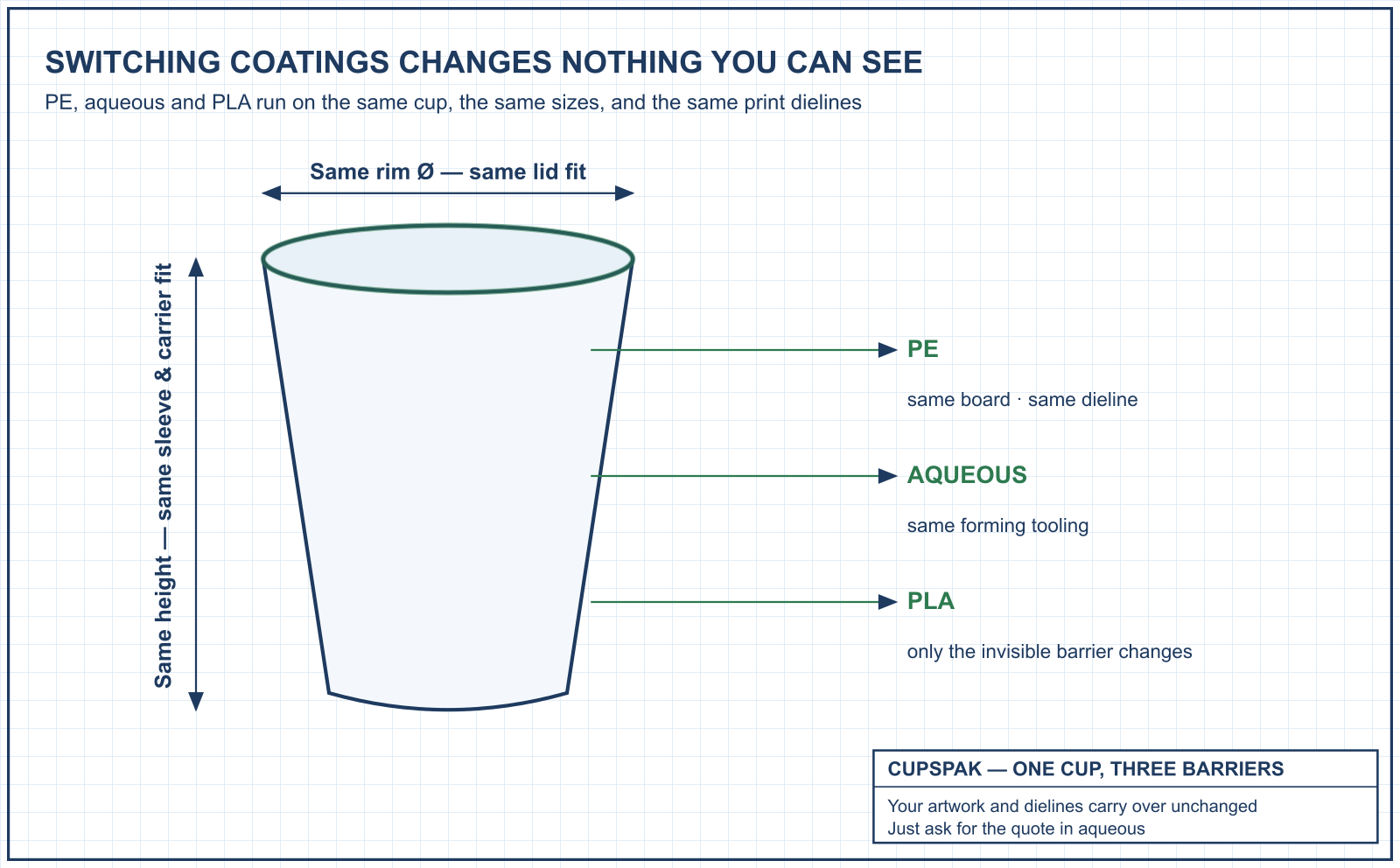
No, and this surprises buyers who assume a coating change means an artwork change. Printing happens on the outside of the board; the barrier coating sits on the inside. Your print process is untouched.
Concretely, on a switch from PE to aqueous:
- Flexo runs up to 7 colors including full-wrap 360° designs, exactly as on PE board
- Pantone spot matching works the same way, since ink sits on the same outer board surface
- Your existing artwork files carry over unchanged: same dielines, same 300 DPI minimum, fonts outlined
- A free digital proof arrives within 3 business days, and a physical pre-production sample is recommended before bulk, same as any coating
There is one print-adjacent difference worth knowing. Because low-plastic positioning is usually the reason for the switch, most converting programs also update the artwork: adding a recyclability mark, removing an old sleeve claim, or reworking the sustainability copy. Budget one artwork revision cycle into your switch timeline. The proof itself takes 3 business days, but internal sign-off on new claims routinely takes brands two to three weeks. Start the claims conversation with your legal or marketing team the same week you request samples, not after.
Surface feel is the other question buyers ask. The dried dispersion gives the inside of the cup a slightly different feel than a PE film: smooth but less glossy. It has no effect on the printed exterior, on lid fit, or on how the cup runs through standard dispensers and sleeves.
How do aqueous cups perform, and how do you plan shelf life?
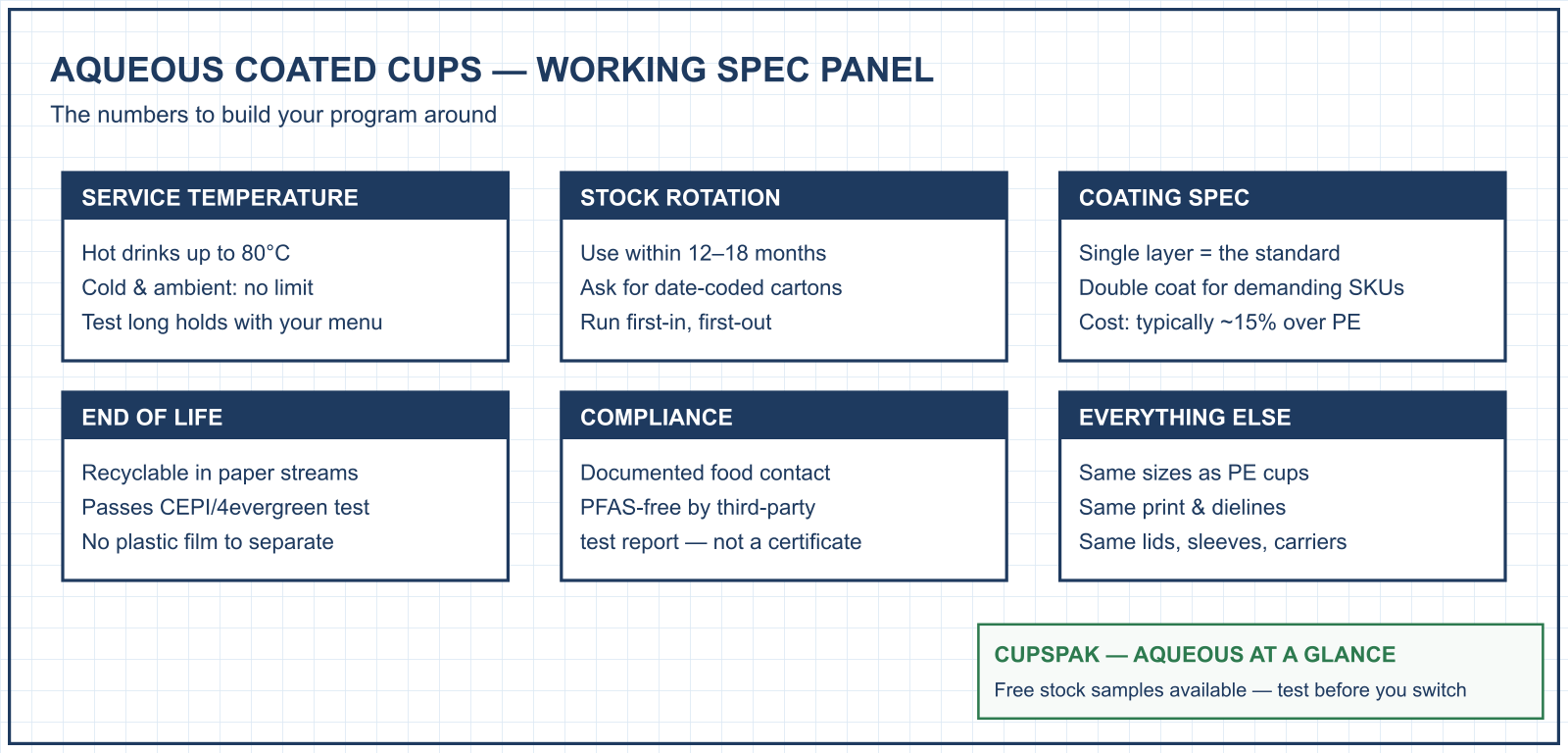
Performance is where the switch needs actual planning. These are the numbers to plan around.
Temperature: aqueous coated cups handle hot beverages up to 80°C, which covers coffee, tea, and chocolate at real serving temperatures for normal drink-and-go service. What they are not built for is sustained abuse: a lidded drink holding near-boiling liquid for hours, or high-fat soups sitting overnight. If your program includes those cases, test them specifically with samples before committing.
Moisture: the barrier gives moderate moisture resistance: comfortably sufficient for beverage service windows, though weaker than a plastic film over very long contact. Iced drinks, water, and juices are routine. Cold desserts work well too; aqueous is one of the standard coating options on ice cream cups, where contact times are short and the no-plastic-film story fits the category.
Shelf life: this is the operational change PE buyers most often miss. A water-based barrier slowly loses effectiveness in storage, so the recommendation is stock rotation within 12-18 months of production. PE cups let you park a two-year safety stock in a warehouse; aqueous cups don’t.
Planning shelf life is straightforward if you do three things at the ordering stage:
- Size orders to your actual burn rate. If you use 100,000 cups a year, order in tranches that turn over inside 12 months, not one 250,000-unit “price break” order that leaves the last pallets aging past the window.
- Demand production date coding on every carton, and run first-in-first-out in the warehouse. This costs nothing and removes the guesswork.
- Set a reorder trigger, not a reorder date. Reorder when stock hits the level that covers your lead time plus a buffer, so fresh production replaces old stock continuously.
Across hundreds of client orders, programs that follow those three rules report no shelf-life issues at all. The failures happen when a buyer treats aqueous inventory like PE inventory and discovers the difference eighteen months later.
Single or double aqueous coating: which should you order?
Order single-layer. That is the norm, and it is what almost every program runs. Double aqueous coating exists (a second dispersion pass for a heavier barrier) but relatively few clients order it in practice.
The reasoning is simple: single-layer aqueous, properly specified, already covers standard hot and cold beverage service. Doubling the coating adds cost to solve a problem most programs don’t have. Where double-layer earns its premium is at the margins: unusually long hold times, delivery-heavy programs where lidded cups travel 30-45 minutes, or high-fat drink menus that stress any barrier.
The right way to decide is with samples, not theory:
- Start with single-layer samples and run your real menu through them: hottest drink, longest realistic hold time, actual lids
- If samples pass, buy single-layer and bank the savings
- If a specific drink fails, raise it at the quoting stage and price double coating for that SKU only. A heavier spec costs far less as a line item than as a complaint after 20,000 cups land.
Note the direction of travel here: aqueous coating primarily targets paper cups. If part of your program is clear cold cups, those stay on PET or PLA; the aqueous decision applies to your paper SKUs.
PE vs aqueous vs PLA: the switching view
Plenty of tables compare coatings in the abstract. This one compares them the way a buyer switching an existing PE program actually experiences the difference. For the deeper three-way breakdown by market and use case, see the PE vs PLA vs aqueous comparison.
| Switching factor | Staying on PE | Switching to aqueous | Switching to PLA |
|---|---|---|---|
| Unit cost | Baseline (lowest) | ≈ +15% vs PE | +8-15% vs PE |
| Recyclability claim | None in standard streams | Yes: standard paper streams, CEPI/4evergreen tested | No (polymer film) |
| Compostability claim | No | Yes: BPI-certified commercial (US), covered SKUs | Yes: BPI-certified commercial (US) |
| “Plastic-free” on the cup | No | No (“no plastic film” is the defensible wording) | No |
| Hot drink ceiling | Hot and cold, proven | Up to 80°C, normal service times | Standard PLA softens above 55°C; CPLA needed for hot |
| Artwork changes needed | None | None for print; claims copy usually updated | None for print; claims copy usually updated |
| MOQ | 20,000 pcs/size | 20,000 pcs/size | 20,000 pcs/size |
| Inventory discipline | Relaxed | Rotate within 12-18 months | Relaxed |
| Best-fit reason to hold/switch | Cost-critical programs, weak-recycling markets | Recyclability + low-plastic positioning at moderate premium | Composting-based sustainability programs |
The blunt verdict: PE wins on cost and tolerance, aqueous wins on defensible recyclability claims (and now carries BPI commercial compostability as a second string), PLA wins when a compostable-first program is the whole strategy. For most brands switching for low-plastic positioning, aqueous is the rational landing spot.
When should you NOT switch to aqueous cups?
An honest supplier tells you when to keep your money. Stay on PE, or choose PLA, in these five cases:
- Your market has weak paper collection. If used cups go to landfill either way, the recyclability premium buys you a claim without an outcome. Spend the difference on paperboard weight or better lids instead.
- Your drinks exceed the 80°C service envelope. Freshly boiled tea programs, hot soups held for hours, high-fat broths: these stress a dispersion barrier beyond its design. Test first; if samples fail, this isn’t your coating.
- Your inventory turns slowly. Seasonal operators and buyers who consolidate a full year into one shipment can drift past the 12-18 month rotation window. If you can’t restructure ordering, PE’s storage tolerance is worth more than the eco claim.
- Your composting claim must cover the EU. BPI certification covers US commercial composting for both PLA and aqueous; for EU composting schemes, ask us for current certification status before you build an EU claim on either coating.
- You’re switching purely on price pressure. Aqueous costs more than PE, full stop. If procurement’s only KPI this year is unit cost reduction, this is the wrong project. Revisit it when the brief includes packaging claims or waste fees.
If none of those five describes you, the switch is low-risk: same MOQ, same print process, same lead times, and a claims upgrade you can document.
How to run the switch: a 5-step pilot
Copy this into your project plan. Total elapsed time from first email to bulk delivery is typically 6-9 weeks.
- Week 1: samples. Request free stock samples of aqueous cups in your sizes (you cover shipping only; samples arrive in 7-10 business days). In parallel, request a quote against your current PE spec. Pricing comes back within 24 hours, so you’ll have the cost delta before samples land.
- Week 2: real-menu testing. Run your hottest drink at serving temperature with lids on, your longest realistic hold time, and your most acidic iced drink. Note carton production dates against the 12-18 month window.
- Week 2-3: claims sign-off. Collect the three documents: plastic-film-free coating specification, CEPI/4evergreen recyclability test result, PFAS screening test report (report, not certificate). Get marketing/legal approval on the exact on-cup wording.
- Week 3-4: artwork and proof. Submit updated artwork with the new claims; the free digital proof comes back in 3 business days. Approve a pre-production sample if the artwork changed materially.
- Week 4 onward: first order. Place the first 20,000 pcs per size, sized to turn over well inside 12 months, with date coding and FIFO agreed in writing. Review performance at 90 days before converting the full program.
Frequently Asked Questions
Are aqueous coated paper cups really recyclable?
Yes, in standard paper recycling streams. The coating is a water-based dispersion with no plastic film, so the cup repulps like coated printing paper, and the recyclability is verified by the CEPI/4evergreen recyclability test, the industry’s standard assessment. The practical caveat is collection: the cup is recyclable everywhere, but it only gets recycled where paper collection actually operates.
What is the hot drink limit for aqueous cups?
Hot beverages up to 80°C, for normal drink-and-go service times. That covers coffee, tea, and hot chocolate at real serving temperatures. For sustained near-boiling contents, multi-hour hold times, or high-fat hot liquids, test samples with your actual product first. Those cases sit outside the coating’s design envelope.
How long can I store aqueous coated cups?
Plan stock rotation within 12-18 months of production. The water-based barrier gradually loses effectiveness in storage, so order to your burn rate, insist on production date coding on cartons, and run first-in-first-out. Programs that follow those three rules see no shelf-life issues in practice.
Should I order single or double aqueous coating?
Single-layer: it’s the norm, and it covers standard hot and cold beverage service. Double aqueous coating exists for demanding cases like long delivery hold times or high-fat drinks, but relatively few programs order it. (Both builds carry their own independent lab reports. The double-coat build has been through the full migration battery too, so choosing it doesn’t mean leaving documented territory.) Test single-layer samples with your real menu first, and spec double coating only for a SKU that fails.
How much more do aqueous cups cost than PE?
Typically about 15% over a like-for-like PE cup, the same band as PLA (+8-15%). The premium applies to a thin coating layer, not the whole cup, and buyers in markets with packaging waste fees often recover part of it. Compare quotes on coating specification, not unit price alone. An unusually cheap “aqueous” quote usually means less barrier on the board.
Here’s the easiest part of switching: nothing else changes. Aqueous runs on the same cups, the same sizes, and the same print dielines as PE. Our catalog doesn’t even list it as a separate range, because it isn’t one. It’s the cup you already buy, with a different (invisible) barrier. If you’re curious how your drinks behave on it, free stock samples are a shipping fee away, and when you’re ready, the words “quote it in aqueous” in any inquiry are all it takes.
Ready to Source Eco-Friendly Paper Cups?
Request a free sample pack or get a wholesale quote tailored to your requirements.