
Henry — Head of Marketing · Reviewed by Austin, Product Manager
July 15, 2026 · 13 min read
An ice cream shop needs three coordinated items: paper cups in 3 to 4 sizes matched to your serving formats, lids for takeaway and delivery, and spoons: all of it rated to stay rigid straight out of a -18°C freezer. For most scoop shops, that means a 4oz single-scoop cup and a 6oz double-scoop cup with clear dome lids and birchwood spoons; gelato parlors typically run 3 to 8oz, and froyo shops run 6 to 16oz. This guide covers all 9 standard ice cream cup sizes, the 3 coating options, lid pairing by rim diameter, and the ordering math that keeps you stocked through the July peak.
What sizes do ice cream cups come in?
The short answer: 9 standard sizes, from a 2oz tasting cup to a 20oz party cup. Here is the full lineup with dimensions, because diameter and height matter as much as volume once you start pairing lids and spoons.
| Size | Volume | Dimensions (Φ × H) | Typical use |
|---|---|---|---|
| 2oz | 60ml | Φ72 × H42mm | Tasting spoons’ big brother, free samples, flavor flights |
| 3oz | 90ml | Φ75 × H45mm | Kids’ scoop, small gelato |
| 4oz | 120ml | Φ76 × H50mm | Single scoop, the workhorse |
| 5oz | 150ml | Φ86 × H50mm | Large single, standard gelato |
| 6oz | 180ml | Φ90 × H58mm | Double scoop |
| 8oz | 240ml | Φ96 × H52mm | Large double, small froyo |
| 12oz | 360ml | Φ105 × H60mm | Regular froyo, triple scoop |
| 16oz | 480ml | Φ105 × H75mm | Sundae, toppings need headroom |
| 20oz | 600ml | Φ120 × H80mm | Party size, shareables |
Do not order all 9. Across hundreds of client programs, the pattern is consistent: a scoop shop runs 3 sizes (4oz, 6oz, 16oz), a gelato parlor runs 3 sizes inside the 3 to 8oz band, and a self-serve froyo shop runs 2 to 3 sizes between 6oz and 16oz. Every extra SKU is a separate MOQ, a separate storage shelf, and a separate thing staff grab wrong during a rush.
Two details buyers miss on the spec sheet. First, the 12oz and 16oz share a Φ105mm diameter: they take the same lid, which cuts one lid SKU from your order. Second, the 16oz sundae cup is tall (H75mm) rather than wide, because sundaes are built in layers and toppings slide off a shallow cup.
If you want the deeper dive (portion weights per size, single serve ice cream cups versus pre-pack formats, and how to pick your 3-size lineup), we cover that in the ice cream cup sizes guide.
Which coating works for frozen desserts?
The short answer: PE if you want the proven default, PLA if your market demands compostable, aqueous if you need to get the plastic film out. All three are food-contact coatings on white or kraft paperboard; what changes is cost, disposal route, and how the cup behaves at freezer temperature.
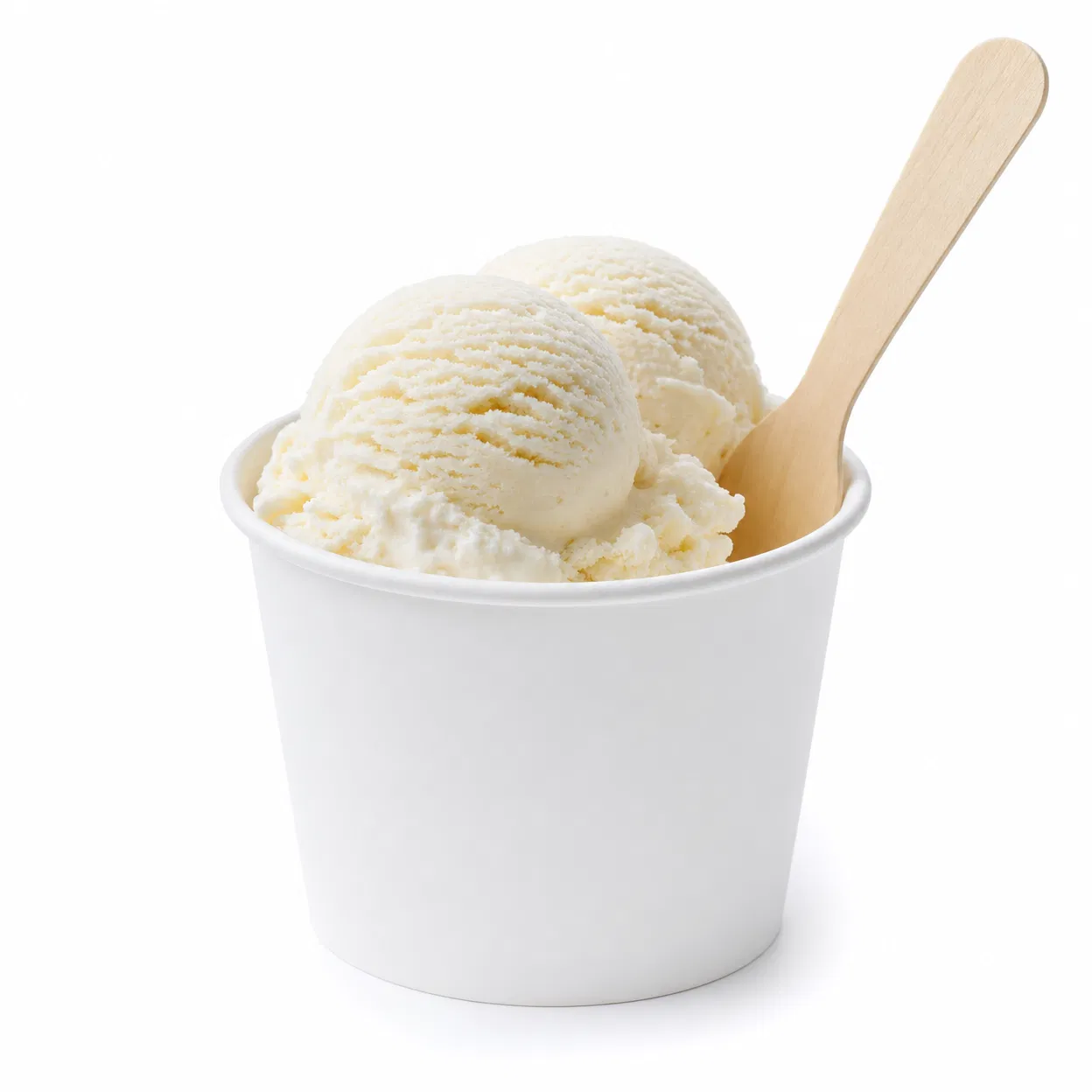
PE (polyethylene) is the industry standard for disposable ice cream cups. It is the lowest-cost barrier, it works across every serving format, and it keeps the cup rigid down to -18°C. That matters, because a cup that softens against a frozen product feels cheap in the customer’s hand. The tradeoff is disposal: PE-coated cups are not recyclable in most paper streams and are not compostable.
PLA is the plant-based option. It is industrially compostable (documents available on request) and it costs 8 to 15% more than PE. The hard limit: PLA is for cold desserts only. Standard PLA softens above 55°C, so if your shop also serves hot drinks or affogato in the same cup, PLA is the wrong pick for that SKU.
Aqueous coating is the no-film option. The cup stays recyclable in ordinary paper streams because there is no plastic film to separate. Call it low-plastic rather than plastic-free in your own marketing: the water-based dispersion is itself a polymer, so an EU program still carries the single-use plastics marking. Its moisture barrier is moderate, which makes it best for short-duration cold service: a scoop eaten at the counter, not a lidded pint melting in a delivery bag for 40 minutes. Plan stock rotation too: aqueous-coated cups should be used within 12 to 18 months.
| PE | PLA | Aqueous | |
|---|---|---|---|
| Cost | Lowest (baseline) | +8-15% vs PE | Between PE and PLA |
| Frozen dessert fit | All formats, rigid to -18°C | Cold desserts only | Short-duration cold service |
| End of life | Not recyclable in most paper streams | Industrially compostable (docs on request) | Recyclable in paper streams |
| Best for | Volume programs, delivery | Eco-positioned brands, compost mandates | Recyclability claims, dine-in service |
The blunt verdict: PE wins on cost and cold performance; PLA and aqueous win on disposal story. If your city has a plastic-reduction ordinance or your brand leads with sustainability, spend the premium. If not, PE remains the rational default. For the full chemistry and cost breakdown, see our PE vs PLA vs aqueous coating comparison, and if aqueous is new to you, start with what aqueous coating actually is.
One attribute that applies across all three: PFAS-free status is verified by third-party laboratory testing, with test reports available on request. It is a test report, not a certification: any supplier waving a “PFAS-free certificate” is mislabeling what the document is.
White or kraft paperboard?
Both are stock options, and the choice is branding, not performance. White paperboard gives you clean, accurate print colors: the right base if your cups carry a multi-color logo or you photograph product for social media. Kraft gives the natural brown look that reads “eco” on the shelf and hides small scuffs better in transit.
One practical note from production: light-colored inks disappear on kraft. If your logo is pastel pink or pale mint, print it on white board, or budget for an extra white underlayer on kraft. Dark, single-color logos (chocolate brown, forest green, black) look excellent on kraft with just 1 to 2 print stations.
Which lid pairs with which cup?
The short answer: match the lid family to your cup’s diameter, then pick the lid style by how the cup leaves the shop. There are 3 lid types for ice cream cups, and they solve different problems.
Clear PET dome lids (available in Φ75, 85, 90, 96, 105 and 120mm) display the scoop. The dome adds headroom, so a swirl of soft serve or a topping-loaded sundae travels without the lid smearing the product. This is the takeaway and delivery default for anything with visual appeal.
PET flat lids (Φ72, 75, 85, 90, 96 and 105mm) are for stacked transport. Flat lids let cups stack in a delivery bag or a catering crate without toppling: the right choice for multi-cup delivery orders and pre-portioned individual ice cream cups you fill ahead and hold in the display freezer.
Paper lids (Φ75, 85, 96, 105 and 120mm) complete an all-fiber program. Pair them with aqueous-coated cups and wooden spoons and the whole package goes in the paper stream rather than the plastics bin.
| Cup size | Cup body Φ | Dome (PP) | Flat (PP) | Paper lid |
|---|---|---|---|---|
| 2oz | Φ72mm | N/A | Yes (Φ72) | N/A |
| 3oz / 4oz | Φ75-76mm | Yes (Φ75) | Yes (Φ75) | Yes (Φ75) |
| 5oz | Φ86mm | Yes (Φ85) | Yes (Φ85) | Yes (Φ85) |
| 6oz | Φ90mm | Yes (Φ90) | Yes (Φ90) | N/A |
| 8oz | Φ96mm | Yes (Φ96) | Yes (Φ96) | Yes (Φ96) |
| 12oz / 16oz | Φ105mm | Yes (Φ105) | Yes (Φ105) | Yes (Φ105) |
| 20oz | Φ120mm | Yes (Φ120) | N/A | Yes (Φ120) |
Read the gaps in that table before you lock your cup sizes. The 6oz double-scoop cup has no paper lid in the standard range, so an all-fiber program should build around the 5oz, 8oz or 12oz instead. The 20oz has no flat lid, and the 2oz tasting cup takes only a flat lid. Lid diameters are nominal; cup figures above are body measurements, so always confirm rim fit on physical samples before bulk: a lid that seats loosely on the shelf will pop off in a courier’s bag.
Full specifications for every lid format are on our cup lids page, and the dedicated guide to ice cream cups with lids walks through delivery-specific pairing in detail.
What about spoons?
We don’t supply spoons. They come from a different supplier on a different lead time, which is exactly why they get forgotten until the cups have already shipped. Spec them anyway, and spec them against your cup range, because the two only work as a pair.
Wooden spoons come in two common lengths, 96mm and 114mm. The practical split: 96mm suits cups up to 6oz, where a longer spoon overhangs awkwardly; 114mm suits 8oz and up, because a 96mm spoon nearly disappears into a 16oz sundae cup that stands 75mm tall.
Spoons matter more than they look on the invoice. They are the one packaging item the customer holds for the entire eating experience, and birch has no plasticky taste transfer at freezer temperatures. They also close the loop on an all-fiber serve: aqueous cup, paper lid, wooden spoon. Nothing in the order needs a plastics bin.
Buy them at a ratio of roughly 1.1 spoons per cup. Staff drop them, customers grab two, and the counter jar always leaks a few. Running out of spoons with a full freezer of product is an avoidable way to look unprepared in week 2 of a heat wave. Put them on the same purchase calendar as the cups, not on the list you get to afterwards.
How do you plan orders around peak season?
The short answer: count backward from July. Custom-printed ice cream cups take 25 to 30 business days in production after artwork approval: that is 5 to 6 calendar weeks before the goods even reach the port. Shipments run FOB Ningbo or Shanghai, so add ocean transit on your lane on top: transit time varies by destination region, so confirm your lane when you plan the calendar.
Here is the timeline for a Northern Hemisphere shop that peaks in July:
- January to February: request free stock samples (7 to 10 business days) and test them loaded and frozen. Confirm sizes, coating and lid fit.
- February to March: send artwork, receive the free digital proof, approve. Quotes come back within 24 hours; digital proofs within 3 business days.
- March to April: production runs 25 to 30 business days after approval and deposit.
- April to May: goods ship FOB Ningbo/Shanghai; ocean freight and customs clearance follow.
- June: stock lands, you shelve it, and the July rush hits a full storeroom.
Now the volume math. Say your shop sells 250 cups a day in July but only 80 a day in the shoulder months. July alone consumes about 7,750 cups; June through August together can run 18,000 to 20,000 at that pace. Suddenly the 20,000-piece custom print MOQ stops looking like a hurdle: it is roughly one full summer season of trade for a single busy location. Buying bulk ice cream cups once for the season, rather than reordering mid-summer, also protects you from the one thing you cannot fix in July: a 3 to 5 week production queue while your shelves sit empty.
What suppliers don’t always volunteer: peak season for your shop is peak season for every shop, and production calendars fill accordingly. An order confirmed in February gets calmer scheduling than the same order confirmed in May. If you are reading this in July with stock running low, ask about rush production and plan the next season properly, and if you sell fries, churros or other snacks alongside scoops, fold paper snack cups into the same seasonal order so everything lands in one shipment.
What does custom printing involve?
Custom printing on ice cream cups runs flexographic, up to 7 Pantone colors, with full-wrap coverage. Every order gets a free digital proof before production, and the custom print MOQ is 20,000 pieces per design. Stock white and kraft cups are the fallback when your volume or timeline cannot support a custom run.
Flexo economics reward simple artwork. Each color needs its own printing plate: a fixed cost that gets divided across your order quantity. A 2-color logo on a 20,000-piece run makes sense; a 7-color photographic design on the same run means the plates eat a disproportionate share of your unit cost. The 7-color ceiling is there for large programs that can spread the plate cost across 50,000+ cups.
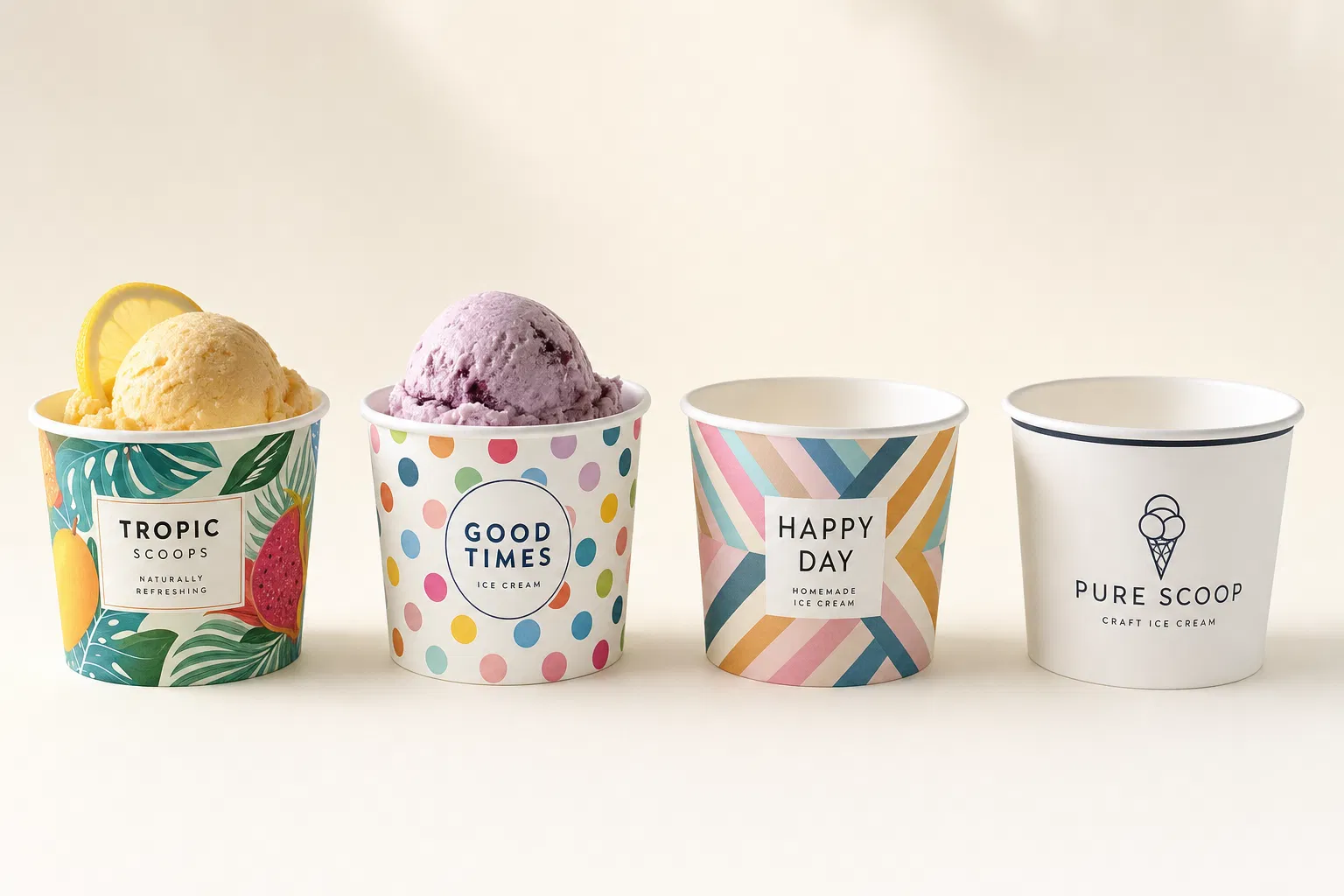
Three artwork rules that prevent delays. Supply vector files (AI, PDF, EPS) or 300 DPI minimum raster images. Outline your fonts: a large share of artwork delays trace back to fonts that were never converted to outlines, and it is a 10-second fix in the design file. Specify colors as Pantone references, not “the blue from our Instagram.” If your file is not print-ready, the design team fixes it free of charge before the proof stage.
One insider note on design for the category: your cup spends its display life in a freezer or a customer’s hand, often photographed from above. Designs that wrap the upper third of the cup wall photograph far better than base-heavy layouts that vanish behind fingers. Look at the ice cream cup range to see how printable wall area changes across the 9 sizes.
Where does the money actually go?
An ice cream packaging program has 4 cost levers, in descending order of impact: cup size, coating, print complexity, and lid type. Understanding them turns a quote from a single mysterious number into something you can negotiate line by line.
Size drives paperboard consumption. A 16oz cup simply contains more board than a 4oz. If your menu lets you serve a “regular” in a well-filled 4oz rather than a half-empty 6oz, that decision compounds across every unit you ever sell.
Coating sets the premium. PLA adds 8 to 15% over PE. Across a 20,000-cup season, that premium is real money: worth paying if compostability wins you customers or satisfies an ordinance, wasted if nobody asks.
Print complexity is a fixed cost divided by volume. Fewer colors, lower plate cost. A confident 1 to 2 color design on kraft is the budget-smart route for a single-location shop; save the 7-color art for when you are ordering ice cream cups wholesale across multiple stores.
Lids and spoons scale with attach rate. Not every scoop leaves the shop lidded. Track your actual takeaway percentage for 2 weeks before ordering: shops routinely over-order domes for dine-in-heavy traffic and under-order them for delivery-heavy traffic.
Get all 4 levers into one request and you will receive a quote you can actually compare against competitors: a quote request with sizes, quantities, coating and print colors specified comes back within 24 hours.
Your packaging spec checklist
Copy this list into your next ice cream cup supplier inquiry. A complete spec on the first email saves a week of back-and-forth.
- Sizes and quantities: e.g. 4oz × 20,000, 6oz × 20,000, 16oz × 20,000
- Paperboard: white or kraft
- Coating: PE / PLA / aqueous, state your disposal priority if unsure
- Lids per size: dome, flat or paper, with quantities matched to your takeaway rate
- Spoons: 96mm or 114mm, at ~1.1 per cup
- Print: number of Pantone colors, artwork as outlined vector, 300 DPI minimum
- Compliance paperwork: documented food-contact compliance; compostability documents for PLA on request
- Timing: target in-store date, worked back through 25 to 30 business days production plus freight
- Samples first: free stock samples before any bulk commitment, test them frozen, lidded and stacked
Frequently Asked Questions
What sizes do ice cream cups come in?
Standard ice cream cups run 9 sizes from 2oz (60ml) to 20oz (600ml). The most-ordered are 4oz for a single scoop, 6oz for a double, and 16oz for sundaes. Gelato parlors typically use the 3 to 8oz band; froyo shops use 6 to 16oz. Most shops stock 3 to 4 sizes rather than the full range.
Are paper cups OK for gelato?
Yes. Gelato parlors typically run paper cups in the 3 to 8oz range, and a PE-coated cup stays rigid down to -18°C: colder than gelato is ever served, since gelato holds at warmer, softer temperatures than hard ice cream. For eco-positioned gelaterias, PLA-coated cups work for all cold desserts and are industrially compostable, with documents available on request.
What is the MOQ for wholesale ice cream cups?
Custom-printed ice cream cups start at 20,000 pieces per design, with flexographic printing up to 7 Pantone colors and a free digital proof before production. For a busy shop, 20,000 cups is roughly one peak season of volume. Free stock samples are available before you commit: you cover only the shipping.
Are there compostable ice cream cups?
Yes: PLA-coated paper cups are industrially compostable, with documentation available on request, and cost 8 to 15% more than standard PE. They are for cold desserts only, since standard PLA softens above 55°C. If cutting plastic matters more than compostability, aqueous-coated cups skip the laminated film and stay recyclable in ordinary paper streams, though the water-based dispersion is still a polymer, so treat them as low-plastic rather than plastic-free.
How long does a wholesale order take?
Production runs 25 to 30 business days after artwork approval and deposit, shipping FOB Ningbo or Shanghai, with ocean freight added on top. Free stock samples take 7 to 10 business days. For a July peak, that means confirming your custom order in early spring; plain stock cups can move on shorter timelines.
Get samples before you commit
Every spec in this guide is easier to judge with the actual cup in your freezer. Request free stock samples (you cover only the shipping), load them with your own product overnight at -18°C, and check rigidity, lid fit and spoon feel before any bulk order. The full product catalog has every size, coating and lid pairing in one PDF for your planning file.
Ready to Source Eco-Friendly Paper Cups?
Request a free sample pack or get a wholesale quote tailored to your requirements.