Austin — Product Manager · Reviewed by Henry, Head of Marketing
July 13, 2026 · 10 min read · Updated July 27, 2026
Ice cream cup sizes run from 2oz (60ml) tasting cups to 20oz (600ml) party cups, across nine standard sizes. The workhorses are 4oz for a single scoop, 8oz for a double, and 12oz for large servings with toppings. Every size in this guide comes with exact rim diameter and height in millimeters: the rim, not the ounce rating, decides which lid fits.
This is the reference chart we point buyers to when they ask “what size should I order?” Bookmark it.
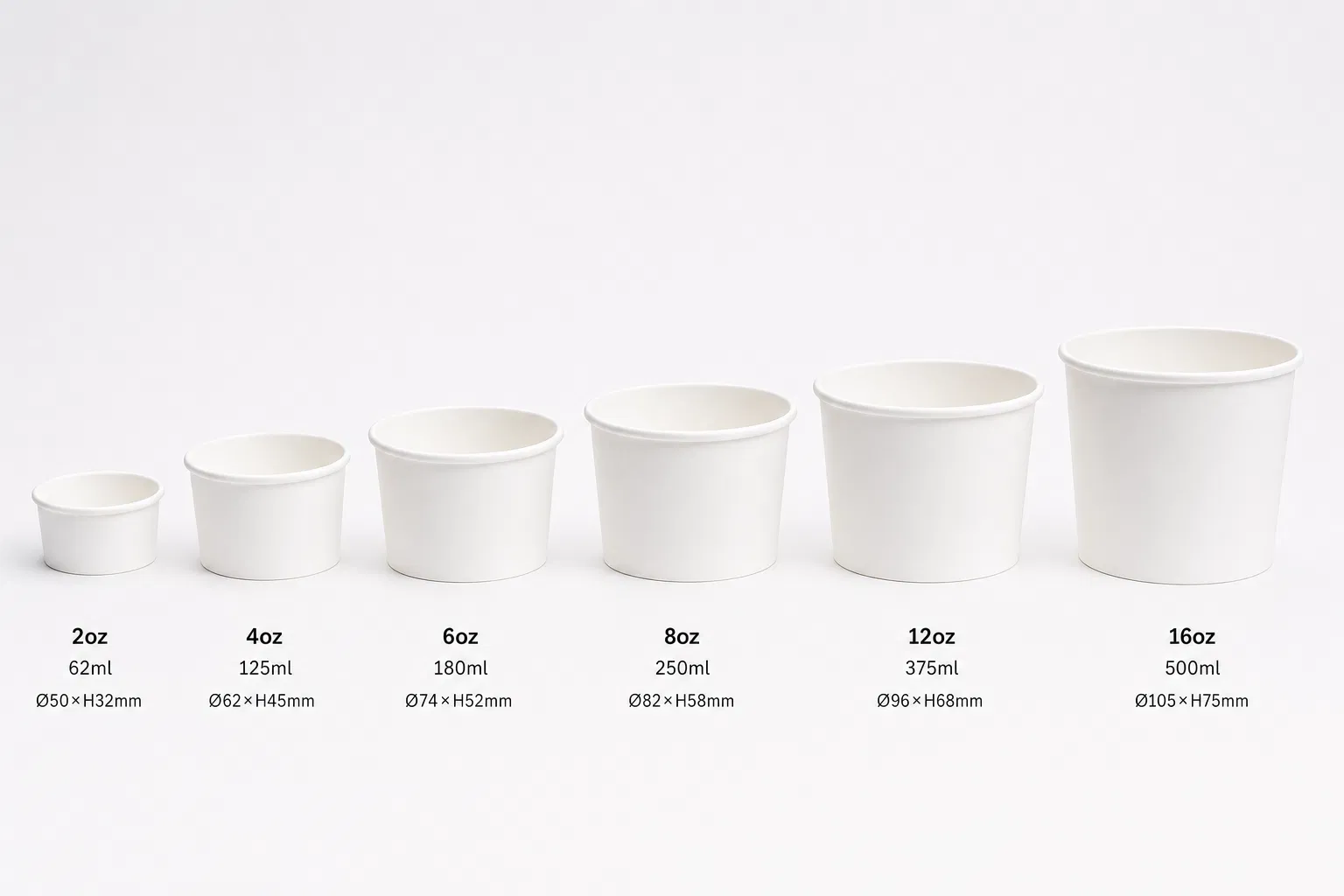
What sizes do ice cream cups come in? The full size chart
Nine standard sizes cover the entire market, from sampling spoons to takeaway sundaes. Dimensions below are taken from the ice cream cup production spec sheets. Φ is the rim diameter, H is the height:
| Size | Volume | Rim Ø × Base Ø × Height | Typical use |
|---|---|---|---|
| 2oz | 60ml | Φ72 × Φ62 × H42mm | Tasting / sampling |
| 3oz | 90ml | Φ75 × Φ60 × H45mm | Mini dessert |
| 4oz | 120ml | Φ76 × Φ61 × H50mm | Single scoop |
| 5oz | 150ml | Φ86 × Φ72 × H50mm | Single scoop + topping |
| 6oz | 180ml | Φ90 × Φ75 × H58mm | Double scoop |
| 8oz | 240ml | Φ96 × Φ80 × H52mm | Double scoop + toppings |
| 12oz | 360ml | Φ105 × Φ85 × H60mm | Large serving |
| 16oz | 480ml | Φ105 × Φ85 × H75mm | Jumbo / sundae |
| 20oz | 600ml | Φ120 × Φ95 × H80mm | Party size / takeaway |
Two patterns worth reading out of this ice cream cup size chart before you order anything:
- Ice cream cups grow outward, not upward. A 12oz ice cream cup is only 60mm tall but 105mm wide. A 12oz coffee cup is the opposite: 110mm tall, 90mm wide. Short-and-wide geometry gives the scooper a target and the customer a surface for toppings. If you’re sizing beverage cups too, they follow completely different dimensions: see our paper cup sizes chart.
- 12oz and 16oz share the Φ105mm rim. The 16oz is simply 15mm taller. That’s deliberate standardization, and it means one lid covers both sizes: more on that below.
Note the oddity at 6oz vs 8oz: the 6oz is actually taller (58mm vs 52mm) while the 8oz is wider (Φ96 vs Φ90). Volume ratings alone tell you almost nothing about the shape of the cup in your hand. Always check the millimeters.
How many scoops fit in each cup size?
The short answer: one 2oz scoop per 4oz of cup, roughly. A standard #16 disher scoop portions about 2oz/60ml of hard ice cream, and the scoop count (not the raw volume) is how shops should think about ice cream cup sizes. (portions vary with overrun and how firmly staff pack the scoop, so treat this as the industry rule of thumb, not a guarantee).
Here’s the ice cream scoop size in cups, translated:
| Cup size | #16 scoops (2oz each) | What the customer sees |
|---|---|---|
| 2oz | ½ scoop | A taste on a spoon |
| 3oz | 1 level scoop | Mini dessert, catering portion |
| 4oz | 1 generous scoop | The classic “single” |
| 5oz | 1 scoop + sauce/topping | Single with room to work |
| 6oz | 2 scoops | A snug “double” |
| 8oz | 2 scoops + toppings | The comfortable double |
| 12oz | 3 scoops + toppings | Large serving |
| 16oz | 3-4 scoops + syrup, whip, wafer | The sundae |
| 20oz | Shareable / packed takeaway | Bigger than a US pint (473ml) |
Why does a 4oz cup take a 2oz scoop and still look full? Because scooped ice cream doesn’t sit flat: a properly scooped ball mounds above the rim, and the dome is part of the presentation. That’s also why ice cream cups don’t need the 10 to 15mm headroom you’d plan into a beverage cup. Fill line and brim line are effectively the same thing here.
The scoop count matters for one more reason: it converts directly into food cost. Say your hard ice cream lands at $7.00 per liter wholesale. A 60ml scoop costs you $0.42. A single scoop in a 4oz cup sold at $3.90 runs an 11% food cost; a double in an 8oz cup at $5.90 runs 14%; a 3-scoop 12oz sundae at $7.90 with $0.35 of toppings runs about 20%. (Swap in your own numbers: the structure holds.) The cup itself is a rounding error next to the ice cream, which is exactly why upsizing your menu one tier is usually margin-positive: the incremental cost is one more $0.42 scoop against a $1.50 to $2.00 price step.
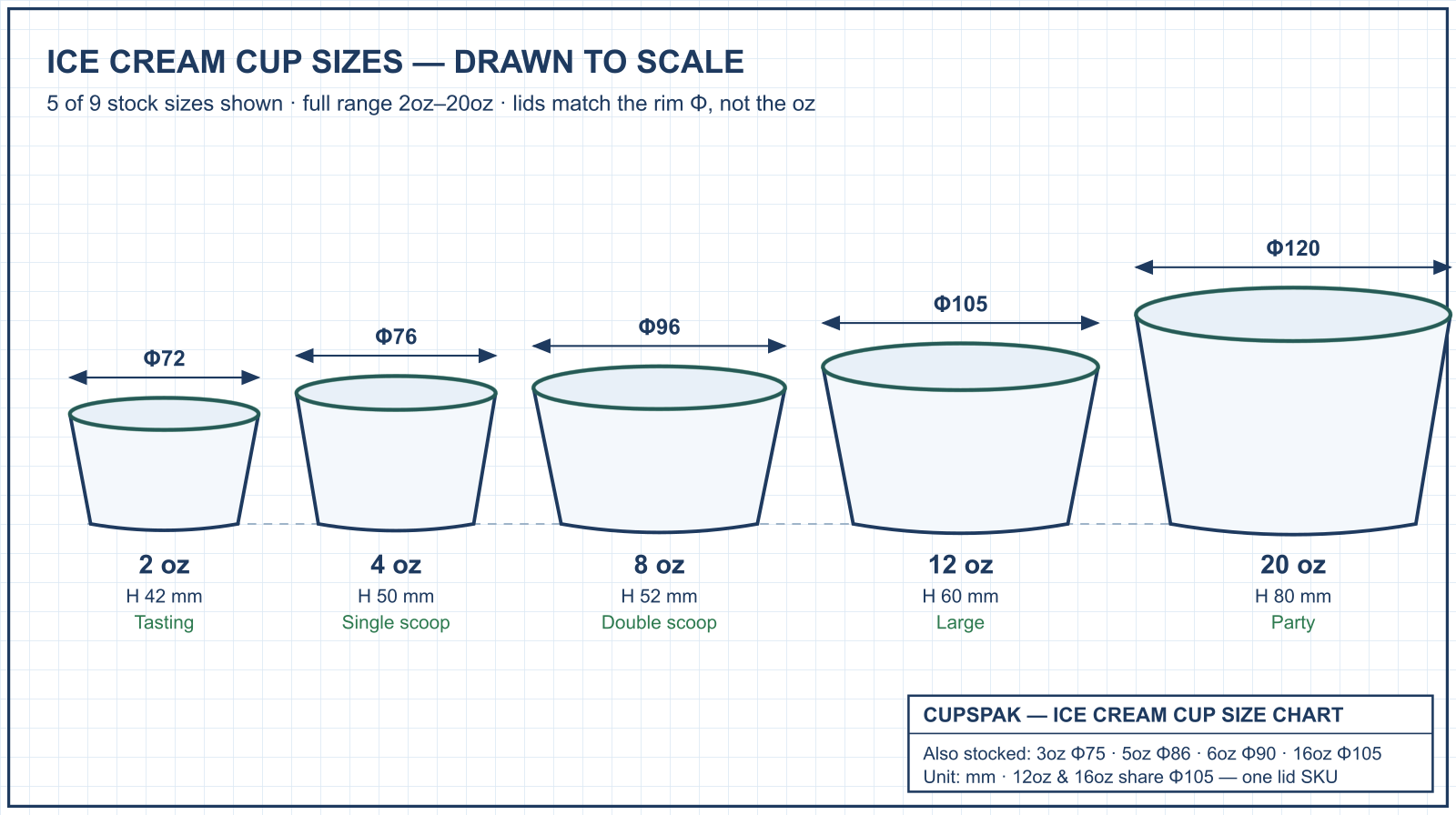
What is the standard ice cream cup size?
4oz (120ml, Φ76 × H50mm) is the closest thing to a standard ice cream cup size: it’s the default “single scoop” vessel worldwide, and the size most shops sell the most of. If a supplier quote just says “standard ice cream cup” with no dimensions, assume 4oz, then confirm the millimeters anyway.
That said, “standard” depends on your format:
- Gelato and dessert bars lean small: 3oz to 5oz, because the product is dense and priced by intensity, not volume.
- Scoop shops center on 4oz/8oz/12oz: single, double, large.
- Frozen yogurt and sundae concepts skew large: 12oz to 16oz, because toppings are the revenue.
- Events, weddings and sampling run 2oz to 3oz mini ice cream cups almost exclusively.
Which sizes should be on your menu?
Start with three sizes, not five. Every size you add is a separate inventory line, a separate print run at 20,000 pieces per design, and (if you lid your cups) potentially a separate lid SKU. The best lineups are the ones where each size maps to a clean price step.
The 3-size lineup (small shop, cart, kiosk)
4oz / 8oz / 12oz: single, double, large. This trio covers roughly the whole demand curve of a scoop-led menu:
- 4oz: one generous scoop, your entry price point
- 8oz: two scoops plus toppings, usually the volume seller
- 12oz: three scoops, the treat-yourself tier
The price ladder practically writes itself: each step up adds one scoop of marginal cost and $1.50 to $2.00 of price. Skipping the in-between sizes (5oz, 6oz) keeps ordering simple for customers and keeps you at three print SKUs instead of five.
The 5-size lineup (full parlor / sundae menu)
3oz / 4oz / 8oz / 12oz / 16oz. Add the small end and the sundae end:
- 3oz: kids’ size and tasting portions; small ice cream cups at this size also double as event catering stock
- 16oz, the sundae build: 3 to 4 scoops plus syrup, whipped cream and inclusions need the Φ105 × 75mm bowl to look right
Note what’s not here: 20oz. Unless takeaway pints-plus or family sharing portions are core to your concept, the 20oz (600ml) is a special-order size, not a menu size. And here’s the quiet advantage of this exact lineup: 12oz and 16oz share the Φ105mm rim, so your two largest sizes run on a single lid SKU.
Menu lineup checklist
Before you finalize sizes, run through this:
- Does each size map to one clear menu item (single / double / sundae)?
- Is each price step at least $1.50 for one added scoop (~$0.40 to $0.50 food cost)?
- Have you counted lid SKUs, not just cup SKUs? (Check rim diameters.)
- Do any two sizes share a rim so lids consolidate? (12oz + 16oz do.)
- Takeaway share of sales over ~30%? Then every takeaway size needs a lid: spec them now, not after launch.
- Ordering custom print? Each size is its own design at 20,000 pcs minimum: 3 sizes = 60,000 cups.
Which lid fits which cup? Order by rim, not by oz
Lid fit is decided by rim diameter alone. A “12oz lid” doesn’t exist as a spec: a Φ105mm lid does. This is the classic ordering mistake: a buyer specs “8oz cups + 8oz lids” from two different sources, the cups arrive at Φ96mm, the lids were tooled for someone else’s Φ90mm 8oz cup, and 10,000 lids go in the bin. Ounce ratings are marketing labels; millimeters are engineering.
Here’s the pairing table for the standard cup lids range, PET dome (for mounded scoops and sundaes), PET flat (for stacking and transport), and paper lids (for all-fiber programs):
| Cup size | Rim Ø | PET dome | PET flat | Paper lid |
|---|---|---|---|---|
| 2oz | Φ72 | N/A | Φ72 | N/A |
| 3oz | Φ75 | Φ75 | Φ75 | Φ75 |
| 4oz | Φ76 | Φ75* | Φ75* | Φ75* |
| 5oz | Φ86 | Φ85* | Φ85* | Φ85* |
| 6oz | Φ90 | Φ90 | Φ90 | N/A |
| 8oz | Φ96 | Φ96 | Φ96 | Φ96 |
| 12oz | Φ105 | Φ105 | Φ105 | Φ105 |
| 16oz | Φ105 | Φ105 | Φ105 | Φ105 |
| 20oz | Φ120 | Φ120 | N/A | Φ120 |
* Lid families use nominal sizing: the Φ75 lid family is the catalog-standard pairing for the 4oz Φ76 rim, and Φ85 pairs with the 5oz Φ86 rim. Fit-test physical samples before bulk orders as a matter of routine.
Three things to take from the table:
- 12oz and 16oz share Φ105 lids. If both are on your menu, you carry one lid SKU for two cup sizes: order lids against combined volume and you’ll hit lid MOQs faster and cheaper.
- Coverage gaps exist. There’s no dome lid at Φ72 (2oz cups are sampled, not sealed), no paper lid at Φ90, and no PET flat at Φ120. If fiber lids are a program requirement, that constraint should influence which cup sizes you pick, before the artwork goes to plate.
- Dome vs flat is a use-case call, not a taste call. Domes protect a mounded scoop and display toppings; flat lids stack for delivery bags and freezer storage. Takeaway-heavy shops often run domes on sundae sizes and flat lids on everything else.
The safest procedure: request stock samples of your exact cup sizes and candidate lids together, and test the snap fit with product inside, at freezer temperature. A lid that fits at room temperature can pop on a frozen, contracting cup. Ten minutes with samples beats a container of mismatched stock.
What about material, print and order specs?
Size is only the first line of the spec sheet. The rest of a typical ice cream cup order looks like this:
- Base board: white or kraft paperboard, with documented food-contact compliance.
- Coating: PE (lowest cost, proven moisture barrier), PLA (plant-based, industrially compostable), or aqueous (no plastic film, recyclable in paper streams). Cold, short-contact desserts are actually the friendliest use case for aqueous coating: no hot liquid to stress the barrier.
- Print: flexographic, up to 7 Pantone colors, full-wrap coverage. Custom print MOQ is 20,000 pieces per design.
- Lead time: 25 to 30 business days for production after artwork approval.
- Samples: free stock samples are available. You cover the shipping. Use them for the lid-fit test above.
One practical note on print: an ice cream cup’s short, wide sidewall is a different canvas from a tall coffee cup. Bold, simple artwork in 2 to 3 colors reads better on a 50mm-tall wall than intricate detail, and every Pantone color you drop is one less flexo plate on the invoice.
Frequently Asked Questions
What is the standard ice cream cup size?
4oz (120ml, Φ76 × H50mm) is the industry’s default single-scoop size and the closest thing to a standard. Most shop menus build around a 4oz/8oz/12oz trio: single, double, large. Always confirm dimensions in millimeters, because two suppliers’ “4oz” cups can differ in rim diameter.
What size ice cream cup do I need for a single scoop?
A 4oz cup holds one generous #16 scoop (about 2oz/60ml of hard ice cream) with the classic mounded presentation. Choose 5oz (150ml, Φ86mm) if you add sauce or toppings to singles: the extra rim width is for the topping, not the ice cream.
Do 12oz and 16oz ice cream cups use the same lid?
Yes. Both share a Φ105mm rim, so a single Φ105 lid SKU (PET dome, PET flat, or paper) covers both sizes. The 16oz is simply 15mm taller (H75 vs H60mm). This is why lids should always be ordered by rim diameter, never by oz rating.
What are mini ice cream cup sizes for events and sampling?
2oz (60ml, Φ72 × H42mm) and 3oz (90ml, Φ75 × H45mm). The 2oz is a pure tasting portion: half a scoop, usually served lidless with a mini spoon. The 3oz holds one level scoop and works for weddings, catering and kids’ portions; it also takes a Φ75 lid if you need to pre-portion.
Is a 12oz ice cream cup the same size as a 12oz coffee cup?
No. Both hold 360ml, but the geometry is opposite: 12oz ice cream cups run Φ105 × H60mm (short and wide for scooping), while a 12oz hot cup runs about Φ90 × H110mm (tall and narrow for drinking). They take different lids and pack in different carton counts: never substitute one for the other on a purchase order.
Ready to spec your lineup? Request free stock samples of any sizes on this chart (you cover shipping) via the sample request page, and grab the full product catalog to compare cups and lids side by side before you commit to a print run.
Ready to Source Eco-Friendly Paper Cups?
Request a free sample pack or get a wholesale quote tailored to your requirements.