
Austin — Product Manager · Reviewed by Henry, Head of Marketing
July 28, 2026 · 11 min read
Ice cream cup suppliers in the US were publishing $0.052 to $0.139 per cup for a plain 4oz paper cup, a 2.67x spread on a product that reads identical in every catalogue. You cannot see that spread from a catalogue page, because sellers quote cases, not cups, and a case is not always 1,000.
This guide does the arithmetic nobody publishes: per cup prices with the sellers named, the case pack math, the five levers that move a quote, the MOQ and lead time spread across five suppliers, and a straight answer on when buying ice cream cups from a distributor down the road beats importing.
It skips the size chart and the lid matching rules, which live in the sibling guides.
Why does the same 4oz ice cream cup cost $0.052 from one supplier and $0.139 from another?
Because per cup price here tracks the seller’s channel and the decoration, not the cup itself. Here is the same day snapshot, normalised to per cup.
| Seller | Cup | Case pack | Case price | Per cup |
|---|---|---|---|---|
| Carryout Supplies | 4oz white | 1,000 | $52.00 | $0.052 |
| Carryout Supplies | 3.5oz | 1,000 | $68.00 | $0.068 |
| Carryout Supplies | 10oz | 1,000 | $55.00 | $0.055 |
| Carryout Supplies | 16oz | 1,000 | $120.00 | $0.120 |
| Sephra USA | 4oz, 1 case | 1,000 | $66.53 | $0.0665 |
| Sephra USA | 4oz, 10+ cases | 1,000 | $59.14 | $0.0591 |
| GotCups | 4oz pink | 1,000 | $97.93 | $0.0979 |
| GotCups | 4oz red polka dot | 1,000 | $139.00 | $0.139 |
| GotCups | 8oz white | 1,000 | $90.45 | $0.0905 |
| GotCups | 12oz white | 1,000 | $103.78 | $0.1038 |
| GotCups | 16oz white | 1,000 | $103.78 | $0.1038 |
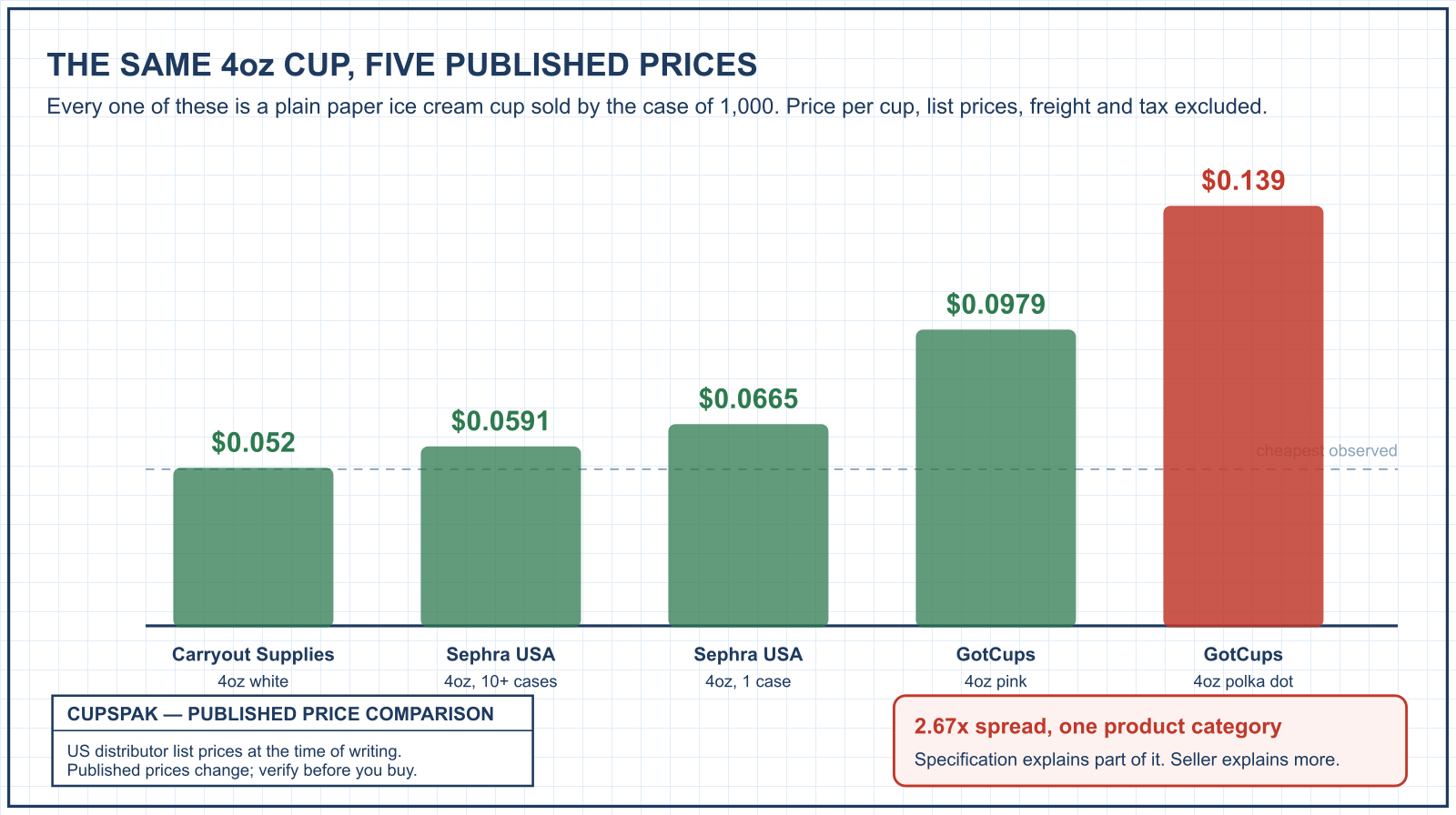
Published distributor list prices, excluding freight and tax, before any account pricing. Several Carryout Supplies SKUs showed as sold out at the time of observation with prices still published. Prices in this category move. Treat the table as a reference range, not a live quote.
Size does not track price. Carryout Supplies charges more per cup for its 3.5oz ($0.068) than for its 4oz, 5oz, 6oz or 10oz, and its 10oz ($0.055) undercuts its own 6oz ($0.057). GotCups prices 12oz and 16oz identically at $0.1038. You are not paying for the volume of ice cream the cup holds.
Decoration is the cheapest premium in this market. Carryout Supplies sells a pre-printed pink polka dot 4oz at $57.00 a case against $52.00 plain: $5 a case, about 9.6% on the unit price. Hold that 9.6%, because it is the benchmark a custom print run has to beat.
Buying ten times more moved the price about 11%. Sephra USA publishes its own break on one 4oz SKU: $66.53 a case at one case, $59.14 at ten or more. That is the only clean distributor volume curve in the dataset, and a 10x order does not halve anything.
Which sizes you stock is a menu decision rather than a cost one, and the ice cream cup size chart runs through the nine of them.
How many ice cream cups come in a case, and why case prices mislead
1,000 per case is the US stock convention, packed as 20 sleeves of 50 cups. Every stock SKU observed at Carryout Supplies, GotCups, Sephra USA and FrozenYogurtParts all used it. The sleeve of 50 is what your staff opens behind the counter, which matters when you plan counter space rather than warehouse space.
Now the trap. Custom short run printers break the convention: on the same day, CustomPaperCup listed 8oz at 960 per case and 12oz at 720. A buyer weighing $179.87 a case against $103.78 a case is comparing 720 cups against 1,000 and does not know it. That 720 figure is evidence of pack variance only, never a like for like price.
Never compare case prices. Compare per cup prices, and get the pack count in writing on every quote.
Volume breaks here are quoted in cases, not units. Sephra’s break sits at 10 cases, CustomPaperCup’s ladder runs 1, 5, 10, 20 and 50 cases, and Good Start Packaging writes its custom minimum as 150 cases. Ask for tiers in cases and you will get an answer faster.
What actually drives the price of an ice cream cup?
Five levers set the number on your quote, and only two are about the cup. Ordered by the movement you can realistically get:
- Order size. Biggest lever, least effort. Sephra’s published break is about 11% per cup for 10,000 over 1,000, and CustomPaperCup’s ladder falls 55% between 960 cups and 48,000. Volume moves price further than any spec argument.
- Print. Every colour is a plate and a setup cost divided across the run, which is why a 2 colour design beats a 7 colour one on a small order, and why flexo turns economical from around 20,000 per design. Flexo through CupsPak covers up to 7 colours, full wrap included.
- Board weight. More fibre per cup, and the spec most quietly thinned to hit a low quote. GetBioPak names 230gsm and 300gsm builds without pricing either. Ask for gsm in writing.
- Coating. PE is the cheapest barrier and will stay that way. PLA and aqueous sit above it. CupsPak offers all three on ice cream cups.
- Lids. A PET dome costs more than a PET flat or paper lid, and lids are priced separately, so they take a bigger share of the line than buyers expect. One cost point: 12oz and 16oz share a 105mm rim and one lid SKU, taking a whole line out of your order. Choosing between a dome, a flat lid or paper moves that number again.
The blunt verdict: the two levers you control are order size and print. The other three are spec conversations.
How much does custom printing add per cup?
There is no single number, and a supplier who quotes one before asking your colours, size, material and quantity is guessing. Five inputs decide it.
- Print method. Flexo is the volume route. Digital skips plates, which suits short runs, but its per unit price never fully falls away.
- Colour count. Flexo plates are charged per colour per design, fixed whether you run 20,000 cups or 200,000. They dominate a small run and vanish into a big one.
- Size. A 20oz cup takes more board and ink than a 4oz, so a print quote has to be size specific.
- Material and coating. Kraft, white and bamboo board take ink differently: colours read warm on kraft, true on white.
- Quantity. Everything above amortises across the run. That is what an MOQ is for.
Curve shape, not a benchmark: one US short run digital printer published tiers for an 8oz four colour CMYK cup, from $0.4408 per cup at 960 units to $0.1971 at 48,000. One printer, one method, one size, one colour count. Short run digital starts high, drops steeply, then flattens. A flexo quote at another size and colour count draws a different curve, and published prices move.
Send these five lines and the quote becomes arithmetic: size and quantity per size; colour count and Pantone needs; board; coating; lid type. Get your own number rather than a market average: ours come back within 24 hours, with a digital proof in 3 business days.
What is the real MOQ for custom printed ice cream cups?
There is no industry MOQ. Published minimums across ice cream cup suppliers ran from none at all to 150,000 per design, and published lead times ran from 5 days to 16 weeks.
| Supplier | Published minimum | Published lead time | Route |
|---|---|---|---|
| CustomPaperCup | No minimum | As few as 5 days | US digital short run |
| Cup Print | 1,000 | 15 working days | US digital |
| CupsPak | 20,000 per design | Proof in 3 business days, then production | Flexo, up to 7 colours |
| GetBioPak | 50,000 per size | 3-4 weeks | Overseas flexo |
| Good Start Packaging | 150,000 (150 cases) | 14-16 weeks from approved proof | Custom compostable |
Published figures at the time of writing. Suppliers change minimums and schedules, so confirm both in writing.
MOQ is not arbitrary: it is the plate and setup cost divided by the run. Digital skips the plates, which is why it carries no minimum and why its per cup price sits several times above a stock cup.
MOQ is per design and often per size. Three sizes carrying one artwork can be three separate minimums. That is the most expensive misunderstanding in this category, and why a lean two size lineup beats a five size one on a first branded order. CupsPak sets 20,000 per design across 9 ice cream cups from 2oz to 20oz.
Below the minimum you have two moves: stay on stock cups and brand something else, or take the short run digital route and accept the unit price.
Why the cheapest cup per unit is usually the wrong first question
The cheapest cup per unit in this research was $0.0576, a 4oz custom printed compostable cup from Good Start Packaging. That undercuts most plain stock cups in the table above. The catch sits in the terms: 150 cases, 150,000 cups, and 14-16 weeks from approved proof.
Do the arithmetic. At that minimum you commit about $8,600 of stock (150 cases at $57.61) and wait three to four months. A shop selling 250 cups a day in peak and 80 off season is buying years of one size.
Three costs never appear on the quote, all from published terms:
- Cash. Custom orders commonly run 50% deposit before production, balance before shipment (Carryout Supplies’ terms). Half the money leaves before anything exists.
- Space. Carryout Supplies gives 30 days free storage under 30 cases, 60 days at 30 or more, then $2.00 per case per 30 day period.
- Tolerance. The same terms allow plus or minus 15% on colour, weight and the number of cases produced. Order 30 cases and budget for 34 or plan around 26.
The first question is not what a cup costs. It is how many cups you can afford to own at once.
Stock or custom printed: which should you buy first?
If one size will not burn through a full print run inside about twelve months, buy stock. That rule settles most of this without a spreadsheet.
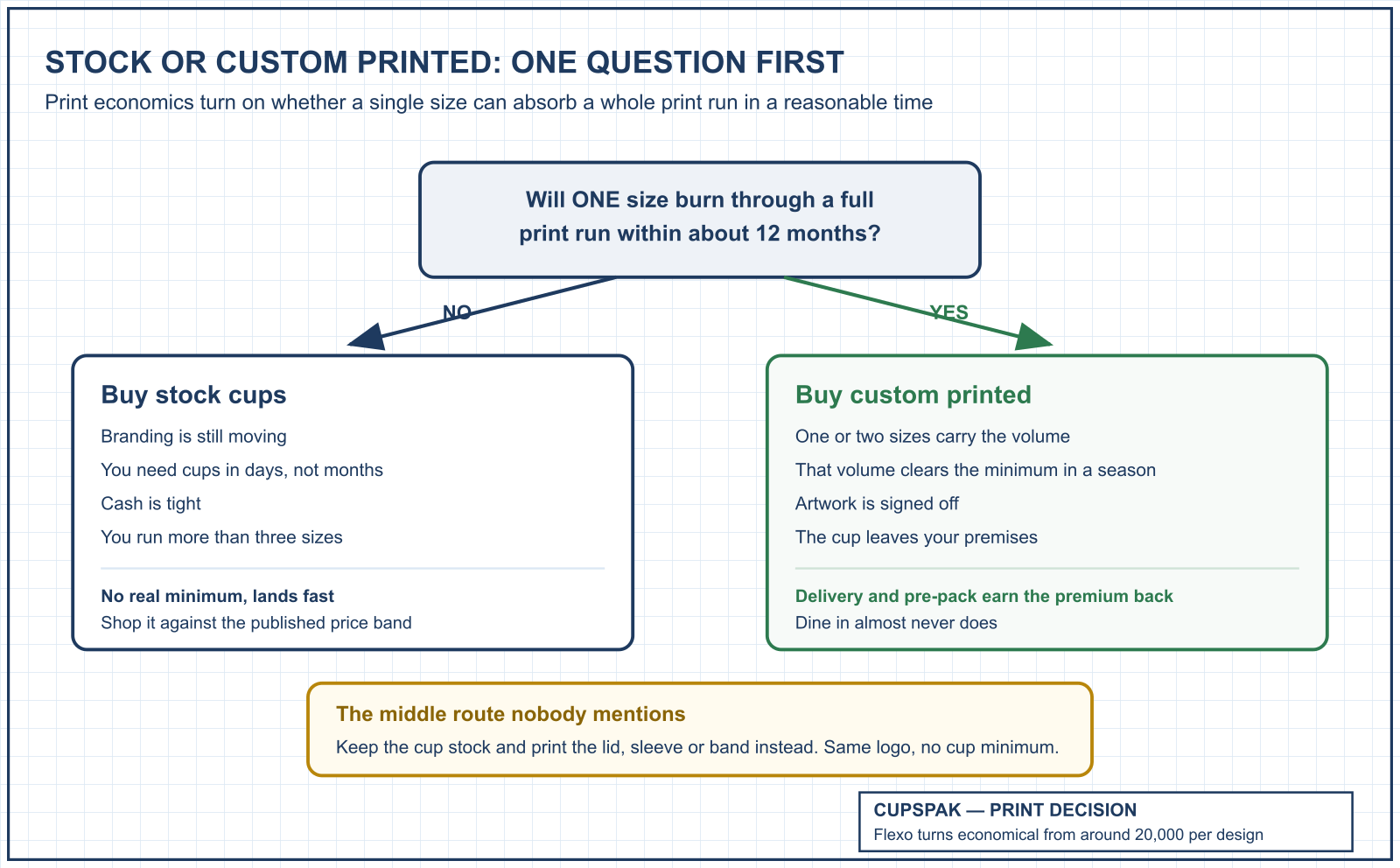
Buy stock cups when your annual volume sits under a print run, your branding is still moving, you need cups in days rather than months, cash is tight, or you run more than three sizes. Stock cups carry no real minimum, land fast, and the table above gives you the band to shop them against.
Buy custom printed when one or two sizes carry most of your volume, that volume clears the minimum inside a season, your artwork is signed off, and the cup leaves your premises where somebody else sees it. Delivery and pre-pack are where a printed cup earns its premium back. Dine in almost never is.
The middle route nobody mentions: keep the cup stock and brand what surrounds it. A printed lid, sleeve or band carries the logo for a fraction of a cup print run, and you can change it next season.
Test before you commit. Free stock samples are available with you covering shipping (sample request), while custom printed samples carry sample fees, which is itself a reason to prove the cup on stock first. Every CupsPak order gets pre-shipment inspection. Seasonal ordering rhythm and the rest of a shop setup are covered in the ice cream shop packaging guide.
When a domestic distributor beats importing direct
For a first order, a small order, or an urgent one, a domestic distributor wins. Not close.
Buy domestic when any of these is true: you need cups inside a month, you order under roughly ten cases, you are testing a size or design, your cash cannot sit in transit, or you reorder in small unpredictable batches. The $0.052 to $0.139 band above is available on a credit card with no paperwork, and a US digital printer will put your artwork on 960 cups in about five days. Nothing imported competes with that.
Import direct when volume, sizes and specification line up: print run scale, one or two settled sizes, planned lead time, and a reason to control board, coating and print rather than take whatever the distributor stocked.
Duty is where import maths goes wrong, and there is no single answer to quote you. The rate depends on your destination country, and it moves with trade policy. US buyers importing from China should be especially careful here: the base tariff line understates the real cost, because additional trade measures sit on top of it and change often. Anyone who tells you paper cups come in duty free is quoting half the picture.
Treat duty as a number you get from a customs broker for your destination and the current schedule, not as a number you assume. Get it before you compare a landed import price against a domestic quote, because it is usually the line that decides which one wins.
One piece of paperwork nobody mentions until it is late: an Importer Security Filing is mandatory on all US ocean cargo regardless of size, filed at least 24 hours before loading at origin. Transit adds weeks on top, and your forwarder’s current lane time is the only number worth planning against.
On the import side of that line, start with the ice cream cups range.
Frequently Asked Questions
How much do ice cream cups cost per cup?
Stock 4oz paper cups ran $0.052 to $0.139 per cup across US distributors, with stock 8oz to 16oz around $0.09 to $0.12. Those are published list prices, excluding freight and tax, and they move.
How many ice cream cups come in a case?
1,000 for US stock cups, packed as 20 sleeves of 50. Custom short run printers break it: one published 8oz cases of 960 and 12oz cases of 720 the same day. Compare per cup, and get the pack count in writing.
What is the MOQ for custom printed ice cream cups?
There is no industry standard. Published minimums run from no minimum for US digital, 1,000, 20,000 per design for flexo through CupsPak, 50,000 per size overseas, and 150,000 for a custom compostable line. Minimums are per design and often per size.
How much does printing my logo on ice cream cups add?
No honest supplier gives one figure. It moves on method, colour count, size, board, coating and quantity. For curve shape only: one US short run digital printer published $0.4408 per cup at 960 units and $0.1971 at 48,000 on an 8oz four colour cup. Flexo turns economical from around 20,000 per design.
How long does it take to get ice cream cups?
Published lead times spanned 5 days to 16 weeks. Stock cups ship immediately from a distributor. Custom print adds artwork, proof and production, with a digital proof inside 3 business days on our route.
Can I get samples before ordering?
Yes. Free stock samples with you covering shipping; custom printed samples carry sample fees. Then test: fit the lid you intend to buy, load the cup, freeze it, stack a column, and check it denests from a sleeve of 50.
Do I have to pay import duty on paper ice cream cups?
Yes, and how much depends entirely on where you are importing to. Rates differ by destination country and move with trade policy. US buyers bringing cups in from China should assume the headline tariff line understates it, because additional trade measures apply on top and change often. Ask a customs broker to calculate the landed duty for your destination before you compare an import price against a domestic distributor’s quote.
Replace these market averages with your own number: order free stock samples and prove the cup in your own freezer, then send sizes, quantities, coating and print colours through the quote form for tiered pricing within 24 hours.
Ready to Source Eco-Friendly Paper Cups?
Request a free sample pack or get a wholesale quote tailored to your requirements.