
Austin — Product Manager · Reviewed by Henry, Head of Marketing
August 28, 2026 · 10 min read
Short answer: most paper cups should not go in a microwave, and the paper is not the reason. The lining is.
A paper cup is not really paper. It is paperboard with a thin barrier on the inside, and that barrier is what fails first. Which barrier your cup has decides whether it survives ninety seconds on high or ends up soft, leaking, and stuck to the turntable.
This matters more if you buy cups by the container than if you buy them by the sleeve. A café that microwaves the occasional cup of cold coffee is doing something the cup was never specified for. A meal-prep brand that expects customers to reheat is making a purchasing decision, and it needs to be made before the order, not after the complaints.
Which Paper Cup Linings Survive a Microwave
Three linings cover almost every paper cup on the market. They behave very differently under microwave heat.
| Lining | Microwave safe | What happens under heat | Typical use |
|---|---|---|---|
| PE (polyethylene) | No | The film softens well below the temperature of the drink inside it | Standard hot and cold cups |
| PLA (plant-based) | No | Softens from around 55°C, so it is the first to deform | Compostable programmes |
| Aqueous dispersion | Yes, where tested and stated per product | No plastic film to soften or delaminate. Board and seam are still separate limits | Hot cups, microwave-tolerant lines |
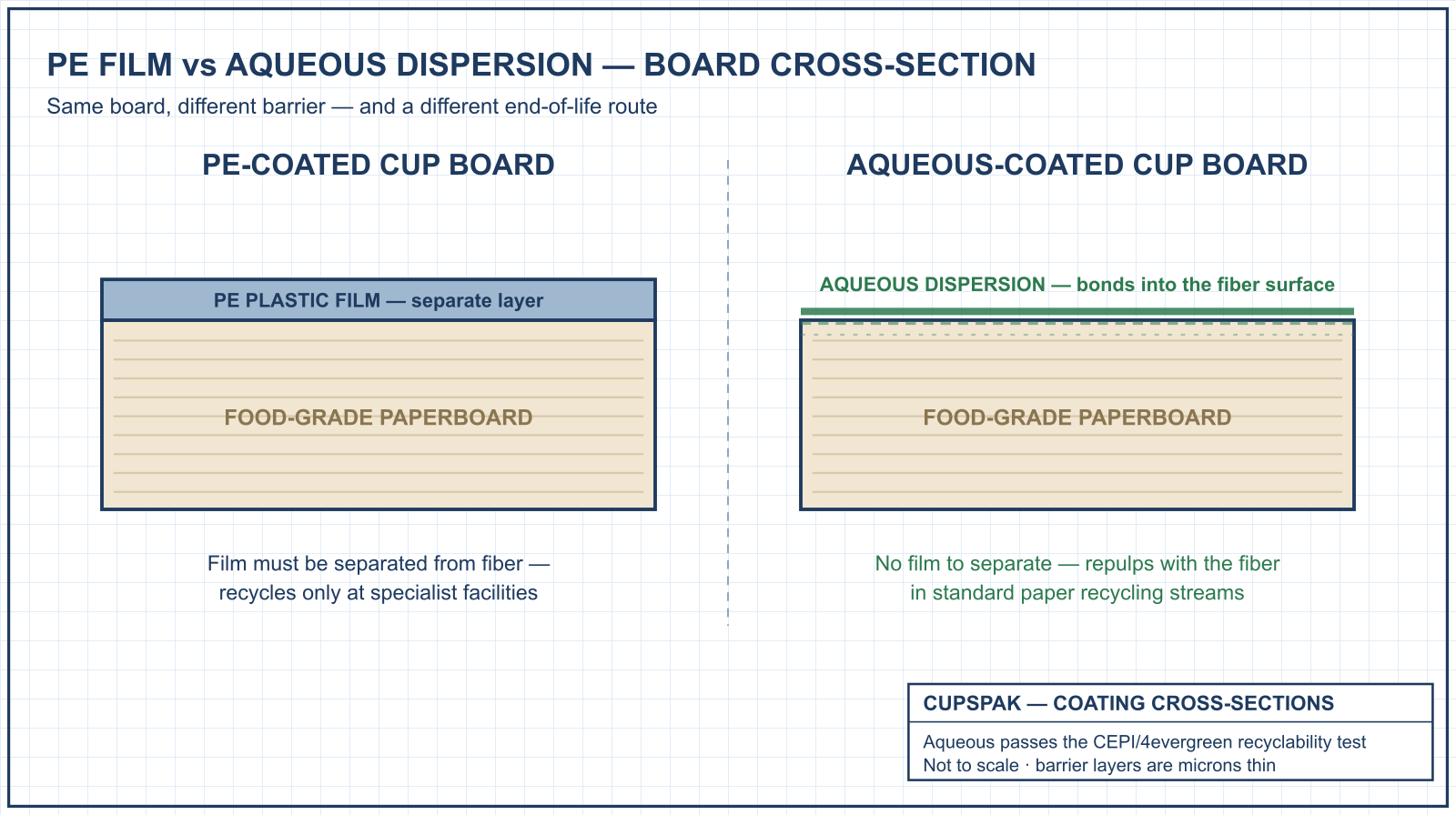
The aqueous cup is the only one of the three that can carry a microwave claim at all, and even then it is a claim about a specific cup, not about the material class. It uses a water-based dispersion instead of a laminated plastic film, so there is no film to soften or peel away from the board. That removes the failure mode that stops PE and PLA. It does not remove the others.
The safe default is still no, and that is how we word it ourselves. Our aqueous-coated cups are specified microwave tolerant and we will send the test report on request. That is a statement about a tested product, not a property you can assume from the word “aqueous” on someone else’s spec sheet.
The scope matters too, and it is where most confusion comes from. Our testing covers cups. It does not cover paper bowls, boxes or trays, so we do not extend the claim to those formats, and you will see us say “not recommended” on those pages for exactly that reason. A supplier who claims microwave tolerance across an entire catalogue has almost certainly not tested it across an entire catalogue.
One thing to be exact about while we are here: an aqueous coating is still a polymer. A typical aqueous cup contains under 5% plastic by weight. It is a low-plastic build, not a plastic-free one, and any supplier telling you otherwise is overselling it.
Why PE Fails Before the Drink Gets Hot
Here is the part that surprises buyers. A PE-lined cup will happily hold coffee at 85°C all day. Put the same cup in a microwave and it can fail in under a minute.
The difference is how the heat arrives. Poured coffee heats the cup from the liquid outward, and the board spreads that heat. A microwave excites the water molecules inside the cup and inside the board itself, and the hot spots land unevenly. The PE film sits right where those hot spots concentrate.
What you see is not usually a dramatic melt. It is a slightly waxy feel on the inside wall, a cup that has lost its rigidity near the rim, and a seam that starts weeping an hour later. The customer does not complain about the microwave. They complain that your cup leaked.
PLA Is the Worst Choice for Reheating
PLA cups look and feel like a normal cup, which is exactly the problem. Standard PLA begins to soften from around 55°C. That is below the temperature of a fresh coffee, let alone a microwave.
PLA is a good material for the job it is designed for, which is cold drinks and compostable programmes. It is a bad material for anything a customer might reheat. If your programme is compostable and your customers reheat, those two requirements are pulling against each other, and someone needs to say so before the purchase order.
The blunt verdict: if reheating is part of how your product gets eaten, do not specify PLA.
The Lid Is a Separate Problem
Even with a microwave-tolerant cup, the lid almost never is. Most drink lids are PS, PP or rPET, and PET in particular has a much lower heat tolerance than the cup underneath it. Paper lids are no exception, and the coated build behaves differently from the uncoated one.
Take the lid off. This sounds obvious, and it is still the most common cause of a “your cup melted” email. The cup did not melt. The lid did, onto the cup.
If your packaging goes out with instructions printed on it, one line about removing the lid before heating costs nothing and prevents the complaint entirely.
What About Hot Drinks That Are Not Microwaved?
A separate question, and a much easier one. Standard single wall paper cups are built for hot beverages at normal service temperature, around 85°C. All three linings handle that.
If the complaint you are trying to solve is “the cup is too hot to hold” rather than “the cup failed”, the answer is not a different coating. It is a double wall cup, a ripple wall cup, or a sleeve. Those change the insulation, not the barrier.
How to Check a Cup Before You Commit to 20,000
Standard minimum on hot cups is 20,000 pieces per size. That is a large quantity to discover a coating problem in, so check before the order rather than after.
Ask for a stock sample and run the test your customers will run. Not water in a lab: your actual drink, at your actual holding time, in your actual microwave if reheating matters.
Questions worth putting to any supplier in writing:
- Which coating is on this specific size? Coating can vary across a range.
- Is the cup specified as microwave tolerant, and is that stated on paper or only in an email?
- What is the stated service temperature, and does the supplier have a test report behind it?
- Does the lid share that rating? It almost certainly does not.
- If the answer is “our cups are fine in a microwave”, ask which coating they mean. A supplier who cannot name it has not checked.
Stock samples are free from us and most serious suppliers, and you pay only the shipping. There is no reason to guess.
The Board Matters Too, Not Just the Lining
The lining fails first, but it is not the only thing happening.
Paperboard is not dry. It holds a few percent moisture by weight even sitting on a shelf, and a microwave heats that water directly. In a cup that has already held a drink, the board near the seam holds more, which is exactly where the structure is weakest.
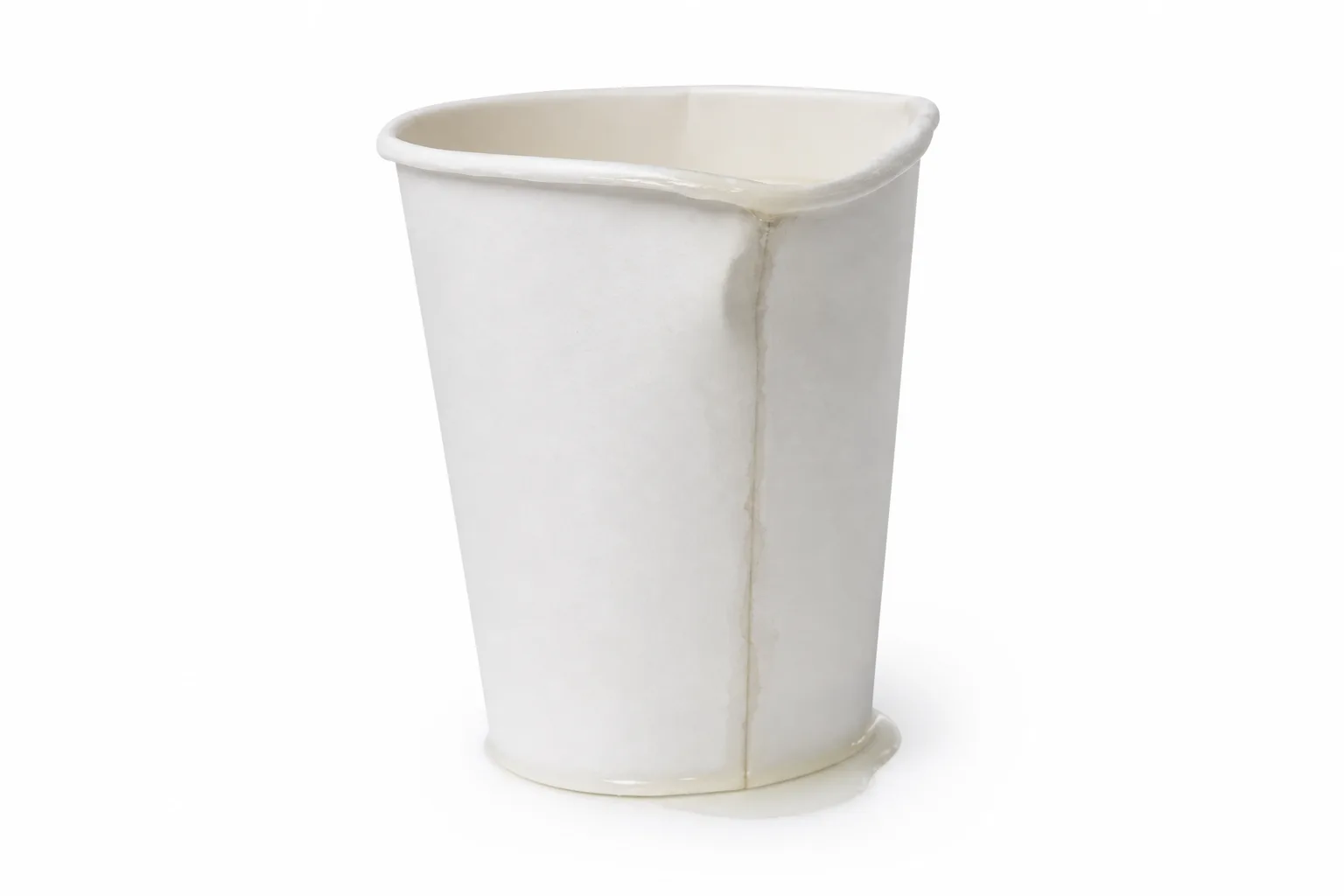
That is why a microwaved cup often looks fine and then gives up an hour later. The board has been through a wet heat cycle, the fibres have moved, and the seam is no longer doing what it did when it left the factory.
The adhesive in that seam is its own limit, and it is the part most guides skip. A paper cup is not a single material: it is board, a barrier, and a glue line holding the wall and base together. That adhesive is specified for cup forming and for holding a hot drink, not for microwave heating. A cup can have a coating that survives and a seam that does not.
It also explains a complaint that confuses people: the same cup, microwaved twice, fails on the second pass. Nothing changed about the cup. The first cycle did the damage and the second one revealed it.
What About Bowls, Boxes and Containers?
This is where reheating actually matters, and it gets asked less than it should.
A customer microwaving a coffee cup is doing something unusual. A customer microwaving last night’s noodles in the box it arrived in is doing exactly what the format invites. If your programme ships hot food that people take home, the container question is more urgent than the cup question.
The same rule applies. It is the barrier that decides, not the fibre:
- PE-lined bowls and boxes are not built for microwave reheating, for the same reason as cups.
- Aqueous-coated formats are the ones to ask about if reheating is part of the journey.
- PLA-lined containers are the worst choice for reheating, and the conflict with a compostable spec is the same one.
If you sell meal kits, ghost-kitchen dinners or anything a customer will finish at home, raise reheating with your supplier at the specification stage. It changes which coating you should be ordering across paper bowls, lunch boxes and trays, not just cups.
What Else the Aqueous Coating Changes
If a microwave-tolerant aqueous cup is what you end up specifying, two other things come with that build, and they usually matter to the same buyer.
It breaks down faster in soil. Aqueous-coated cups begin visibly breaking down within about 85 days under natural burial and degrade by around 245 days. PE-lined cups in the same conditions are still structurally intact at 245 days. That is a landfill and litter observation, not a composting certification, and it should not be quoted as one.
It carries a lower footprint. On an assessment aligned with ISO 14067, 1,000 units of an 8oz aqueous cup come out at approximately 21.92 kg CO₂e against 24.77 kg for the PE equivalent, roughly an 11.5% reduction.
Keep the methodology wording attached to that number if you use it in your own marketing, particularly in the EU, where green claims are scrutinised on whether they are substantiated.
What the aqueous build does not give you is a plastic-free product. The dispersion is itself a polymer and the cup still carries plastic content, which is why it still needs SUP marking in the EU. Anyone selling it to you as plastic-free is telling you something that will not survive an audit.
How to Specify a Reheatable Programme
If reheating is genuinely part of how your product is consumed, put it in the specification rather than hoping. Four lines cover it:
- Name the coating, not the outcome. “Microwave safe” is a claim. “Aqueous dispersion coating” is a specification. Ask for the second.
- State the temperature and the time. A cup that survives 30 seconds is not the same as one that survives three minutes. Tell your supplier what the customer will actually do.
- Handle the lid separately. Specify that lids are not rated for heating and print a removal instruction if the pack carries any copy at all.
- Ask what documentation exists. Not “is it microwave safe” but “what test report sits behind that, and for which size”.
A supplier who can answer all four has run the product. One who answers the first and skips the rest has not.
Is It Dangerous, or Just Ruined?
Worth separating, because the honest answer is different for the two.
In the overwhelming majority of cases a microwaved paper cup is a ruined cup, not a hazard. The lining softens, the board weakens, the cup leaks. Annoying and messy, not dangerous.
There is one real exception, and it is the thing to actually watch for: anything metallic. Foil stamping, metallic inks and any foil laminate will arc in a microwave. That is a genuine fire risk rather than a performance complaint, and it applies to decoration far more often than to the cup itself.
This catches people out on accessories rather than cups. Foil finishing is common on flat paper cup sleeves, where the print area is large enough to justify it. A sleeve is exactly the sort of thing someone leaves on a cup without thinking. If any part of your packaging carries foil or metallic ink, it should never go near a microwave, whatever the cup underneath is lined with.
Standard flexo inks on a plain printed cup are not the issue. Metal is.
What About the Old Wax-Coated Cups?
Occasionally someone remembers wax cups and asks whether those were better. They were not, and they are largely gone from foodservice for good reasons.
Wax melts at a much lower temperature than PE softens at. A wax-lined cup in a microwave does exactly what you would expect, and it does it faster. Wax also cannot handle a hot drink poured in at 85°C without softening at the surface, which is why the industry moved to extruded PE decades ago.
If a supplier offers you a wax-coated cup today for a hot or reheatable application, that is a signal about the supplier, not an interesting alternative.
Is There a Microwave-Safe Symbol to Look For?
Not a reliable one, and this is where a lot of buyer confusion comes from.
The wavy-lines microwave symbol is widely used on consumer packaging but it is not a certification mark issued by a standards body in the way an ISO number is. On foodservice disposables it usually reflects the supplier’s own assessment. That is not automatically wrong, but it is not independent either.
What you should ask for instead is specific and checkable:
- The coating type by name, per size.
- The stated service temperature range and what test sits behind it.
- Whether the assessment covers the lid as well as the cup, which it usually does not.
- Whether the documentation is written for your destination market, since requirements differ.
A symbol on a carton is a marketing decision. A named coating with a report behind it is a specification. Buy against the second.
The Short Version for a Café Counter
If you landed here because a customer asked and you need an answer in one sentence, here it is by coating:
- PE-lined cup: no. It will hold hot coffee but not microwave heat.
- PLA-lined cup: definitely not. It starts softening from around 55°C.
- Aqueous-coated cup: yes where it has been tested and stated for that product. Ours are, and the report is available on request. Do not assume it from the coating name alone.
- Any lid: no, remove it first, regardless of the cup.
- Anything with foil or metallic ink: never, including sleeves.
If you do not have that statement in writing for the exact cup you buy, treat the answer as no.
If you do not know which coating your current cups have, that is the actual answer to give the customer, and it is worth a five-minute email to your supplier to fix permanently.
Frequently Asked Questions
Can you microwave a paper coffee cup?
Usually not, and the safe default is to assume not. Most coffee cups are PE-lined, and the plastic film softens under microwave heat even though it handles a hot drink poured into it. Aqueous-coated cups are the exception: ours are specified microwave tolerant, with a test report available on request, because there is no plastic film to soften or delaminate. That is a per-product statement, so ask for it against the size you are buying rather than assuming it from the coating name.
How do you tell what coating a paper cup has?
You cannot reliably tell by looking or feeling. An aqueous cup and a PE cup can be visually identical. Ask the supplier for the coating type per size in writing, and ask whether a test report exists behind the service temperature they quote.
Are compostable paper cups microwave safe?
PLA-lined compostable cups are not. Standard PLA starts softening from around 55°C, which is lower than a fresh hot drink. If you need both a compostable build and reheating, raise the conflict with your supplier before ordering rather than after.
Why did my paper cup leak after microwaving?
The seam or the lining failed, not the paperboard. Microwave heating creates uneven hot spots that concentrate exactly where the lining sits. The cup often looks fine straight away and weeps later, which is why the complaint usually arrives after the customer has walked out.
Is the lid microwave safe if the cup is?
No, and it is worth assuming it is not. Drink lids are commonly PS, PP or rPET, and PET has a much lower heat tolerance than the cup. Remove the lid before heating, whatever the cup is made of.
Not sure which coating is on the cup you are buying now? Send us the size and what goes in it, and we will tell you which build fits, including when the honest answer is that reheating and your current spec do not go together. Free stock samples ship in 3 to 5 business days and you cover only the freight.
Ready to Source Eco-Friendly Paper Cups?
Request a free sample pack or get a wholesale quote tailored to your requirements.