
Henry — Head of Marketing · Reviewed by Austin, Product Manager
July 17, 2026 · 13 min read
Double wall paper cups are hot cups built from two layers of paperboard with an insulating air gap between them, so the drink stays hot and the outside stays comfortable to hold, no sleeve needed. For most coffee programs pouring 12oz and up all day, they replace two SKUs (cup plus sleeve) with one, and that single change removes an inventory line, a counter assembly step, and a whole category of small waste. The catch nobody prints on the quote: “8oz double wall” describes the volume, not the cup: the inner and outer board weights (GSM) are what you are actually buying, and no industry standard fixes them.
This guide covers both sides of the double wall decision: the economics of built-in insulation versus a single wall cup with a sleeve, and the spec lesson that makes two double wall quotes actually comparable.
What is a double wall paper cup, and how does the air gap work?
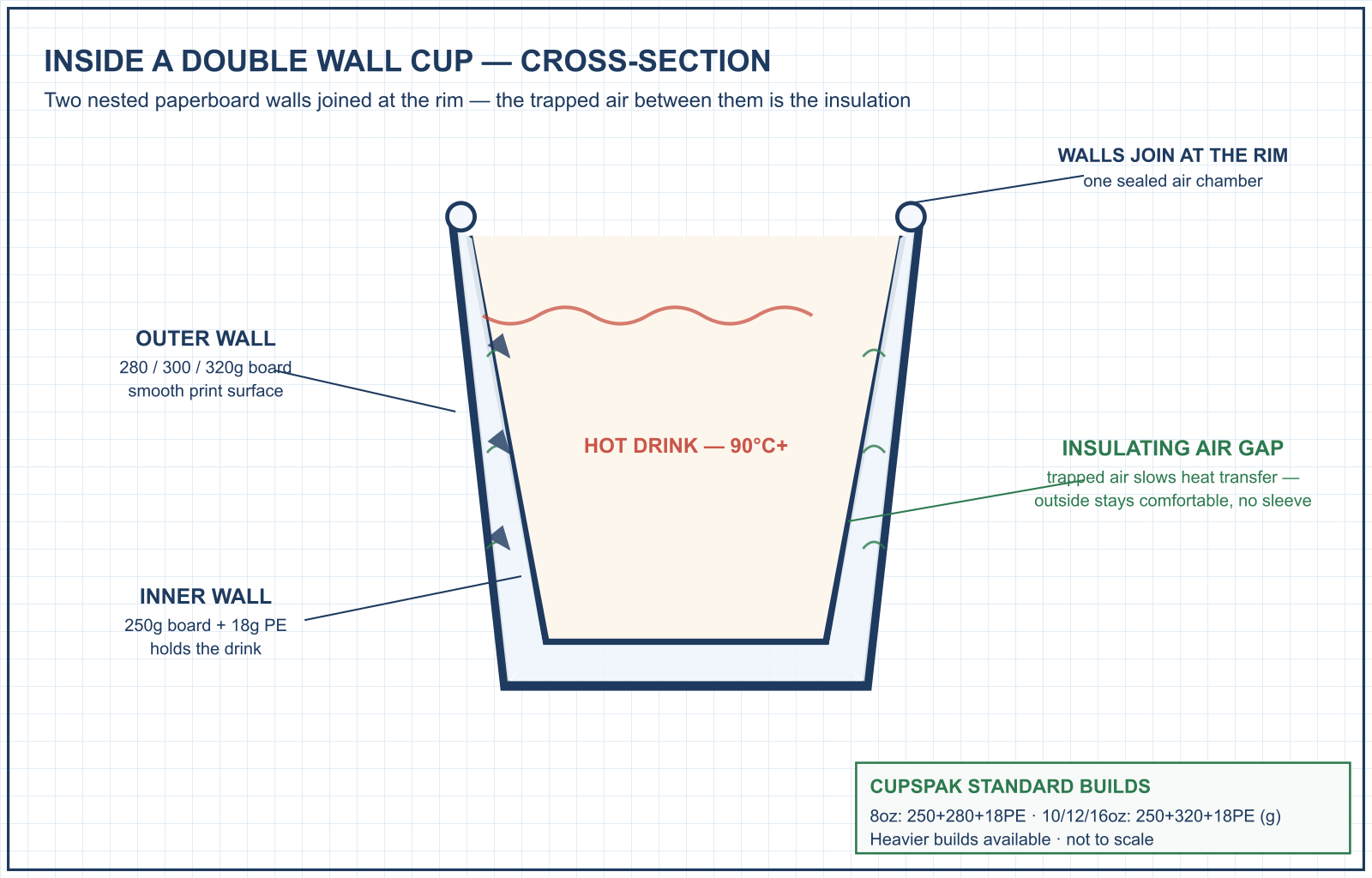
A double wall paper cup is exactly what the name says: two complete paperboard layers formed into one cup, with a thin pocket of air trapped between them. The inner wall holds the drink. The outer wall is what the customer’s hand touches. The air gap in between is the insulator: still air conducts heat poorly, which is the same principle behind double-glazed windows.
That gap does two jobs at once. It keeps the outside of the cup at a holdable temperature with a 90°C+ drink inside, and it slows how fast the drink loses heat to the room. A double wall paper cup straight off the counter needs no sleeve, no double-cupping, and no apologetic “careful, it’s hot” from your barista.
The second, quieter benefit is rigidity. Two bonded walls make a noticeably stiffer cup than one. Customers squeeze cups (at the lid, at the grab, getting into a car), and a double wall cup resists that squeeze instead of flexing and popping the lid. For delivery and drive-through programs, that stiffness is often worth as much as the insulation.
Structurally, the outer wall is also your print surface. It is smooth, continuous, and never interrupted by a sleeve seam, which is why double wall cups take full-wrap flexo printing up to 7 colors cleanly. Your brand covers the entire cup, not the two-thirds of it a sleeve leaves visible.
Double wall or single wall + sleeve: which actually costs less?
The short answer: on pure unit cost, single wall + sleeve usually wins: sleeves are genuinely cheap. Where double wall earns its higher price is everything around the number: one SKU instead of two, a sturdier cup in the hand, and a full print surface with no sleeve covering it. Decide by what your program values, not by the unit-price line alone.
Here is the honest starting point. A single wall paper cup uses one board layer, so it will always quote below a double wall cup of the same size: the second wall is real paperboard, and you pay for it. If your menu is mostly iced drinks, or hot drinks are a small share of a low-volume operation, single wall with sleeves on request is the rational call. Nobody needs built-in insulation on a lemonade.
Let’s put the real number on the table. A plain kraft coffee cup sleeve runs roughly $0.01 to 0.04 per piece, with custom printed sleeves at the top of that range. Even added to the single wall cup price, the combo often still quotes below a double wall cup. So if unit cost is your only lens, single wall + sleeve keeps the edge, and an honest supplier will tell you so. The case for double wall lives in the costs a quote sheet doesn’t show.
What the quote sheet doesn’t show. Count these the way an operations manager would:
- Two SKUs instead of one. Two purchase orders, two MOQs to manage (sleeves carry their own 10,000-piece minimum), two reorder points, two things that can run out. When sleeves run out and cups don’t, staff double-cup, and now you are burning two cups per drink, which costs more than the sleeve ever did.
- A small but constant counter step. Someone slips a sleeve onto every hot cup. It is quick (this is not a labor crisis, and we won’t pretend it is) but it is one more motion in every serve, one more thing to train, and one more thing skipped when the queue is long.
- Fit and waste: minor at volume. Sleeves are sized to rim diameter and cup height, and at proper volume the loss rate is genuinely low. The occasional loose fit or dropped sleeve happens; the bigger waste risk is the stockout above, when double-cupping burns two cups per drink.
- Storage. Sleeves are light but bulky, and they take shelf space in back-of-house that most cafés don’t have to spare.
Here is the whole comparison in one table:
| Cost factor | Double wall cup | Single wall + sleeve |
|---|---|---|
| Unit price | Higher per cup: second board layer is real material | Lower: cup + $0.01-0.04 sleeve usually still cheapest overall |
| SKUs to manage | 1 | 2 (separate MOQs: 20,000 cups + 10,000 sleeves) |
| Counter labor | None: serve straight from the stack | One quick extra motion per hot drink |
| Failure modes | None specific to insulation | Sleeve stockouts → double-cupping; occasional loose fits |
| Print surface | Full cup, uninterrupted, up to 7 colors | Split between cup and sleeve; sleeve hides the cup art |
| Rigidity | High: two bonded walls | Standard single wall, sleeve adds grip not stiffness |
| When it wins | Hot-drink-led menus, 300+ hot drinks/day, delivery | Mixed hot/cold menus, low hot volume, seasonal hot programs |
The blunt verdict: sleeves are cheap and, at volume, sleeve waste is small: if pure unit cost decides, single wall + sleeve wins. You buy double wall for what the quote sheet doesn’t show: one SKU to manage, a premium in-hand feel, and a print surface no sleeve interrupts. When hot drinks are the majority of what you serve and your brand lives on the cup, that trade is usually worth it.
One legitimate reason to stay with sleeves even at volume: some brands treat the sleeve itself as a design element: a different texture, a seasonal print swapped quarterly without reprinting cups. That is a marketing decision, not a cost decision, and it is a fair one. Make it deliberately.
Where does ripple wall fit in?
Ripple wall is the third option: a double wall cup with a corrugated (rippled) outer layer instead of a smooth one. The ridges add extra air channels and a distinctive textured grip, and the look reads craft-coffee to a lot of customers. The trade-off is the print surface: a corrugated wall never takes fine print detail the way a smooth double wall does, so complex artwork belongs on double wall.
If you are weighing all three constructions side by side, the full breakdown (insulation, cost logic, print behavior, and which venues choose which) is in our single wall vs double wall vs ripple wall comparison. For this guide, the short version is enough: ripple is a styling variant of the same built-in-insulation idea, and everything below about GSM specs applies to it just as much.
Why does “8oz double wall” tell you nothing about the cup?
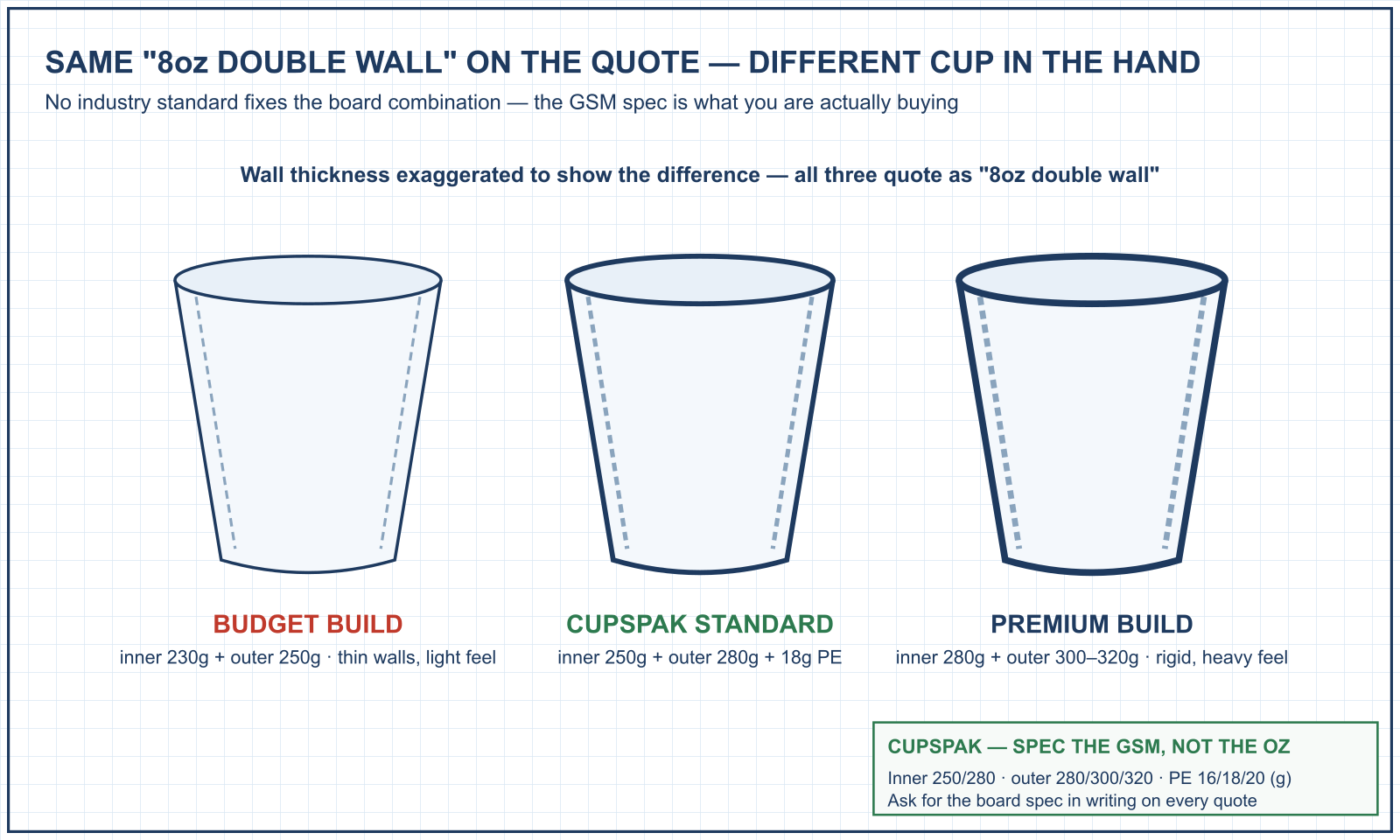
Here is the part of this guide worth printing out. There is no national or industry standard that locks the inner and outer board combination of a double wall paper cup. The size on the quote (8oz, 12oz) fixes the volume. It fixes nothing else. Two suppliers can both quote “8oz double wall paper cups,” and one means a 230g inner wall with a 250g outer, while the other means 280g + 300g. Different cup. Different weight in the hand. Different rigidity, different insulation, different freight weight per carton, and a genuinely different cost of goods. Same four words on the quote.
What suppliers don’t tell you is that this ambiguity is useful to them. When a quote comes in 15 to 20% below the others, that money almost always comes out of the paperboard: a lighter inner wall, a lighter outer wall, or both. The sample you approved and the bulk order you receive can even drift apart the same way, because “8oz double wall” was never a complete specification to begin with.
The market reality, across hundreds of client orders:
- Inner walls commonly run 250g or 280g.
- Outer walls commonly run 280g, 300g, or 320g.
- PE lamination (the waterproof layer bonded to the board) runs 16g, 18g, or 20g.
Every combination of those numbers exists somewhere in the market, sold under the same size names. A 12oz double wall alone commonly ships as 300g+18gPE+250g from one production line and 280g+18gPE+280g from another, and both are legitimate cups; they are just not the same cup, and they should not carry the same price.
For reference, these are the CupsPak standard builds against the market spread:
| Size | CupsPak standard build (inner + outer + PE) | Common market range |
|---|---|---|
| 8oz | 250g + 280g + 18g PE | inner 230-280g, outer 250-300g, PE 16-20g |
| 10oz | 250g + 320g + 18g PE | inner 250-280g, outer 280-320g, PE 16-20g |
| 12oz | 250g + 320g + 18g PE | often 300+18PE+250 or 280+18PE+280 |
| 16oz | 250g + 320g + 18g PE | inner 250-280g, outer 300-320g, PE 16-20g |
Heavier builds are available on request for programs that want a more substantial cup: the standard builds above are the baseline, not the ceiling.
If you have read our lid guides, you have seen this exact lesson before: you order lids by rim diameter, not by oz, because oz doesn’t define the fit. Double wall cups are the same lesson one layer deeper. Oz doesn’t define the cup: GSM does. The volume is the container’s size; the board spec is the product.
What does the GSM difference actually change?
Three things a buyer feels directly. First, hand feel and perceived quality: a 250+320 build is noticeably more substantial than a 230+250 build, and customers register it instantly even if they can’t name why. Second, rigidity under a lid: heavier outer walls resist the sidewall squeeze that pops lids on grab-and-go drinks. Third, cost and freight: board is the biggest material input in the cup, so every 20 to 30g of GSM moves the unit price and adds real kilograms to a 20,000-piece shipment.
None of these show up on a quote that only says “8oz double wall.” All of them show up in your customer’s hand.
How do you make two double wall quotes comparable?
The short answer: require the full board spec in writing on every quote, and refuse to compare quotes that don’t include it. This takes one sentence in your RFQ and removes the single biggest source of apples-to-oranges pricing in this category.
Here is the checklist to paste into your next inquiry:
- Inner wall board weight (GSM): e.g., 250g
- Outer wall board weight (GSM): e.g., 320g
- PE lamination weight: e.g., 18g (or the PLA/aqueous equivalent if you are buying a film-free build)
- Board color: white or kraft, inner and outer stated separately
- Coating type: PE, PLA, or aqueous, stated by name
- Rim diameter in mm: so your lids fit, regardless of what the oz label implies
- A physical sample of the exact build quoted: not “a similar cup”
Two quotes that both answer this list are comparable line by line. Two quotes that just say “12oz double wall, white, printed” are not comparable at all: the cheaper one may simply be less cup.
Then hold the spec through the order. The board weights belong on the pro forma invoice, not just in an email, and the pre-shipment inspection should confirm the delivered cups match the quoted build. Every CupsPak order passes QC inspection before shipment, and the quoted GSM build is part of what gets checked.
One more insider habit: weigh your samples. A cup built from specified boards has a predictable piece weight. If the bulk shipment’s cups weigh meaningfully less than the approved sample, the board changed, and a kitchen scale catches it in thirty seconds.
What sizes, colors, and coatings do double wall cups come in?
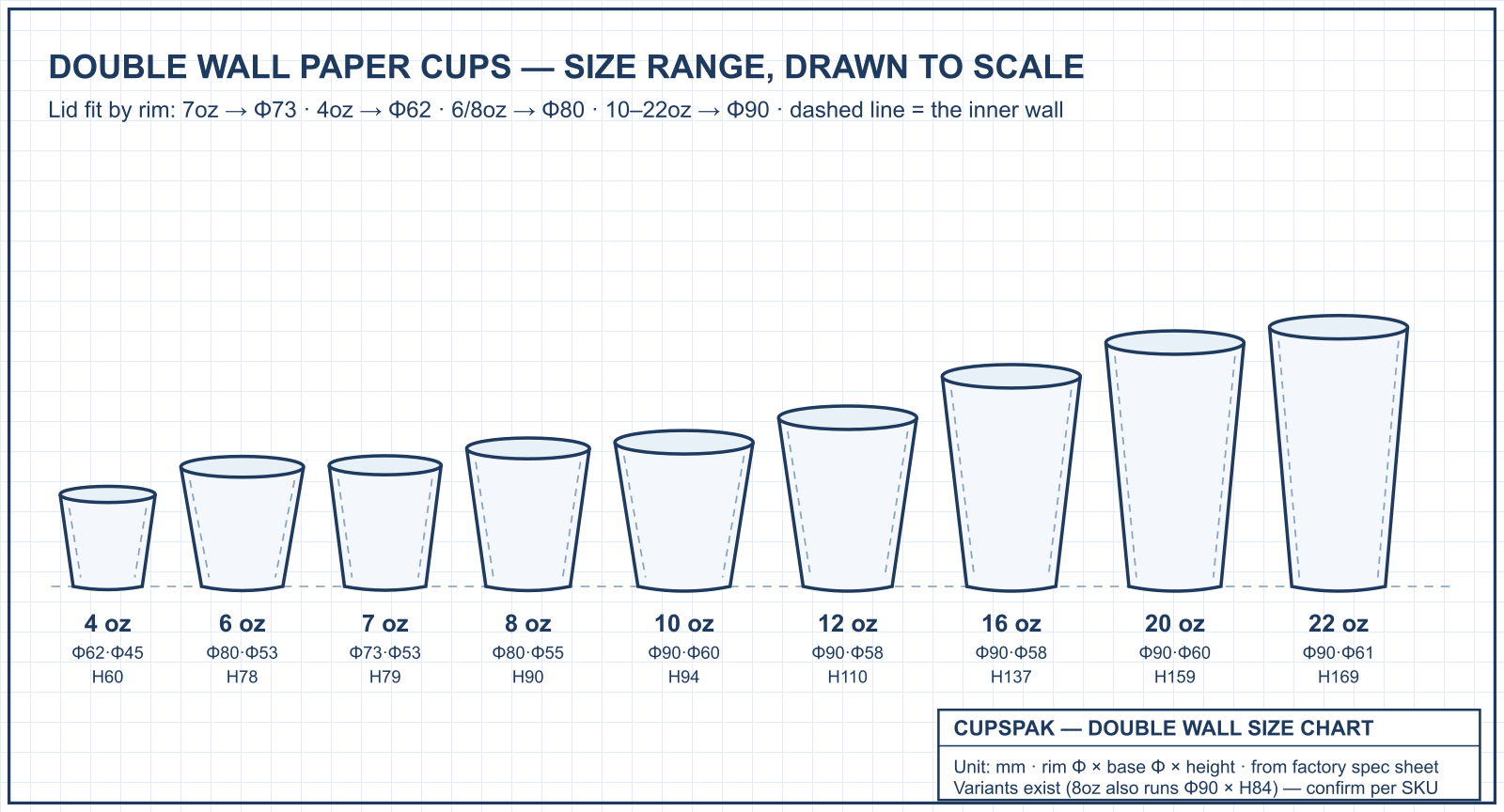
The double wall range runs 7 sizes from 6oz to 22oz, in white and kraft board, which covers everything from a cortado to a large drive-through drip. Custom printing is flexographic, up to 7 colors including full 360° wraps, with Pantone spot matching.
Coatings follow the same three-way choice as the rest of the paper cup range:
- PE lamination, the default: lowest cost, proven waterproof barrier, available in the 16/18/20g weights discussed above.
- PLA, plant-based and industrially compostable, adding roughly 8 to 15% to the cup price. Note standard PLA softens above 55°C, so confirm the right grade for hot service.
- Aqueous (water-based) coating, no plastic film and recyclable in ordinary paper streams, typically about 15% over a like-for-like PE cup. Dimensions and tooling are identical to the PE version, so switching later doesn’t change your lids or your artwork dielines. The full switching math is in our aqueous coated paper cups guide.
If sustainability messaging is part of why you are upgrading cups anyway, price the aqueous double wall alongside the PE build from the start: quoting both costs you nothing and gives you a real number instead of a guess.
What are the MOQ, samples, and lead times?
Double wall paper cups carry a MOQ of 20,000 pieces per size, which is one production run per SKU. Free stock samples are available so you can feel the standard builds in hand before committing, the samples are free, you cover the shipping, and they arrive in 7 to 10 business days.
The working timeline, once you move: quotes come back within 24 hours, a digital artwork proof follows within 3 business days, and standard production runs 25 to 30 business days after approval and deposit. Build the sample step into that schedule rather than skipping it: a week spent holding the actual cup is cheaper than 20,000 pieces of the wrong GSM. The full range, with dimensions and case packs, is in the product catalog.
Frequently Asked Questions
Do double wall paper cups need sleeves?
No. The air gap between the two walls is the insulation: that is the entire point of the construction. A double wall cup serves a 90°C drink comfortably with no sleeve, no double-cupping, and no extra assembly step at the counter. If you find yourself sleeving double wall cups, you are paying for insulation twice.
What GSM should an 8oz double wall paper cup be?
There is no standard answer, which is exactly why you must ask. The CupsPak standard 8oz build is a 250g inner wall + 280g outer wall + 18g PE lamination; market builds range from lighter 230+250 constructions to heavier 280+300 ones. Any of these can be sold as “8oz double wall,” so get the board weights in writing and judge the quote against the spec, not the size name.
Which insulates better: double wall or ripple wall?
Both insulate well; the practical difference for most programs is look and print, not temperature. Ripple wall adds a corrugated outer texture that reads craft and grips well, while smooth double wall takes fine multi-color artwork far better. Our three-way wall comparison covers the full decision.
What is the MOQ for custom printed double wall cups?
20,000 pieces per size, with flexo printing up to 7 colors including full-wrap designs. Each size is its own SKU with its own MOQ. Free stock samples (buyer covers shipping) let you check the build quality first, and custom orders get a digital proof within 3 business days.
Can double wall cups take an aqueous coating?
Yes. Aqueous-coated double wall cups carry no plastic film and recycle in standard paper streams, at typically ~15% over the equivalent PE cup. Dimensions, dielines, and lid fit stay identical to the PE version, so it works as a drop-in switch for existing programs.
Get the spec, then get the samples
The whole lesson of this guide fits in one sentence: buy the board, not the oz. Before your next order, do two things. First, request free stock samples of the standard double wall builds: weigh them, squeeze them, pour something hot in one, and let the cup argue its own case. Second, when you request a quote, ask for the inner GSM, outer GSM, and lamination weight in writing. It is one extra line in an email, and it is the difference between comparing cups and comparing four-word descriptions.
Ready to Source Eco-Friendly Paper Cups?
Request a free sample pack or get a wholesale quote tailored to your requirements.