
Austin — Product Manager · Reviewed by Henry, Head of Marketing
August 29, 2026 · 10 min read
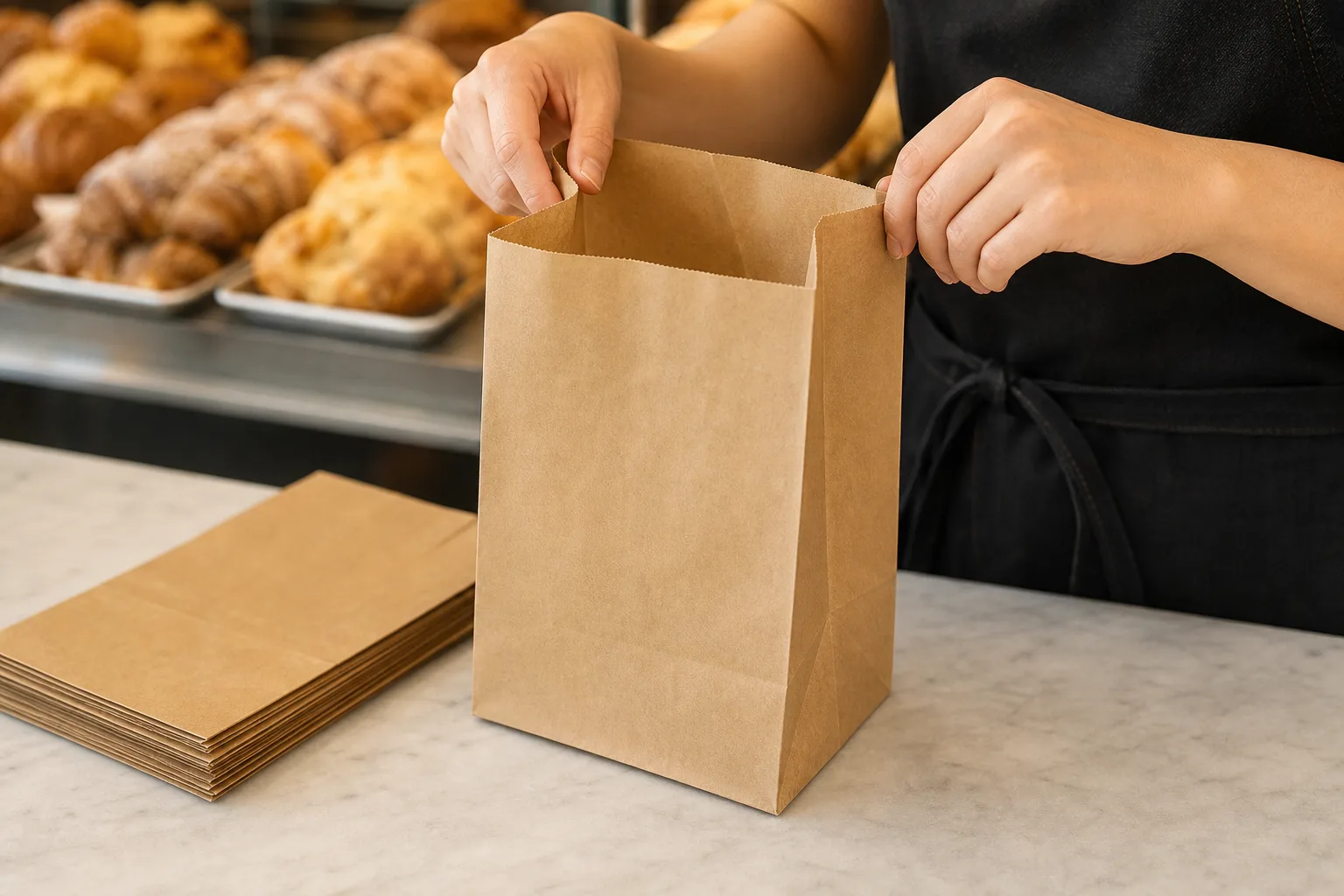
SOS stands for self-opening square. It is a flat-bottom paper bag that snaps open with one hand and then stands up on its own, and it is the bag under almost every takeaway counter you have ever used.
The name describes the trick. Grip the top, flick the bag, and the pre-creased base squares itself into a rectangle. No second hand, no shaking it open, no holding it while someone loads it. At a counter doing 300 covers at lunch, that one-handed action is the entire reason the format exists.
Here is what separates it from the other paper bag structures, and what to specify when you order one.
What Makes a Bag “SOS”
Three features, all in the base.
A pre-formed square bottom. The base panel is scored and folded so it opens into a flat rectangle rather than a point. That is what makes it stand.
Side gussets that fold flat. The bag ships flat for shipping and storage, then expands into a box shape in use. You are not paying to ship air.
No handles, usually. The classic SOS is handle-free. Add handles and you are into carrier-bag territory, which is a different structure with a different price.
Everything else, the paper weight, the colour, the print, the window, is a variable on top. The self-opening square base is the definition.
SOS Versus the Other Structures
Five paper bag structures cover the market. Picking the wrong one is the most common mistake in this category, and it is usually a mismatch between how the bag is loaded and how the bag opens.
| Structure | Stands up empty | Loaded with | Best for |
|---|---|---|---|
| SOS / flat bottom | Yes | One hand, at speed | Bakery, takeaway counters, deli |
| Gusseted (side fold) | No | Two hands or hung | Bread, produce, bulk items |
| Flat / merchandise | No | Slid in flat | Documents, single flat items |
| Carrier with handles | Yes | Handed to the customer | Retail, boutique, gift |
| Block bottom with window | Yes | One hand | Coffee, snacks, where the product sells itself |
The blunt verdict: if a member of staff loads the bag while doing something else with their other hand, you want SOS. If the customer carries it any distance, you want handles, and that is a different bag. See grocery paper bags for how to specify one that survives being carried full.
What the Paper Weight Actually Changes
Paper for these bags typically runs 50 to 200 g/m², and the number does more than describe thickness.
50 to 70 g/m² is light. Fine for a pastry, a bread roll, a single item handed straight over. It creases easily and it will not survive a heavy load.
80 to 120 g/m² is the working range for most takeaway and bakery counters. Enough body to stand reliably, cheap enough to use in volume.
140 to 200 g/m² is for weight and for appearance. A bag that carries a full meal, or one where the paper itself is part of the brand impression.
Going heavier is not automatically better. A 200 g/m² bag under a croissant is money spent on stiffness nobody notices, and it costs you on every unit for the life of the programme.
Kraft or White, and What Printing Does to Each
Brown natural kraft and white kraft are the two base papers, and the choice is mostly about how your artwork will land.
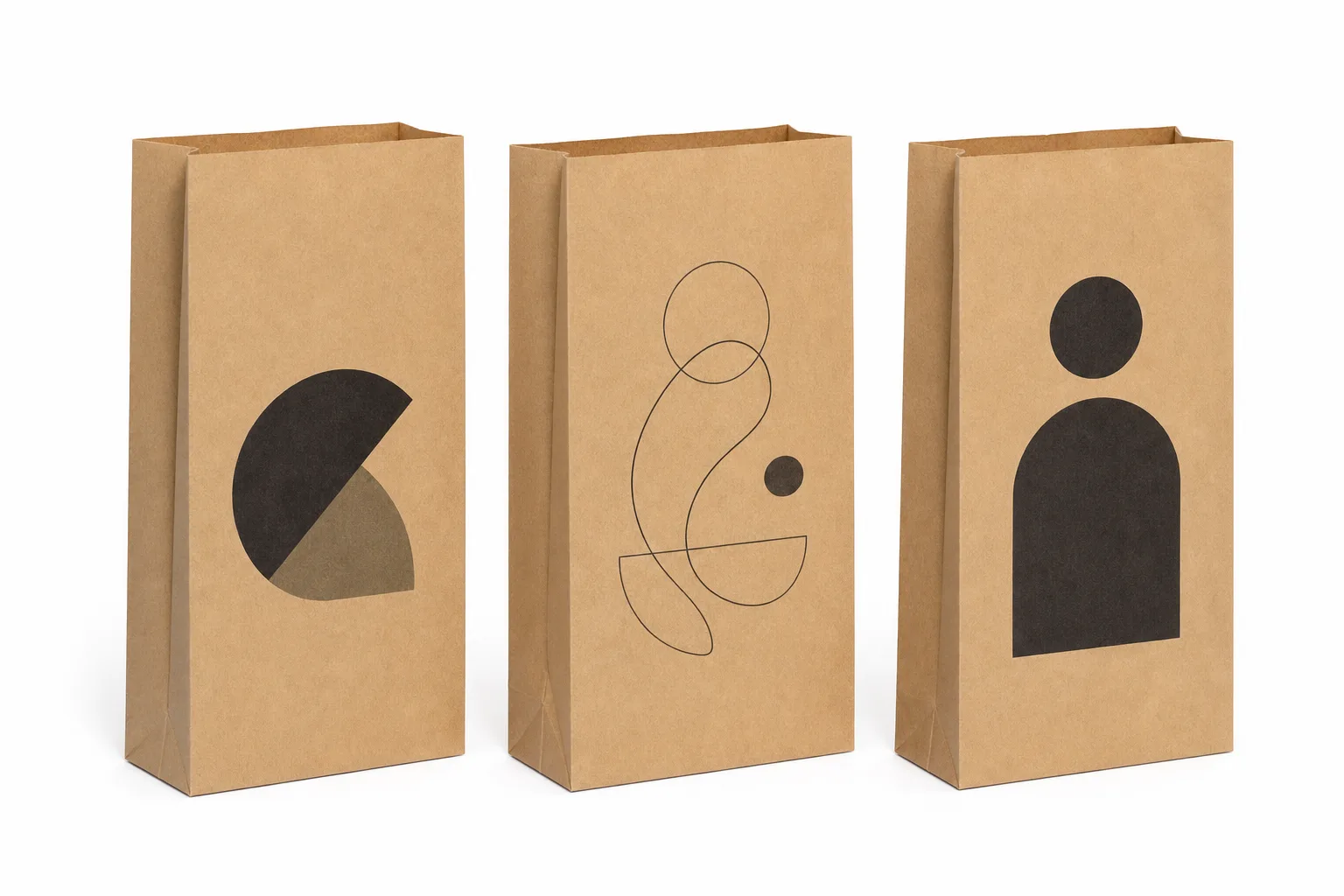
On brown kraft, every colour shifts. The paper is a mid-tone warm brown, so inks print over it rather than onto a neutral ground. Dark colours hold up. Pale colours and anything relying on white will not read, because there is no white ink laying down a base in standard flexo. A design that looks crisp on screen can arrive muted.
On white kraft, colours reproduce closest to what your designer intended. It is the choice when brand colours have to be exact.
The practical rule: design for brown kraft from the start if brown is what you want, rather than designing on white and hoping it translates. Ask for a printed sample on the actual paper before the run, not a digital proof on screen.
Printing runs to up to 7 colours in flexo. Each colour is a plate, and plates are a fixed cost spread across the run, which is why a seven-colour design on a small order makes very little sense. The kraft paper bag guide covers the paper grades in more depth, and the wider range sits under bags and accessories.
Greaseproof, Windows and the Other Variables
Grease resistance. A plain bag under a buttery pastry will show through and eventually mark a customer’s hands. The same barrier question runs through deli paper and wraps, which sit on the same counter. If fat is involved, ask for a greaseproof specification and be specific about what goes inside, because a croissant and a portion of fried chicken are not the same test.
Windows. A film panel lets the product sell itself, which works well for bakery. It also means the bag is no longer plain paper, which changes the disposal conversation and, in some markets, the paperwork. Worth knowing before you print a claim next to it.
Handles. Adding them changes the structure and the cost. Twisted paper handles and flat paper handles behave differently under load; flat ones are cheaper, twisted ones carry more.
Food contact. If food touches the bag directly, the specification needs to say so, and the documentation should come with the order rather than after a customer asks.
How an SOS Bag Is Actually Made
Understanding the process explains most of the specification decisions, and it takes two minutes.
The bag starts as a reel of kraft, not as sheets. That reel is printed first, while the paper is still flat and moving at speed, which is why flexo is the process and why each colour needs its own plate on the press.
The printed web is then formed into a tube, glued down one side, and that side seam runs the full height of the bag. Look at any takeaway bag and you will find it, usually toward the back. It is the strongest constraint on your artwork: a design that has to line up across that seam is asking the press to hit a tolerance it will not reliably hit, which is why most bag artwork either keeps the seam in plain background or accepts a visible join.
The base is then scored, folded and glued into the square that gives the format its name. That base is a stack of folded layers rather than a single thickness, which is why the bottom of an SOS bag is stiffer than its walls and why it stands.
Two things follow from this that affect what you order:
Artwork near the base folds is risky. The base is where the paper takes the most creasing. Fine detail placed there can crack along a fold.
The bag ships flat. Because it collapses, freight is charged on a much smaller volume than the assembled bag suggests. This is one of the few packaging formats where shipping does not punish you for buying a large size.
Where SOS Bags Fail, and Why
Four failure modes cover almost every complaint in this category.
The base blows out under weight. Almost always a paper weight problem rather than a construction one. A 70 g/m² bag under a full lunch order is being asked to do a 120 g/m² job.
Grease shows through. Plain kraft under fat, with no greaseproof specification. It looks like a quality problem and it is a specification problem.
The bag will not snap open cleanly. Usually humidity. Kraft absorbs moisture from the air, and a pallet stored in a damp back room loses some of the crispness the base creases depend on. Store bags dry and off the floor.
The print looks nothing like the proof. Brown kraft again, and a design that was approved on a white screen. A printed sample on the actual paper is the only fix, and it should happen before the run rather than after.
None of these are exotic. All four are decided at the quoting stage, which is the point of asking about them then.
What Drives the Price
Bags are cheap per unit and the variables are few, which makes the cost structure unusually easy to read.
| Lever | Effect | Worth knowing |
|---|---|---|
| Paper weight | Direct, roughly proportional | The most common place buyers overspend |
| Print colours | A plate per colour, fixed cost spread over the run | A 7-colour design on 10,000 bags is still mostly plate cost |
| Greaseproof | Adds cost per unit | Only specify it where fat is genuinely involved |
| Handles | Changes the structure, not just a fitting | The step from SOS to carrier is a real price step |
| Window | Adds a material and a step | Also changes the disposal story |
| Quantity | From 10,000 per size, improving above it | Per size, not per order |
The reorder is where the economics improve. With plates already made and the specification unchanged, a repeat run skips the plate cost and the proofing cycle entirely. If you expect to reorder, it is worth getting the first specification right rather than treating it as a trial you will revise.
Sizing an SOS Bag Without Guessing
Bags are specified as width × gusset × height, in that order, and the gusset is the number most often misread.
Width is the front panel. Gusset is the depth when the bag is open, so it is the dimension that decides whether a box, a container or a wrapped sandwich actually fits. Height is the front panel from base to top edge.
Two ways to get it right:
Measure what goes in it. Take the largest item, add a little clearance, and match the gusset to its depth first. Most sizing mistakes are a gusset too shallow for the container going in.
Take a bag you already use and measure that. Flatten it, measure across the front, then open it and measure the base depth. This is faster than reading a catalogue and it removes the risk of comparing two suppliers who describe the same bag differently.
Quantities and What to Expect
Paper bags carry the lowest entry quantity in our range: from 10,000 pieces per size. That is genuinely reachable for a single site, which is why bags are usually the first item an independent operator prints their own design on.
The quantity is per size and per specification, not per order. Two sizes is two lots. Mixed sizes can generally be combined toward a container, but each size has to clear its own minimum.
Before you place it, settle these:
- Width × gusset × height, taken from the item that goes inside
- Paper weight, and whether greaseproof is needed
- Brown or white kraft, with a printed sample on the actual paper
- Number of print colours, knowing each one is a plate
- Handles or not, since that changes the structure
- Whether food touches the bag, and what documentation comes with it
The Disposal Question, Answered Without Overclaiming
Paper bags are the format where sustainability copy gets loosest, so it is worth being precise about what is actually true of an SOS bag.
A plain, unprinted, uncoated kraft bag is just paper. No barrier layer, no film, no plastic component. It goes with paper, and that is a genuinely simple story compared with almost anything else in disposable packaging.
Four things complicate it, and every one of them is a specification you chose:
A window. The film panel is not paper. A bag with a window is a mixed-material item and the window has to come out for the paper to go in the paper stream, which in practice means it usually does not.
A greaseproof treatment. Depending on the treatment, this can change how the bag is handled at end of life, and it is worth asking what the treatment actually is rather than accepting “greaseproof” as a complete answer.
Heavy ink coverage. A bag printed edge to edge in seven colours is still recyclable, but the more coverage there is the more the conversation shifts, and some buyers prefer lighter coverage for that reason alone.
Handles and reinforcement. Paper handles keep it simple. Anything else does not.
The honest position: if the disposal story is the reason you are choosing paper, the bag that delivers it best is plain kraft with modest print and no window. Every feature you add is a trade against that, and they are all reasonable trades to make as long as nobody pretends the trade did not happen.
One thing we will not do is put a compostability or recyclability badge on a bag as a blanket claim. What a given market accepts varies, and a badge that is true in one place and misleading in another is worse than no badge.
Who Actually Uses This Format
SOS turns up wherever speed of service and standing-up-on-a-counter both matter.
Bakeries are the classic case. One-handed loading, a bag that stands while it is filled, and a format that has been the counter standard long enough that customers do not think about it.
Delis and sandwich counters for the same reason, usually a size up and often with a greaseproof specification.
Takeaway and delivery kitchens use the larger sizes with handles added, at which point it becomes a carrier, but the base structure is the same.
Coffee shops use small SOS bags for pastries alongside the drink, and this is the size where a printed design gets seen most often relative to what it costs.
Retail and market stalls where produce or dry goods are weighed and bagged at speed.
What these have in common is a person behind a counter doing the loading. Where the customer does the loading, as in self-service, the format matters much less and cheaper structures usually win.
Frequently Asked Questions
What does SOS stand for on a paper bag?
Self-opening square. The base is pre-creased so the bag squares itself and stands upright when you snap it open with one hand, without needing to be held or shaken open.
What is the difference between an SOS bag and a flat-bottom bag?
They are the same thing. SOS is the trade term, flat bottom describes the base. Some suppliers use one and some the other, which occasionally makes two identical quotes look like two different products.
Are SOS bags greaseproof?
Not by default. Plain kraft will mark under fat. Greaseproof is a specification you ask for, and it should be matched to what actually goes in the bag, since a pastry and fried food place very different demands on it.
What is the minimum order for custom printed SOS bags?
From 10,000 pieces per size. That applies per size and per design, so two sizes are planned as two lots. It is the lowest entry quantity across our range, which is why bags are usually where an independent operator starts with custom print.
How do I measure an SOS bag?
Width × gusset × height. Width is the front panel, gusset is the base depth when the bag is open, height is front panel top to bottom. The gusset is the one people misread, and it is the dimension that decides whether your container fits.
Can SOS bags have handles?
They can, but adding handles changes the structure and the price, and at that point you are specifying a carrier bag rather than a classic SOS. If the customer carries it any real distance, that is the right call anyway.
Not sure whether your counter needs SOS or a carrier? Tell us what goes in the bag and who carries it, and we will tell you which structure fits and what size to run. Free stock samples ship in 3 to 5 business days, and the full range is on the paper bags page.
Ready to Source Eco-Friendly Paper Cups?
Request a free sample pack or get a wholesale quote tailored to your requirements.