
Austin — Product Manager · Reviewed by Henry, Head of Marketing
August 4, 2026 · 12 min read
Kraft paper bags come in four working formats: handled carrier bags (120 to 250g paper), flat bottom SOS bags (50 to 100g), PE-lined gusseted bags for greasy or moist food, and eight-side seal bags for premium retail. Picking the right one comes down to three specs: what the bag carries, how heavy that load is, and whether food touches the paper directly. Get those three right and everything else (handle type, print, size) falls into place.
This guide walks through each format, the paper weight (GSM) logic behind load capacity, the three handle types and when each earns its cost, and the food-grade lining decision that most buyers only think about after the first grease stain complaint.
Which kraft paper bag format do you actually need?
The short answer: carrier bags for anything handed over a counter with weight in it, SOS bags for fast single-serve filling, PE-lined bags for greasy food, and eight-side seal bags for products that sit on a shelf. Most programs need two of the four. Very few need only one, and buyers who force a single format into every job end up either overpaying (heavy carriers for pastries) or underdelivering (bare SOS bags for fried chicken).
Here is the full map before we go format by format:
| Format | Paper weight | Handles | Best for |
|---|---|---|---|
| Carrier bags | 120-250g | Twisted, flat, or die-cut | Retail purchases, multi-item takeout, delivery orders |
| Flat bottom (SOS) bags | 50-100g | None | Bakery items, sandwiches, single-serve counter orders |
| PE-lined gusseted bags | Kraft outer + food-grade PE inner film | None | Fried food, pastries with butter, moist or saucy items |
| Eight-side seal bags | Laminated multi-layer construction | None | Products sold by the pack on a retail shelf rather than served over a counter |
Carrier bags: the workhorse with handles
A kraft paper carrier bag is the format most people picture: flat or gusseted body, a handle at the top, your logo on the front. It runs on 120 to 250g paper, which is 2 to 3 times heavier than a lunch-style bag, and that weight is what lets it take real load without the sides going soft.
Carrier bags come in kraft brown, white, or custom colors, and the front and back panels give you the widest print area of any bag format. This is the bag your delivery order arrives in, the bag a boutique hands over, and the bag that gets reused as a gift bag if the print is good enough. Orders run from 10,000 pieces per size on the paper bags line.
The one decision that separates a good carrier order from a bad one is not size or color. It’s matching the paper weight and handle type to the actual load, which is why those two topics each get their own section below.
Flat bottom (SOS) bags: built for filling speed
SOS stands for self-opening satchel. Flick the bag open and the square base pops out and locks flat, so the bag stands upright on its own while staff fill it. That one mechanical trick is the whole point of the format: no second hand to hold the bag open, no bag tipping over mid-fill, no lost seconds during a lunch rush.
SOS bags run lighter than carriers (50 to 100g paper) because they carry a sandwich or two pastries, not a stacked order. They have gusseted sides, a square base, and no handles; the customer grips the rolled top or cradles the bag. SOS bags are ordered by size number rather than by dimension, and the range covers everything from a single cookie sleeve up to a family bread order. Ask for the current size list with internal width, gusset and height in mm before you order, because size numbering is not identical across suppliers.
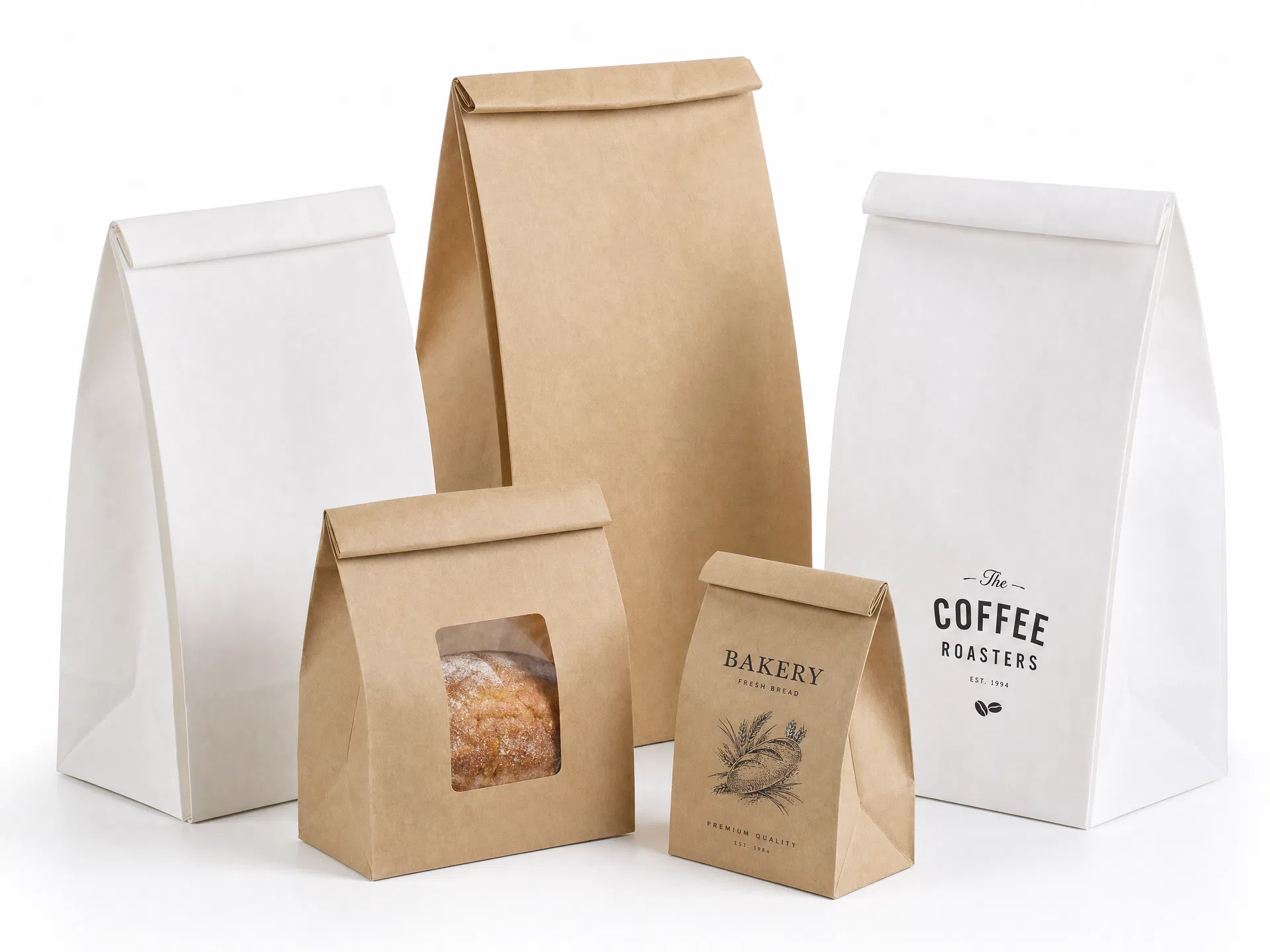
If you run a bakery counter, this is your default format, and it pairs naturally with the rest of a counter program, the same logic covered in our retail and bakery solutions overview. MOQ is 10,000 pieces per size.
PE-lined gusseted bags: when the food is the problem
Here’s what most first-time buyers learn the expensive way: kraft paper looks rustic and food-friendly, but bare paper wicks grease like a lamp wick. Put warm fried chicken, a buttery croissant, or anything with sauce into an unlined bag and you have a translucent grease bloom on the outside within minutes: right where your logo is.
PE-lined gusseted bags solve this with a food-grade PE inner film bonded to the kraft outer. The paper does the structure and the branding; the film does the barrier work. These bags carry documented food-contact compliance, so the paperwork question your food-safety auditor will ask is already answered. MOQ from 30,000 pieces — gusseted bags run on different tooling.
The blunt verdict: if the food is greasy or moist and touches the bag directly, the lined bag is not an upgrade: it’s the spec. The only alternative is wrapping the item first, which we cover in the food-safety section below.
Eight-side seal bags: the premium retail format
Eight-side seal bags are the flat-bottom, stand-up format you see holding coffee beans and premium snacks on retail shelves. The name comes from the sealed edges around the base and side gussets, which produce a bag that stands rigidly upright on a shelf instead of slumping, and which gives you printable area on the front, back and both side panels rather than just two faces.
This is a shelf-presence format, not a counter format. If your product is sold by the pack rather than served over a counter, and it needs to look deliberate next to established brands, this is where the eight-side seal earns its premium over a simple gusseted pouch. For most food service operators it’s the fourth bag they add, not the first.
What paper weight (GSM) do kraft paper bags need?
The short answer: weigh the heaviest realistic order, then buy the GSM that carries it, not the GSM that looks right in a mockup. GSM (grams per square meter) is the single number that determines whether a bag handles its load or fails at the handle joint halfway to the car.
Here’s the insider pattern: across hundreds of client orders, almost nobody underspecs bag size, but underspec’d GSM shows up constantly, because on a screen, a 120g bag and a 250g bag look identical. The difference only appears when the bag is loaded.
The working logic runs like this:
- 50 to 80g: light SOS territory. One sandwich, a couple of pastries, a bread roll order. The bag is a single-trip container, not a carrier.
- 90 to 100g: the heavy end of SOS. Larger bakery orders, a boxed slice plus a drink-adjacent item, denser single-serve loads.
- 120 to 150g: the light-bag tier, usually run on refined kraft, white kraft, or Finnish board. Light retail purchases, pastry boxes, single-meal orders (loads of roughly 1 to 3 kg).
- 160 to 200g: the mainstay takeout and delivery carrier, typically on Russian or American kraft liner. Multi-item meal orders, mixed retail baskets (loads around 3 to 5 kg).
- 200 to 250g: the heavy-load end. Bottles, jars, multi-meal delivery stacks; American and Russian kraft liner carries roughly 5 to 7 kg here, while refined kraft and Finnish board top out around 5 kg at the same weight. That last detail is the insider point: the board type matters as much as the GSM. Two 220g bags from different furnish stocks do not carry the same load.
Two practical rules make this table useful. First, spec for the heaviest order, not the average one: the bag that fails is always carrying the Friday-night family order, and one dropped order costs more in refunds and reviews than the GSM upgrade costs across a thousand bags. Second, weight-test with real product before approving bulk: load a sample bag with your actual heaviest order and carry it 50 meters. Free stock samples are available for exactly this (buyer covers shipping): request them via the sample request page.
One more thing worth knowing: moving up a GSM tier typically changes the per-bag price less than buyers expect, because paper is only one component of the bag’s cost: handles, print, and converting stay the same. When in doubt between two weights, the heavier one is rarely the expensive mistake.
Twisted, flat, or die-cut handles: which is right for your bags?
The short answer: twisted rope for premium feel and heavier loads, flat paper for economical everyday carry, die-cut for light loads at the lowest cost. Handle type is the second-biggest driver of both cost and perceived quality after GSM, and unlike GSM, it’s visible from across the street.
| Handle type | How it’s made | Load character | Cost & logistics | Best for |
|---|---|---|---|---|
| Twisted rope | Paper cord twisted into a rope, glued under a reinforcing patch | Highest of the three | Highest handle cost; bags stack with handles up | Boutique retail, restaurant delivery, gift-grade bags |
| Flat paper | Folded flat paper strip, glued internally | Solid mid-range | Economical; bags fold fully flat for storage | Everyday takeout, grocery, high-volume programs |
| Die-cut | Oval punched directly through the reinforced top fold | Light loads only | Lowest cost: no handle component at all | Apparel, pharmacy, light retail |
Twisted handles: the premium default
A twisted handle is paper cord twisted into a rope and glued under a reinforcing patch inside the bag. It reads as premium the moment a customer takes it, and it carries more load than the other two types because the rope distributes pull across the patch rather than a fold line. If your bag doubles as a walking advertisement (restaurant delivery, boutique retail), this is the handle that matches a 180 to 200g body.
Flat handles: the economical workhorse
A flat handle is a folded paper strip glued inside the bag rim. It costs less than twisted, carries respectable mid-range loads, and has one logistical advantage nobody mentions until they’ve stored 20,000 bags in a back room: flat-handle bags fold completely flat, so they stack denser in storage and ship tighter. All-paper construction also keeps the recycling story simple: one material, one stream. For high-volume takeout at 150 to 170g, this is the sensible default.
Die-cut handles: minimum cost, minimum load
A die-cut handle isn’t a handle component at all: it’s an oval punched through a reinforced double fold at the top of the bag. No cord, no strip, no glue joint, which makes it the cheapest option and the most space-efficient. The trade-off is direct: all the load rides on a paper edge, so die-cut is for light loads only: a t-shirt, a prescription, a greeting card.
The blunt verdict: put twisted handles on any bag a customer keeps, flat handles on any bag a customer carries daily, and die-cut handles only on bags that carry less than the paper costs to upgrade.
Are kraft paper bags safe for direct food contact?
The short answer: plain kraft paper is fine for dry, quick-contact food, but anything greasy, moist, or hot needs either a PE-lined bag or a wrapped item inside a standard bag. The bag material question and the food-contact question are separate specs, and conflating them is the most common food-service bag mistake we see.
Think of it as a two-layer decision:
- Dry goods, short contact: bread, whole pastries in a sleeve, boxed items. A plain kraft SOS or carrier bag handles this directly. The contact time is minutes and there’s no oil migration to fight.
- Greasy, saucy, or moist food: fried items, buttered pastries, dressed sandwiches, anything hot enough to steam. Here you need a barrier, and you have two clean ways to get one.
The first is the PE-lined gusseted bag: food-grade PE film on the inside, kraft on the outside, documented food-contact compliance on file. This is the right answer when the food goes into the bag loose and the bag is the only packaging.
The second is the wrap-then-bag approach: wrap the item in deli paper and drop it into a standard kraft bag. The deli sheet takes the grease hit, the bag stays clean and printable, and you get an unwrap moment at the customer’s end. Most takeout programs land on this combination (wrapped items plus a flat-handle carrier) because one lined SKU per food type gets expensive fast, while one deli paper spec covers everything. The full pairing logic is laid out in our food delivery and takeout solutions overview.
What suppliers don’t always volunteer: “food-grade paper” claims on unlined bags deserve scrutiny. Food-grade describes the paper’s composition, not its barrier performance: a food-grade unlined bag will still show grease-through with oily food. Ask for the food-contact documentation and ask specifically what the lining is. If the answer to the second question is “there isn’t one,” the bag is for dry goods, whatever the listing says.
Why custom printed kraft bags are the cheapest branding you’ll buy
The short answer: a printed carrier bag is a mobile ad your customer carries through the street, at a marginal cost of cents over a plain bag. No other branding surface you buy gets voluntarily displayed by the customer, at their expense, on their commute.
The kraft format is unusually print-friendly. Carrier bags offer a wide front and back print area (effectively two poster faces per bag) and the kraft brown base has become its own design language: one or two ink colors on brown paper reads as premium and eco-conscious simultaneously, which is a trick almost no other substrate pulls off. White bags flip the logic, giving full-color artwork a clean base when the brand palette demands it.
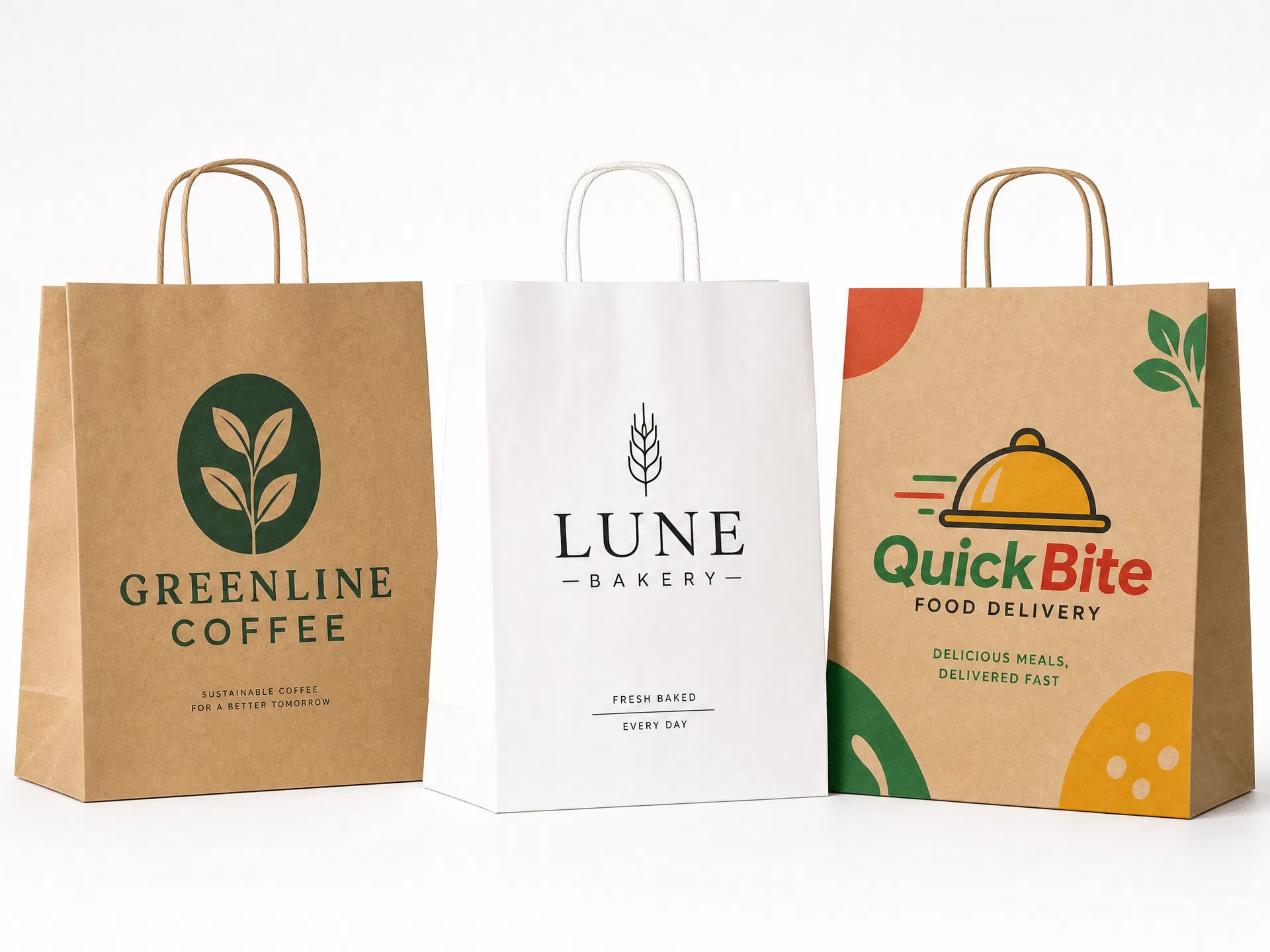
The same format, three print approaches. The two-color mark on brown holds up; the fine serif needed a white bag to stay legible.
Three practical notes from the production side:
- Simple art wins on kraft. Brown paper mutes and warms ink colors, so a bold one-color or two-color mark outperforms a delicate full-color design on the brown base. Save photographic art for white bags.
- Both faces are paid for: use both. The back panel is where the second message goes: a tagline, a QR code, a reorder prompt. Across hundreds of client orders, the back panel is the most commonly wasted print real estate.
- Proof before volume. Every order gets a digital artwork proof within 3 business days, so the design conversation happens before a single bag is converted, not after.
Custom print starts at the same 10,000 pieces per size as plain bags on the paper bags line. If you’re building a full program (bags plus cups plus wraps in one visual system), the catalog shows the whole printable range in one place.
Your kraft bag ordering checklist
Copy this into your RFQ and you’ll skip two rounds of back-and-forth:
- Format: carrier / SOS flat bottom / PE-lined gusseted / eight-side seal; one line per format, don’t mix specs
- Paper weight: state GSM explicitly (e.g., “160g”), not just “heavy duty”
- Handle type: twisted / flat / die-cut, or “none” for SOS and lined bags
- Size: give internal dimensions W × gusset × H in mm, or the SOS size number
- Color: kraft brown / white / custom
- Food contact: state what food goes in and whether it’s greasy or moist; let the lining recommendation come back to you
- Print: number of colors, faces printed (front / front+back), artwork format ready or design help needed
- Quantity: pieces per size (from 10,000 per size)
- Timeline check: quote within 24 hours, digital proof in 3 business days, production 15 to 25 business days after approval: work backward from your launch date
- Samples: request free stock samples first (buyer covers shipping) and weight-test with real product
Frequently Asked Questions
What GSM do I need for kraft paper bags?
Match GSM to the heaviest realistic load. Light SOS bags run 50 to 100g for single-serve counter items; carrier bags run 120 to 250g: the 120 to 150g tier carries roughly 1 to 3 kg, 160 to 200g on Russian or American kraft handles 3 to 5 kg, and 200 to 250g reaches 5 to 7 kg on American/Russian kraft (refined kraft and Finnish board top out near 5 kg at the same weight). When you’re between two weights, take the heavier one: a failed handle costs more than the paper upgrade.
Should I choose twisted or flat handles?
Choose twisted handles for premium presentation and heavier loads: the rope-and-patch construction carries more and reads as gift-grade. Choose flat handles for everyday takeout and high-volume programs: they cost less, carry solid mid-range loads, and fold completely flat for denser storage and shipping. Die-cut handles are the third option, for light loads at minimum cost.
Are kraft paper bags food safe?
Plain kraft bags are fine for dry, short-contact food like bread and boxed items. Greasy or moist food needs a barrier: either a PE-lined bag with food-grade inner film and documented food-contact compliance, or the item wrapped in deli paper inside a standard bag. Bare kraft paper is not a grease barrier, whatever the listing claims.
What is the minimum order quantity for custom paper bags?
MOQ starts at 10,000 pieces per size for carrier bags and flat bottom SOS bags, and 30,000 for PE-lined gusseted and eight-side seal bags, which run on different tooling: the same threshold for plain and custom-printed runs. Quotes come back within 24 hours, digital artwork proofs in 3 business days, and production runs 15 to 25 business days after approval.
What does SOS mean in paper bags?
SOS stands for self-opening satchel. The bag has a square base and gusseted sides folded so that one flick pops the base open and the bag stands upright on its own. That self-standing base is why SOS bags dominate bakery and counter service: staff fill them one-handed at speed. Sizes run No. 2 through No. 16.
Get bag samples in your hands before you commit
Paper weight and handle feel are exactly the specs a screen can’t show you. Request free stock samples (buyer covers shipping) through the sample request page, load them with your actual heaviest order, and see which GSM and handle combination holds up. If you’d rather start with a conversation, send your bag list and you’ll have a quote within 24 hours.
Ready to Source Eco-Friendly Paper Cups?
Request a free sample pack or get a wholesale quote tailored to your requirements.