Austin — Product Manager · Reviewed by Henry, Head of Marketing
August 29, 2026 · 12 min read
A grocery bag has one job that most paper bags do not: it has to survive being carried, full, by a person who is not being careful with it.
That single requirement drives every specification decision below. Paper weight, handle type, base construction and where the load actually sits are not independent choices, and getting one wrong makes the others irrelevant. A beautifully printed bag that dumps a shop on the pavement is a worse outcome than a plain one that does not.
Where a Grocery Bag Actually Fails
Three failure points, and they are not equally likely.
The handle attachment, by a wide margin. Not the handle itself. The point where it joins the bag is carrying the entire load through a small glued area, and it is where nearly every real-world failure starts.
The base, under a point load. A tin or a bottle sitting on a corner concentrates weight where the folds meet. A flat, evenly-loaded base is much stronger than the same base with something heavy on one edge.
The side seam, when the bag is overfilled. Less common, and usually a symptom of the bag being the wrong size rather than the wrong specification.
The design consequence: if you are choosing between spending more on heavier paper and spending more on better handle attachment, the handles win. Heavier paper with the same weak attachment fails at the same point, just with more material around it.
Paper Weight: What Each Range Will Carry
Grocery bags sit at the heavier end of the paper bag range, typically 80 to 200 g/m².
80 to 100 g/m² handles a light shop. A few items, nothing dense. This is where a lot of bakery and boutique bags sit, and it is under-specified for a real grocery load.
110 to 150 g/m² is the working grocery range. Enough body for tins, bottles and mixed loads without paying for stiffness that goes unused.
160 to 200 g/m² is for heavy or premium. A full shop, or a bag where the paper itself is doing brand work and needs to feel substantial in the hand.
| Paper weight | Carries | Typical use | Handle to specify |
|---|---|---|---|
| 80 to 100 g/m² | A few light items | Bakery, boutique, single purchase | Flat paper |
| 110 to 130 g/m² | Mixed shop, some weight | Convenience, general grocery | Twisted paper |
| 140 to 160 g/m² | Tins, bottles, a full basket | Full-service grocery, delis | Twisted, reinforced |
| 170 to 200 g/m² | Heavy or premium presentation | Larger shops, brand-led retail | Twisted, reinforced |
There is a real cost of over-specifying here. Board weight is close to the largest single lever on unit price, and every gram you add is paid on every bag for the life of the programme. Match the weight to the heaviest realistic load, not to the heaviest imaginable one.
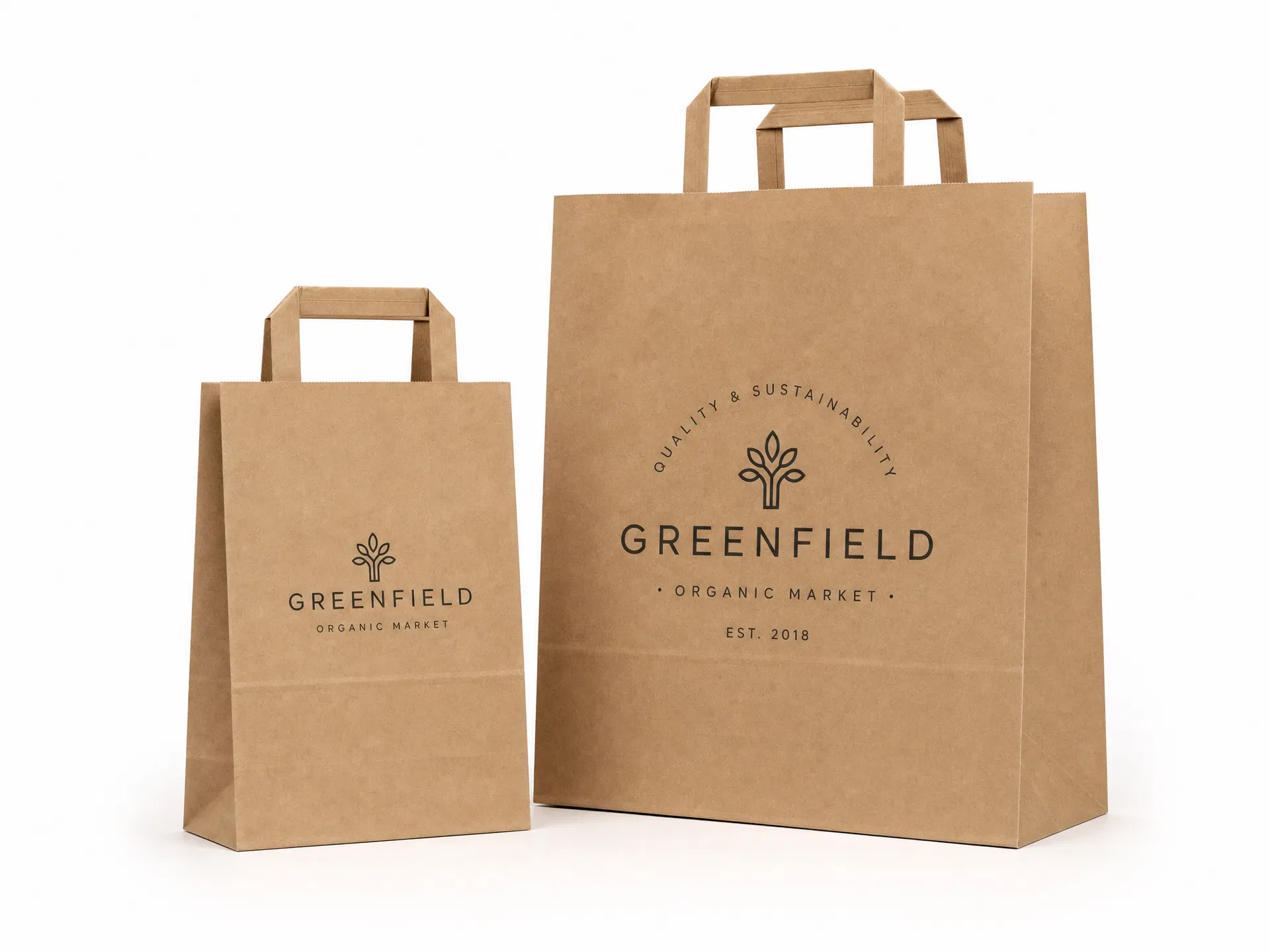
Twisted or Flat Handles, and Why It Matters More Than It Sounds
Two paper handle types dominate, and they are not interchangeable.
Twisted paper handles are rope-like, made by twisting paper into a cord. They carry more, they are more comfortable in the hand under weight, and they cost more. For anything grocery-weight, this is the default.
Flat paper handles are a folded strip. Cheaper, perfectly adequate for lighter loads, and less comfortable once the bag gets heavy because the load concentrates on a narrow edge against the fingers.
The comfort point is not a soft consideration. A handle that hurts gets carried differently, usually by grabbing the bag body instead, and that is how a bag that passed its load test fails in a car park.
Ask specifically how handles are attached, not just what they are made of. Attachment is where the strength is, and it is the part that varies most between suppliers quoting what looks like the same bag.
Sizing: Read the Gusset First
Bags are specified width × gusset × height. The gusset is the base depth when the bag is open, and it is the number that decides whether your goods fit.
For grocery, work from the awkward item rather than the average one. A two-litre bottle standing upright sets your height. A cereal box on its side sets your gusset. Most sizing complaints trace back to a gusset chosen to look proportionate on a spec sheet rather than measured against something real.
If the bag will be loaded at a counter rather than carried far, the handle-free SOS format is cheaper and faster to fill. A practical shortcut for sizing either one: take the bag you currently use, flatten it, measure the front panel width, then open it and measure the base depth. That gives you a comparable specification in two minutes and removes the risk of two suppliers describing the same bag with different conventions.
If you carry more than one size, keep the count low. Every size is its own minimum and its own stock line, and three sizes rarely serve customers better than two.
Kraft, White, and What Print Does to Each
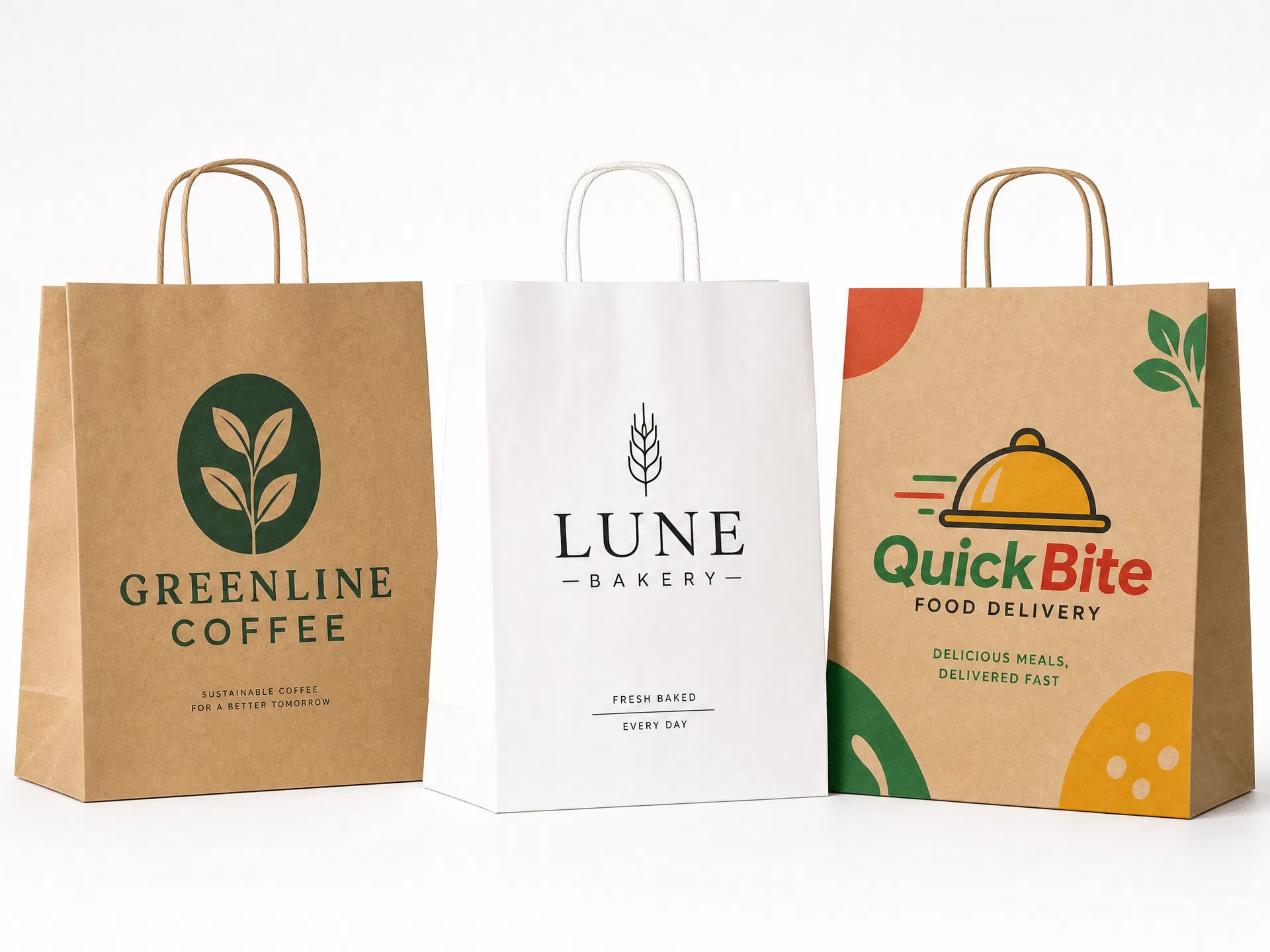
Brown natural kraft is the grocery default and the cheapest base. White kraft costs more and reproduces colour far more faithfully.
On brown kraft every colour sits over a warm mid-tone rather than a neutral white. Dark inks hold. Pale colours and anything depending on white will not read, because standard flexo lays no white base under the design. This surprises people every time, and the fix is not technical: design for brown from the start, and ask for a printed sample on the actual paper before the run.
The kraft paper bag guide goes deeper on paper grades and handle construction. Printing runs to up to 7 colours in flexo, one plate per colour. Plates are a fixed cost divided across the run, so the colour count matters far more at 5,000 bags than at 100,000. Two to four colours is where most grocery programmes land and it is rarely a visible compromise.
Sustainability Claims That Survive a Check
Grocery bags attract more environmental copy than any other format in this category, and a lot of it does not hold up. Here is what is defensible.
A plain kraft bag with paper handles is paper. No barrier layer, no film, no plastic component. That is a genuinely clean story and it is the strongest claim in the category, precisely because it is simple.
FSC-certified board is available on request. That is a supply-chain claim about the fibre, and it is checkable, which is what makes it worth having. Which documents exist for which article is listed on the certifications page.
Recycled content and recyclability are different claims. One is about what went in, the other about what happens after. Mixing them is the most common overreach in bag marketing.
Four things weaken the story, and each is a choice you made:
- A window introduces film and makes the bag mixed-material.
- A greaseproof treatment changes the end-of-life conversation, so ask what the treatment actually is.
- Non-paper handles break the single-material claim entirely.
- Very heavy ink coverage does not make a bag unrecyclable but it does shift the conversation.
What we will not do is put a blanket compostability or recyclability badge on a bag. Acceptance varies by market and a badge that is accurate in one place and misleading in another is worse than none. If a specific claim is needed for your market, tell us the market and we will tell you what can be evidenced.
Paper Against the Alternatives, Honestly
Grocery is the one category where paper is not automatically the answer, so it is worth naming what it loses on as well as what it wins on.
Against a reusable bag, paper loses on almost every environmental measure that matters, provided the reusable bag actually gets reused enough times. Anyone selling you single-use paper as the sustainable choice against a reusable is selling you the wrong comparison. Paper’s real competition is the single-use plastic bag it replaced, not a bag-for-life.
Against single-use plastic, paper wins on material story and on what happens if it escapes into the environment, and loses on wet strength and on carrying weight per gram of material. Those are real trade-offs, not marketing points.
Against a heavier reusable paper bag, the question is just how many trips you expect. A 200 g/m² bag with reinforced handles will survive several shops. Whether customers actually bring it back is a question about your customers, not your packaging.
Where paper is clearly the right call: a bag that will be carried once, over a short distance, where the material story matters to your customers and the load is predictable. That describes most grocery and convenience retail, which is why the format dominates there.
Where it is not: heavy loads carried a long way in wet weather, or anywhere the bag needs to survive a week in a car boot.
What Changes at the Counter
The specification is one thing; how the bag behaves in service is another, and staff notice the difference before customers do.
Opening speed. A flat-bottom bag snaps open one-handed. A bag that needs two hands slows a till queue, and at peak that is a real cost even though it never appears on a quote.
Storage footprint. Bags ship and store flat, so the volume is manageable, but 5,000 heavy-weight bags is still a pallet-scale item. Check where it goes before it arrives.
Damp storage kills them quietly. Kraft absorbs moisture from the air. A pallet in a damp back room loses stiffness in the base creases and the bags stop snapping open cleanly. This gets reported as a quality problem and is almost always a storage problem.
Double-bagging is a specification failure. If staff routinely double-bag, the paper weight is wrong. Two light bags cost more than one correct one and carry worse, because neither handle attachment is taking the load properly.
Two Sizes Beat Four
The instinct when specifying bags is to cover every eventuality with a size for each. It is almost always wrong, and it costs on three fronts at once.
Every size is its own minimum, its own stock line and its own thing for staff to choose between at a till. Four sizes means four lots of 5,000 sitting in a stockroom, and it means a decision at every transaction that slows service without improving it.
Two sizes cover most retail:
A small bag for one or two items, the kind of purchase a customer could almost carry in a hand. This is the high-frequency size and it should be the cheaper specification, because it is never carrying much.
A main bag sized to your most awkward realistic item and specified for the heaviest realistic load. This is where the paper weight and the twisted handles go.
If you genuinely need a third, make it larger rather than intermediate. A gap between small and main is easier for staff to work around than a gap above main, where the only alternative is double-bagging.
The exception is where a specific product forces it, such as a wine bottle or a long baguette. Those are a shape problem rather than a capacity problem and they deserve their own bag rather than an oversized general one.
What Goes on the Order
Grocery bags run from 5,000 pieces per size, the lowest entry quantity across our range. That is reachable for a single site, which is why bags are usually where an independent retailer prints their own design first.
The minimum is per size and per specification. Two sizes is two lots. Mixed sizes can generally be combined toward a container as long as each clears its own minimum.
Settle these six before you place it:
- Width × gusset × height, measured against your most awkward item
- Paper weight, matched to the heaviest realistic load
- Handle type and attachment method, with twisted as the default for grocery weight
- Brown or white kraft, with a printed sample on the actual paper
- Colour count, knowing each one is a plate
- Any claim you intend to print, and which market it has to hold up in
How to Test a Sample Properly
Free stock samples are the cheap part of this. Testing them badly is what costs money.
Load the bag with your actual worst case. Not a token weight. The tins, the bottle, the awkward box, arranged the way a customer would arrange them, which is to say badly.
Carry it, do not lift it. Failures happen during carrying, not during the first lift. Walk with it for a few minutes.
Test it damp. A bag that gets rained on, or that carries something from a chiller, behaves differently. Kraft loses strength when wet and this is a normal condition, not an edge case.
Test the handle at an angle. Customers do not carry bags vertically. Most handle failures happen with the bag swinging or pulled sideways.
If a bag passes all four, the specification is right. If it fails the damp test only, you may need a heavier weight rather than a different structure.
Frequently Asked Questions
What paper weight do I need for a grocery bag?
For a real grocery load, 110 to 150 g/m² is the working range. Below 100 is under-specified for tins and bottles. Above 160 is for heavy loads or where the paper is doing brand work, and it costs on every bag, so match it to the heaviest realistic load rather than the heaviest imaginable one.
Are twisted handles stronger than flat handles?
Yes, and they are more comfortable under weight, which matters more than it sounds. A flat handle concentrates the load on a narrow edge, and a handle that hurts gets carried by the bag body instead, which is how bags fail after passing a load test. For grocery weight, twisted is the default.
Where do paper bags usually fail?
At the handle attachment, by a wide margin. The join carries the entire load through a small glued area. The base under a point load is second, and the side seam a distant third. If you are choosing where to spend, spend on attachment before paper weight.
Can grocery paper bags be recycled?
A plain kraft bag with paper handles is just paper and goes with paper. A window, a greaseproof treatment or non-paper handles change that, because the bag stops being a single material. What any given programme accepts varies by market, which is why we do not print blanket badges.
What is the minimum order for custom printed grocery bags?
From 5,000 pieces per size, which is the lowest entry quantity in our range. It applies per size and per design, so two sizes are planned as two lots.
How do I know what size to order?
Measure your most awkward item rather than your average one, and get the gusset right first, since that is the base depth and the dimension people misread. Alternatively, flatten a bag you already use, measure the front panel and the base depth, and quote from that.
Not sure whether your load needs 120 or 150 g/m²? Tell us what goes in the bag and how far it gets carried, and we will tell you which specification holds, including when a lighter paper would do the same job. Free stock samples ship in 3 to 5 business days so you can load one and walk with it. The full range is on the paper bags page.
Ready to Source Eco-Friendly Paper Cups?
Request a free sample pack or get a wholesale quote tailored to your requirements.