
Austin — Product Manager · Reviewed by Henry, Head of Marketing
July 31, 2026 · 11 min read
Stock soup container sizes run 10 formats from 8 oz to 64 oz, and three of those ounce labels come in two completely different builds. The spec that decides your order is rim diameter in millimeters, not the ounce figure on the label. Those 10 sizes sit on five lid diameters, and one of the five covers four sizes by itself.
Get that diameter wrong and the bill arrives later: industry lid-fit guidance reports rim differences of 3mm to 5mm between suppliers on nominally identical volumes, which is how a reorder shows up with lids that will not seat on containers you already have. Ounces tell you what to print on the menu. Millimeters tell you what will actually close. Every dimension in the soup bowl range is below, in mm, along with the lid that fits it.
Soup Container Sizes Chart: All 10 Sizes in mm and oz
Ten stock sizes, five rim diameters. Here are the paper soup cup sizes in millimeters, rim diameter by base diameter by height, with the lid that fits each one.
| Size (oz) | Rim Φ x base Φ x height (mm) | Lid Φ | Best for |
|---|---|---|---|
| 8 oz | Φ90 x 75 x H60 | Φ90 | Sides, pairings, miso and light broth |
| 12 oz (tall build) | Φ90 x 72 x H86 | Φ90 | Broth-forward standalone portions that travel |
| 12 oz (squat build) | Φ115 x 92 x H65 | Φ115 | Chunky chowders eaten with a spoon |
| 16 oz (tall build) | Φ97 x 75 x H100 | Φ97 | Generous mains, deeper fill column |
| 16 oz (squat build) | Φ115 x 96 x H82 | Φ115 | Wide-mouth mains with solids and garnish |
| 24 oz | Φ115 x 85 x H113 | Φ115 | Compact noodle serves, oversized mains |
| 26 oz | Φ117 x 92 x H110 | Φ117 | Mid-size noodle bowls, loaded soups |
| 32 oz (Φ117 build) | Φ117 x 92 x H135 | Φ117 | Quart takeout on delivery-heavy menus |
| 32 oz (extra-tall build) | Φ115 x 80 x H147 | Φ115 | Quart takeout sharing the Φ115 lid line |
| 64 oz | Φ170 x 142 x H118 | Φ170 | Catering, soup bars, family packs |
Three things worth noticing in that table.
First, diameter does not climb with volume. The 24 oz and the extra-tall 32 oz both sit on a Φ115 rim, while the 26 oz and the other 32 oz sit on Φ117. That 2mm gap is not a rounding difference. It is a different lid.
Second, inside a rim family the volume comes from height. The Φ115 group runs 65mm, 82mm, 113mm and 147mm tall to deliver 12, 16, 24 and 32 oz on an identical mouth. Same footprint on a shelf, four different portions.
Third, the 64 oz is the outlier twice over. It is the only size on a Φ170 rim, and the only one with no transparent lid option at all.
Every container in the range is built with a double-seamed base. Dimensions may vary slightly by production batch, so treat the figures above as the build spec rather than a caliper guarantee, and fit-test before you commit volume. Ask for dimensions and dielines on any size in the soup bowl range.
Why One Ounce Label Comes in Two Shapes: Tall Cup vs Squat Bowl
A buyer reorders 16 oz soup cups, opens the pallet, and finds a container that is 18mm wider and 18mm shorter than the last one. Nothing was substituted. Three of the ten sizes simply exist as two physically different containers:
- 12 oz: a tall Φ90 cup (Φ90 x 72 x H86) or a squat Φ115 bowl (Φ115 x 92 x H65)
- 16 oz: a tall Φ97 cup (Φ97 x 75 x H100) or a squat Φ115 bowl (Φ115 x 96 x H82)
- 32 oz: the Φ117 build (Φ117 x 92 x H135) or the extra-tall Φ115 build (Φ115 x 80 x H147)
Same volume, different lid, different SKU.
The shape rule shows up in the height-to-base ratio. The 12 oz tall build stands 1.2 times its base diameter; the squat build 0.7 times. The 16 oz tall build runs 1.33 against 0.85 for its squat twin.
Tall is the broth-forward, drink-and-carry format: deeper fill column, smaller footprint per unit on a counter or in a courier bag. Squat is the spoon format: wider mouth for solids and garnish, more stability in transit.
Nominal ounce sizing is a volume spec, not a rim spec. Industry lid-fit guidance reports rim variance of 3mm to 5mm between suppliers on the same labeled volume, and lid flange depth can differ even when the diameters match, so lids that look identical will not snap-seal. Operators who switch suppliers describe lids that slide on loose or will not snap down at all. The fix is one line in your paperwork: state ounce size and rim diameter as a pair in every RFQ (16 oz, Φ97), because that pair reads the same at every supplier on earth.
 Same 12 oz label, two builds: the tall cup runs Φ90 x 86mm high, the squat bowl Φ115 x 65mm. Lids do not transfer between them.
Soup Container Lid Sizes: 10 Sizes, 5 Lid Diameters
Ten container sizes take five lid diameters, and four of the ten sit under a single one.
| Lid Φ | Container sizes it covers | Paper | PP transparent |
|---|---|---|---|
| Φ90 | 8 oz, 12 oz tall | Yes | Yes |
| Φ97 | 16 oz tall | Yes | Yes |
| Φ115 | 12 oz squat, 16 oz squat, 24 oz, 32 oz extra-tall | Yes | Yes |
| Φ117 | 26 oz, 32 oz (Φ117 build) | Yes | Yes |
| Φ170 | 64 oz | Yes | No |
 All 10 builds at true scale, grouped by the lid diameter they share. Every container inside a bracket takes the same lid.
Run the inventory math on the Φ115 row. A four-size soup menu built inside that family is four container commitments but one lid line item on the reorder sheet, and a lid shortage on the 24 oz gets covered out of 32 oz lid stock the same afternoon instead of by an airfreight invoice.
The counterweight, stated honestly: staying inside Φ115 costs you the tall Φ90 and Φ97 cup formats entirely. If your 12 oz is a broth that customers drink on the move, the squat bowl is the wrong container no matter what it does for your lid SKU count. Make the tradeoff deliberately rather than treating one lid diameter as a rule.
Paper against PP transparent, blunt version: paper is the lower-plastic option and stacks cleanly for transport, PP transparent lets the packer and the customer see the fill level, which matters on a delivery line where the wrong soup in the wrong bag becomes a refund. Neither wins both. The 64 oz decides itself, because it is paper only.
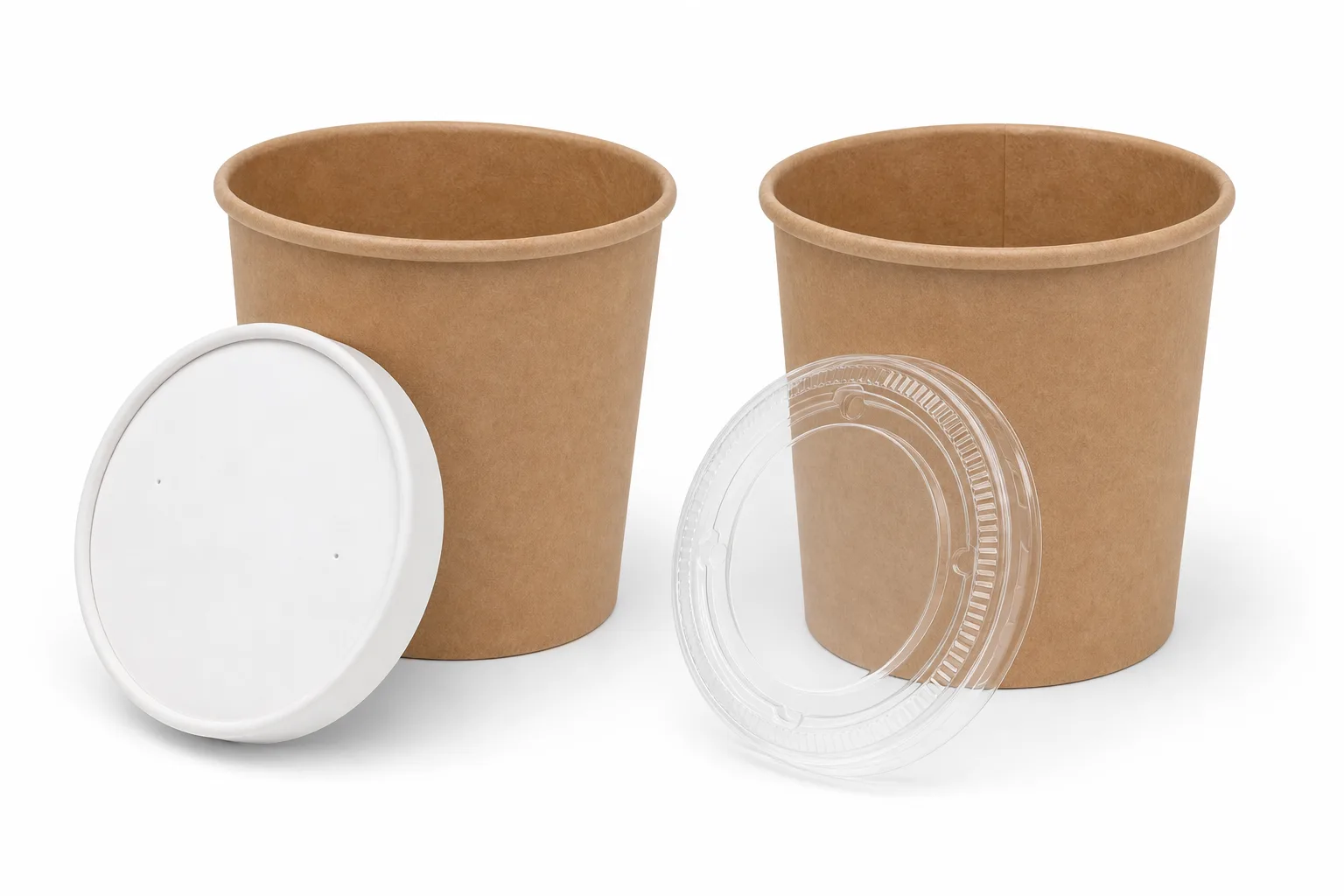 Paper lids run Φ90/97/115/117/170. Transparent PP stops at Φ117: the 64 oz takes paper only.
Lids are sold separately from containers and must match the container diameter. That is standard across the category rather than a quirk of this range: one major US converter sells its 32 oz paper soup container and the matching lid as two different SKUs. Order lids by diameter and quantity, never by container size.
32 oz Soup Bowls With Lids: Which of the Two Builds to Order
There are two 32 oz builds and they take different lids. The Φ117 build measures Φ117 x 92 x H135 and takes a Φ117 lid shared with the 26 oz. The extra-tall build measures Φ115 x 80 x H147 and takes a Φ115 lid shared with the 12 oz squat, the 16 oz squat and the 24 oz. Both are available with paper or PP transparent lids, sold separately.
Delivery-bag stability decides it, and that is arithmetic rather than opinion. The extra-tall build stands 147mm on an 80mm base, a height-to-base ratio of 1.84. The Φ117 build stands 135mm on a 92mm base, 1.47. Taller on a narrower base carries more tipping risk in a courier bag, and a comparable 32 oz plastic soup container on the market runs the same tapered profile (a 4.5 inch rim over a 3.5 inch base).
If your volume goes out through third-party delivery, the Φ117 build is the safer default. If your 32 oz is counter pickup or a soup-bar fill and you want it sharing lids with your 24 oz, the Φ115 build wins on inventory.
 Both are 32 oz: the Φ117 build stands 135mm, the Φ115 build 147mm. Same volume, different bag fit.
One fill note before you spec either. Delivery guidance across the industry puts liquid-heavy fill at roughly 75% of capacity, so a 32 oz container is not a 32 oz portion. The quart-class jobs still fit: family takeout, catering pans portioned out, and a full ramen serve. Both builds are in the soup bowl range.
Which Soup Container Size Fits Which Menu Item
For a deli or cafe soup program the working lineup is a cup portion, a bowl portion and a quart. Panera runs the convention most US customers already know: an 8 fl oz cup as the side, a 12 fl oz bowl as the standalone meal. Mapped onto this range:
- 8 oz (Φ90 x 75 x H60). Sides, pairings, kids portions, miso and light broth.
- 12 oz, either build. The standalone meal. Tall Φ90 if it is broth-forward and travels, squat Φ115 if it is a chowder eaten with a spoon.
- 16 oz, either build. A generous main or a light noodle serve.
- 24 oz and 26 oz. Middle noodle sizes and loaded soups.
- 32 oz. The quart, in the build your channel calls for.
- 64 oz (Φ170 x 142 x H118). Catering, soup bars, family packs and holiday orders.
Noodle soups need their own math, and most takeout soup container sizing guides skip it. Noodle-bowl sizing research puts a compact serve at 700ml to 900ml, a full ramen with broth, protein and egg at 900ml to 1,100ml, and a loaded pho at 1,100ml to 1,300ml, with pho bowls typically shallower and wider than the deeper ramen shape. That maps to the 24 oz and 26 oz for compact serves and to the 32 oz builds for full ramen.
Standard Vietnamese takeout splits an order across three containers: broth, noodles and protein, and garnishes. Packaging suppliers frame that as quality control rather than over-packaging, because combined packing over-hydrates the noodles and lets the broth cool. Three containers per order changes both your soup bowl sizes and your unit count.
Cream against broth is the last variable. Technical viscosity comparisons put broth around 0.6 on the Bostwick scale against roughly 3.0 for cream soup, a five times difference. Thin broth moves under transit vibration and finds the lid seam, so broth-forward items belong at the low end of the fill range and in the tall build. Thick cream soups tolerate a fuller fill and suit the squat build.
Cold items are a different range: see salad bowl sizes.
Coatings for Hot Soup: What PE, PLA and Aqueous Will and Will Not Do
PE wins hot soup. It is not close. The PE coating is rated hot liquid resistant up to 95C, and that is a temperature position rather than a sustainability one.
PLA is where buyers get talked into the wrong container. Standard PLA softens above 55C, which is below serving temperature for any soup or broth worth selling. Vendor content that markets PLA as a hot-soup liner is making a disputed claim rather than a settled one, because independent material sources put the softening point at 55C to 60C.
PLA belongs on cold formats, which is what the salad bowl range is built for. There is no microwave claim on any item in this range. Aqueous sits in its own lane: the wording is “no plastic film”, with moderate moisture resistance, and it is not a hot-broth barrier.
On green claims, take the version you can defend. BPI certified commercial compostable is available per SKU and covers US commercial composting only. If you sell into the EU, ask for current certification status before anything about composting goes on the pack. On PFAS, the wording is that items are screened against a 106-substance PFAS panel by independent labs, which is a test report and not a certification.
One piece of third-party context for your next supplier call: industry guidance on hot-broth delivery notes that lightweight single-wall paper containers absorb moisture and weaken within 20 to 30 minutes, and that formed paper foodservice containers typically run 180 to 280 GSM board, with lower GSM buckling under fill weight. That gives you a number to ask for.
When to Order Soup Containers and What to Put in the RFQ
Soup is a Q4 and Q1 business. Market research puts November to February at roughly 40% to 50% of annual soup volume in North America and Northern Europe, and 61% of consumers say they are more likely to order soup when it is cold out. Industry lead times for packaging run about 15 to 30 days depending on capacity and season, and peak-season capacity constraints stretch that further. Work it backwards: a lineup that has to be on the shelf by early November is a late-summer order, not an October one.
Two ordering realities, unsoftened. MOQ is 20,000 pcs per size. Because it is per size, and because three of the ten sizes exist in two builds, a 12 oz tall and a 12 oz squat are two separate 20,000 pcs commitments, which is exactly why you pick sizes by rim diameter before you pick them by ounces. Free stock samples are available with the buyer covering shipping, and that is how the fit test happens before a purchase order runs it for you.
A quotable RFQ needs seven lines:
- Ounce size and rim diameter as a pair (16 oz, Φ97), never ounces alone
- Build: tall or squat, on any size that offers both
- Coating: PE for hot soup
- Board: kraft or white, and whether you are printing
- Lid type and quantity per diameter, not per container size
- Quantity per size against the 20,000 pcs MOQ
- Service temperature, so a coating mismatch surfaces at quoting rather than at delivery
Send your size list through the contact form, or start from the soup bowl range.
Frequently Asked Questions
What size is a 32 oz soup bowl with a lid?
There are two builds. One is Φ117 x 92 x H135 and takes a Φ117 lid, the other Φ115 x 80 x H147 with a Φ115 lid. Lids are sold separately in paper or PP transparent and must match the diameter. The Φ117 build sits on a wider base, so it is steadier in a delivery bag.
What size soup container is a standard bowl of soup?
The US deli convention most customers know is an 8 fl oz cup as the side and a 12 fl oz bowl as the meal. That maps to the 8 oz (Φ90 x 75 x H60) and either 12 oz build, the tall Φ90 x 72 x H86 for broth or the squat Φ115 x 92 x H65 for chowders.
Why don’t my old lids fit my new soup containers when the oz size matches?
Because the ounce label is a volume spec, not a rim spec. Industry guidance reports rim variance of 3mm to 5mm between suppliers on the same labeled volume, and flange depth can differ even when diameters match. In this range, 12 oz, 16 oz and 32 oz each come in two builds on different rims. Fit-test samples first.
Can you put hot soup in a PLA lined container?
No. Standard PLA softens above 55C, well below the serving temperature of any soup or broth. PE is the hot-liquid coating here, rated up to 95C. Treat any marketing that puts PLA under hot soup as a disputed claim rather than a settled one. There is no microwave claim on any item in this range.
How many soup container sizes do I need to stock?
Three sizes cover most menus, but the number that matters is lid diameters. The Φ115 family covers the 12 oz squat, 16 oz squat, 24 oz and 32 oz extra-tall, so a four-size lineup can still be one lid line item. MOQ applies per size.
Sizing an order? Request free stock samples (shipping on you) and fit-test both 32 oz builds against your own delivery bags, or send your size list through the contact form and get the spec sheet back with pricing.
Ready to Source Eco-Friendly Paper Cups?
Request a free sample pack or get a wholesale quote tailored to your requirements.