
Austin — Product Manager · Reviewed by Henry, Head of Marketing
July 24, 2026 · 11 min read
If the drink must reseal, pick the bottle. If it must be sealed and seen, pick the can. If it is drunk on the spot, pick the cup. That one line settles most of the plastic cans vs bottles debate before any spec sheet opens.
The format decision comes before the flavor decision because it locks in three things no recipe can undo: the machine on your counter, the minimum order on your first invoice, and the sales channels open to you. Each format below gets the honest treatment: what it wins, what it loses, and who should pick it.
Plastic cans vs bottles vs cups: how do the three formats compare?
The short answer: three questions sort almost every drink program, asked in this order.
- Does the customer need to close the drink again? Commuters, desk drinkers, kids’ lunchboxes, anyone who sips across an hour or more. If yes, the decision is over: the screw-cap bottle is the only format here that reseals.
- Does the drink leave your sight before it is drunk? Delivery bags, grab-and-go coolers, and retail shelves all demand a true tamper-evident seal. If you also want the drink itself visible through the package, that points at the clear PET can.
- Is it made, handed over, and finished within the hour, on premise? Then a cup with a lid is the cheapest, fastest tool for the job, and the sealed formats are solving problems you do not have.
Sealed formats matter more every year for one reason: market math. Ready-to-drink beverages are a USD 120.03 billion market in 2026, growing 6.5% a year toward roughly USD 211.55 billion by 2035, per Precedence Research. Sealed, shelf-ready packaging is how small brands step into that market without a bottling plant.
Here is the full spec picture. My advice: read it by the row that keeps you up at night, not top to bottom.
| Spec | PET can | PET bottle | Cup with lid |
|---|---|---|---|
| Seal | Seamed ring-pull end, tamper evident | Screw cap, tamper-evident options | Snap or heat-sealed lid, closed not sealed |
| Resealable | No, opens once | Yes | Snap lid re-snaps, but never seals |
| Product visibility | Full, through a clear body | Good, label covers part | Full in clear cups |
| Equipment | Can seamer required | None; hand-tighten or simple capper | None |
| MOQ entry | 5,000 clear / 10,000 printed | From 5,000 | From about 1,000 stock |
| Sizes | 120-650ml; 350ml and 500ml best sellers | 50ml-1,200ml; 350ml single-serve standard | All standard hot and cold service sizes |
| Retail-shelf ready | Yes | Yes | No |
| Survives delivery | Best | Good | Weakest |
| Per-unit cost tier | Highest | Middle | Lowest |
| Decoration | Screen print up to 3 colors | Screen print up to 3 colors | Flexo up to 7 colors on paper cups |
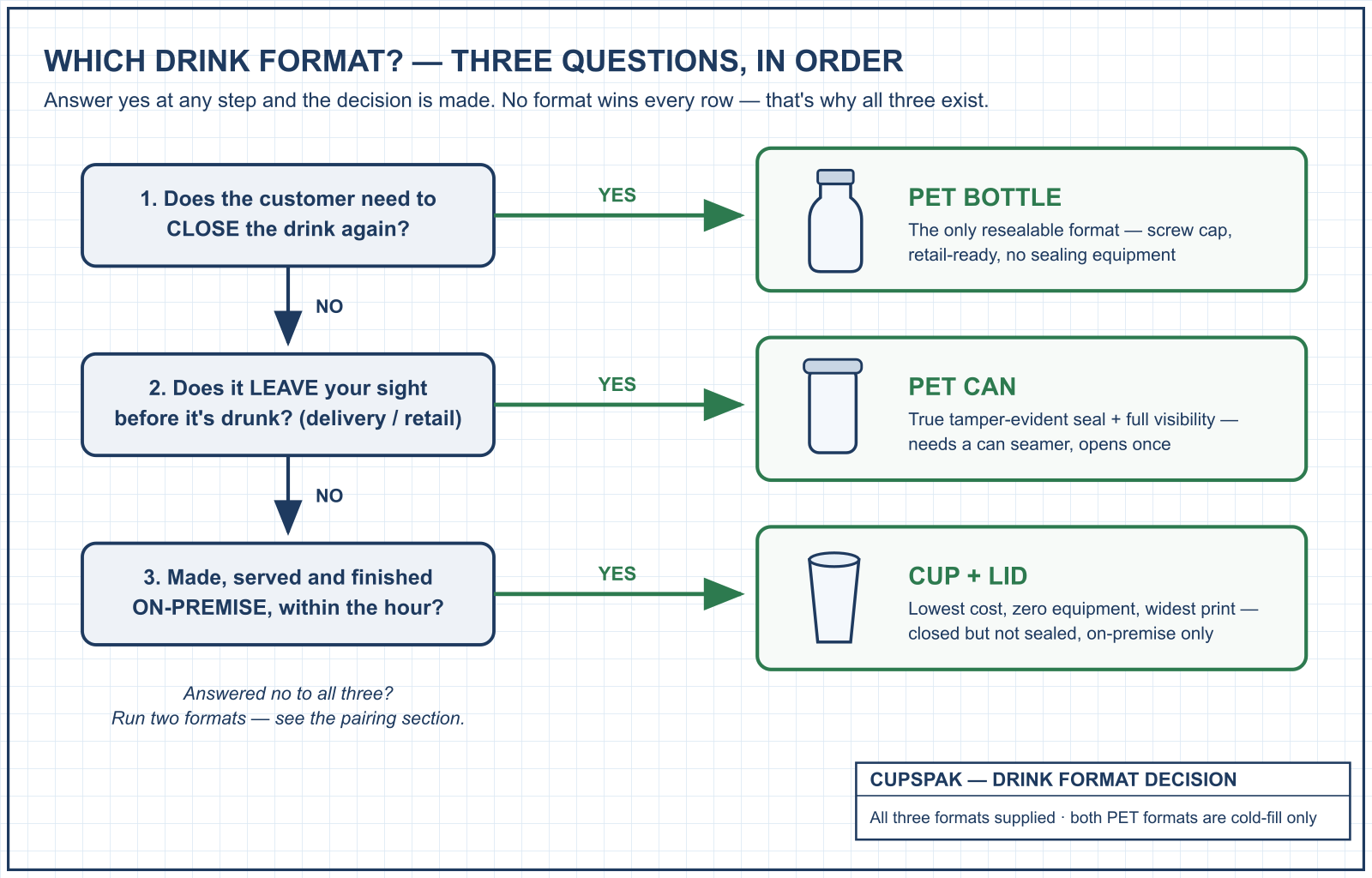
No format wins every row, and that is the honest reason all three exist. The can takes seal and visibility, the bottle takes reseal and retail familiarity, the cup takes cost and speed. The next three sections argue each case properly, losing rows included.
1. When is a PET can the right call?
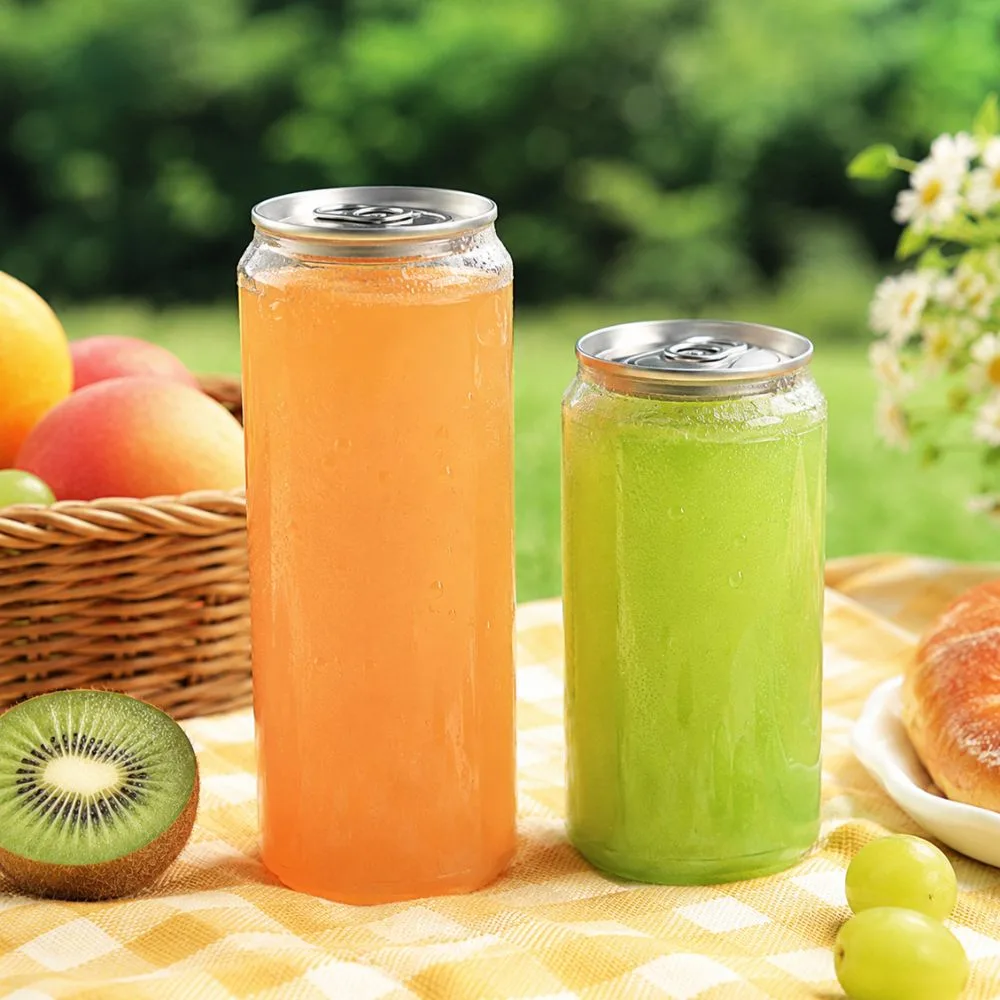
Choose the PET can when you need a true seal and full product visibility in the same package. Nothing else on this page does both. The format is a clear blow-molded PET body closed with an aluminum ring-pull end, seamed on after filling; the full anatomy is in our PET drink cans guide, and the stock range lives on the plastic drink cans page.
Delivery platforms are quietly making this decision for a lot of shops. The Uber Eats merchant guidelines include one checklist line that matters here: “All food is properly sealed in tamper-evident packaging.”
That is not an aspiration; it is the standard couriers are told to work to at handoff. A seamed ring-pull end satisfies that sentence completely, and a snap lid never will. Once a third of your orders ride in someone else’s bag for 20 minutes, tamper evidence stops being packaging jargon and becomes a refund-prevention tool.
The can also carries the premium-serve angle: a layered fruit tea or a cold brew in a fully clear can is its own marketing photo before you print a single color. And the entry math is friendlier than the format’s looks suggest: 8 stock volumes from 120ml to 650ml across 7 stock body shapes, no tooling fee, with 350ml and 500ml carrying most orders. If you are unsure whether your drink suits the format, the cheapest test is a stock sample filled with your actual recipe, photographed next to your current cup. The drinks that belong in a can announce themselves.
Now the honest losses:
- It opens once. A customer who saves half for later is holding the wrong package.
- It needs a can seamer. A real machine and a real budget line. CupsPak supplies semi-automatic seamers alongside the cans, which shortens the shopping trip, but the requirement itself does not disappear.
- Cold fill only. PET softens around 60°C, so hot filling is out.
- Direct print caps at 3 screen-print colors. Complex artwork moves to a label.
- Highest per-unit cost of the three formats.
Best for: delivery-heavy bubble tea and juice shops, and any brand whose drink is beautiful enough to be its own label. Skip it if your customers reseal, your budget cannot absorb a seamer, or you need volumes past 650ml.
2. When does a PET bottle win?
Choose the PET bottle when your customer drinks over time instead of all at once. Iced tea sipped across a commute, juice in a school bag, a smoothie split over a morning: those are bottle jobs, because the bottle is the only resealable format of the three. The stock range is on the plastic juice bottles page, and the size logic gets its own article in the juice bottle sizes guide.
Reseal is the headline win, and the data backs the instinct: in a 2024 Harris Poll commissioned by the bottled-water industry, 79% of US adults said resealable containers matter when choosing a beverage. An industry-commissioned number deserves that flag, but it matches what any cooler shelf tells you: people buy drinks they can put down and pick back up.
The rest of the bottle’s case:
- The widest volume span of any format here: 50ml wellness shots to 1,200ml family jugs, with 350ml (12 oz) as the cold-press single-serve standard.
- Retail already speaks bottle. Planograms, shelf heights, and cooler racks were designed around this silhouette, so a bottle asks the retail buyer no questions.
- Zero sealing equipment. Caps tighten by hand at small scale or with a simple capper later. Your first production day needs no machine at all.
What it honestly loses:
- Novelty. Every drink aisle is a wall of bottles, so your label does the work a clear can gets for free.
- The neck-and-cap SKU trap. Caps must match the neck finish exactly, so the same volume with a different neck is a separate SKU with its own MOQ. Design your lineup around shared necks, or pay for the lesson twice.
- Custom molds are a commitment: 50,000 pieces and roughly 20 business days of tooling before production starts.
- The same cold-fill ceiling: PET softens around 60°C, so this is a chilled and ambient format.
The blunt verdict: the bottle wins on reseal and retail, full stop. It loses on shelf presence, and it will never make your drink the label the way a clear can does.
3. When are cups the smarter start?
Choose a cup when the drink is made in front of the customer and finished within the hour. For that job, both sealed formats are overkill: the cup’s weaknesses stop mattering the moment the buyer is standing at your counter watching the drink being built. The cold cup range covers the clear side of the menu, with paper cups handling the hot side.
What the cup wins:
- The lowest barrier in drink packaging. No seamer, no capper. Pour, snap a lid, serve.
- MOQs from about 1,000 pieces for stock cups, a fraction of any sealed format’s entry.
- Full menu coverage: clear cold cups for iced drinks, paper for coffee and tea, one supplier conversation for both.
- The widest decoration of the three. Paper cups run flexo print up to 7 colors in a full 360° wrap, where cans and bottles cap direct print at 3 screen-print colors. If brand impact per dollar is the metric, nothing beats a printed cup.
What it honestly loses is one thing wearing three costumes: a snap lid closes a cup, it does not seal it. No tamper evidence means retail shelves and grab-and-go coolers are off the table. And the delivery bag is where snap lids go to fail.
Bubble tea shops resisted delivery for years for exactly this reason: owners knew fresh milk tea degrades in an open cup in transit, and many only relented when lockdowns forced the channel. The industry’s answer has been heat-sealed film lids on cups as the minimum bar for off-premise boba. That is a real improvement, worth ordering if delivery is occasional, but read it for what it is: a step toward sealed formats, not a substitute for them.
My advice: if the counter is your point of sale, start here, spend the savings on 7-color print, and revisit sealed formats the month delivery or retail becomes a real channel rather than a hope.
Which format fits your business? Five scenarios and the dual-format play
Frameworks are tidy; businesses are not. Here is where five common drink programs land:
- Bubble tea shop doing 40% delivery: PET cans for the delivery menu, cups for the counter. The seamed end kills the spill-refund problem where it starts.
- Cold-pressed juice brand entering retail: PET bottles, 350ml core. Retail wants reseal and a familiar silhouette; give it both.
- Cafe serving in-house: cups, and nothing else yet. Spend the savings on a 7-color wrap people photograph.
- Juice shots program: mini cans at 120ml or small bottles at 50-100ml. Nobody reseals a shot, so pick on look and channel: cans for counters and coolers, bottles for multipack retail.
- Farmers-market smoothie stand: cups now, bottles for take-home sales later. A stand rarely justifies a seamer.
The entry math deserves real numbers. When Kombucha Town founder Chris McCoy priced printed aluminum cans, the minimum for a printed SKU was “a full truckload or 155,000 units.” That is an aluminum-industry number, not ours, but it explains why so many small brands feel locked out of cans entirely.
Clear PET cans and bottles with locally applied labels start at 5,000 pieces, printed cans at 10,000, and stock cups at about 1,000. That is the difference between a bet and a test. At shop scale, 5,000 cans is weeks of delivery inventory, not a warehouse commitment, and the leftover cash funds the drinks that go in them.
Across hundreds of client orders, the strongest shop programs do not pick one format at all. They run cups on premise plus cans for delivery and retail: same recipe, priced two ways, and customers read the two prices as two products rather than one drink upcharged. The counter keeps its speed and margin; the sealed format opens the channels the counter cannot reach. One artwork identity travels across the whole set: a 7-color wrap on the cup, a label or 3-color screen print on the can, a label on the retail bottle.
Before you request a price, answer these six questions:
- Does the customer need to reseal the drink?
- Does the drink leave your premises before it is finished?
- Is it filled cold, below 60°C?
- Are you ready to place and budget a can seamer?
- Does your cash line fit the MOQ: about 1,000 for cups, 5,000 for sealed formats?
- Do you need more than 3 printed colors on the package itself?
Your answers point at one format, or more likely two. From there, free stock samples cost only the shipping, and the quote form returns format pricing within 24 hours, seamer included if cans make the cut.
Frequently Asked Questions
Can I start with one format and add another later?
Yes, and it is the normal path: cups first while the counter is the business, cans when delivery grows, bottles when retail calls. Each format carries its own MOQ, so treat every addition as its own order rather than an accessory. Your artwork transfers between formats with minor adaptation, so the brand identity you paid for once keeps working across all three.
Which drink format is cheapest to launch?
Cups, and it is not close. There is no equipment to buy, and stock MOQs start at about 1,000 pieces. Bottles come second: 5,000-piece minimums with no machinery beyond a hand-tightened cap. PET cans carry the highest entry cost because the one-time seamer sits on top of the 5,000-piece clear-can minimum.
Which drink formats need equipment?
Only the PET can. Sealing it requires a can seamer, and a semi-automatic model is the realistic scale for a shop; budget for it as covered in the PET can section above. Bottles need nothing beyond hands or a simple capper, and cups need no equipment at all: pour, snap the lid, hand it over.
Which format is best for delivery apps?
PET cans. A seamed ring-pull end is spill-proof and tamper evident, the two things platform rules and rough delivery handoffs punish most. Capped bottles run a close second and add reseal. Snap-lid cups are the format behind most spill refunds, which is why off-premise bubble tea moved to heat-sealed film lids as standard practice rather than a premium extra.
Are clear plastic cans with lids resealable?
No. The seamed end is tamper evident precisely because it cannot close again; opening it leaves permanent evidence. Reseal is the PET bottle’s job. If your customers routinely save half a drink for later, that habit settles plastic cans vs bottles on its own: pick the bottle.
Ready to Source Eco-Friendly Paper Cups?
Request a free sample pack or get a wholesale quote tailored to your requirements.