
Austin — Product Manager · Reviewed by Henry, Head of Marketing
July 20, 2026 · 12 min read
Stock PET juice bottles run from 50ml (about 1.7 oz) juice shots up to 1,200ml (about 40 oz) family jugs, with the single-serve sweet spot sitting at 350ml (12 oz) and 500ml (17 oz). In the US market, buyers search in ounces: 12 oz and 16 oz are the two volumes that dominate cold-pressed juice shelves. Below is the full size chart with real dimensions, the ml-to-oz conversion for every volume, and the one spec most first-time buyers miss: the neck diameter, which decides your cap and your filling line before volume even enters the conversation.
What sizes do plastic juice bottles come in?
The short answer: 13 stock volumes between 50ml and 1,200ml, and almost every juice program on the market builds its lineup from six or seven of them. Here is the full chart, with the ounce conversion built in, because if you sell in the US, your customers think in oz while your spec sheet thinks in ml.
| Size (ml) | Size (oz) | Dimensions (Φ × H, mm) | Best for |
|---|---|---|---|
| 50ml | ~1.7 oz | Φ45 × H71 (gourd shape) | Juice shots, tastings, event sampling |
| 100ml | ~3.4 oz | Φ48 × H94 | Wellness shots, kids’ minis |
| 150ml | ~5 oz | Φ47.5 × H122.5 | Small serves, hotel breakfast juice |
| 200ml | ~7 oz | Φ75 × H84 (squat build) | Kids’ drinks, lunchbox minis |
| 250ml | ~8.5 oz | Φ68 × H150 | Standard small juice |
| 300ml | ~10 oz | Φ69.5 × H140 | Mid single serve |
| 350ml | ~12 oz | Φ72 × H156 | The single-serve standard |
| 400ml | ~13.5 oz | Φ77 × H158 | Large single serve |
| 500ml | ~17 oz | Φ78 × H171 | Large juice / smoothie standard |
| 550ml | ~18.6 oz | Φ78 × H176 | Oversized single serve |
| 650-750ml | 22-25 oz | Various builds | Sharing bottles, post-workout |
| 1,000ml | ~34 oz | Slim and wide builds | Family size, cleanse programs |
| 1,200ml | ~40 oz | Largest stock format | Family jug, food service |
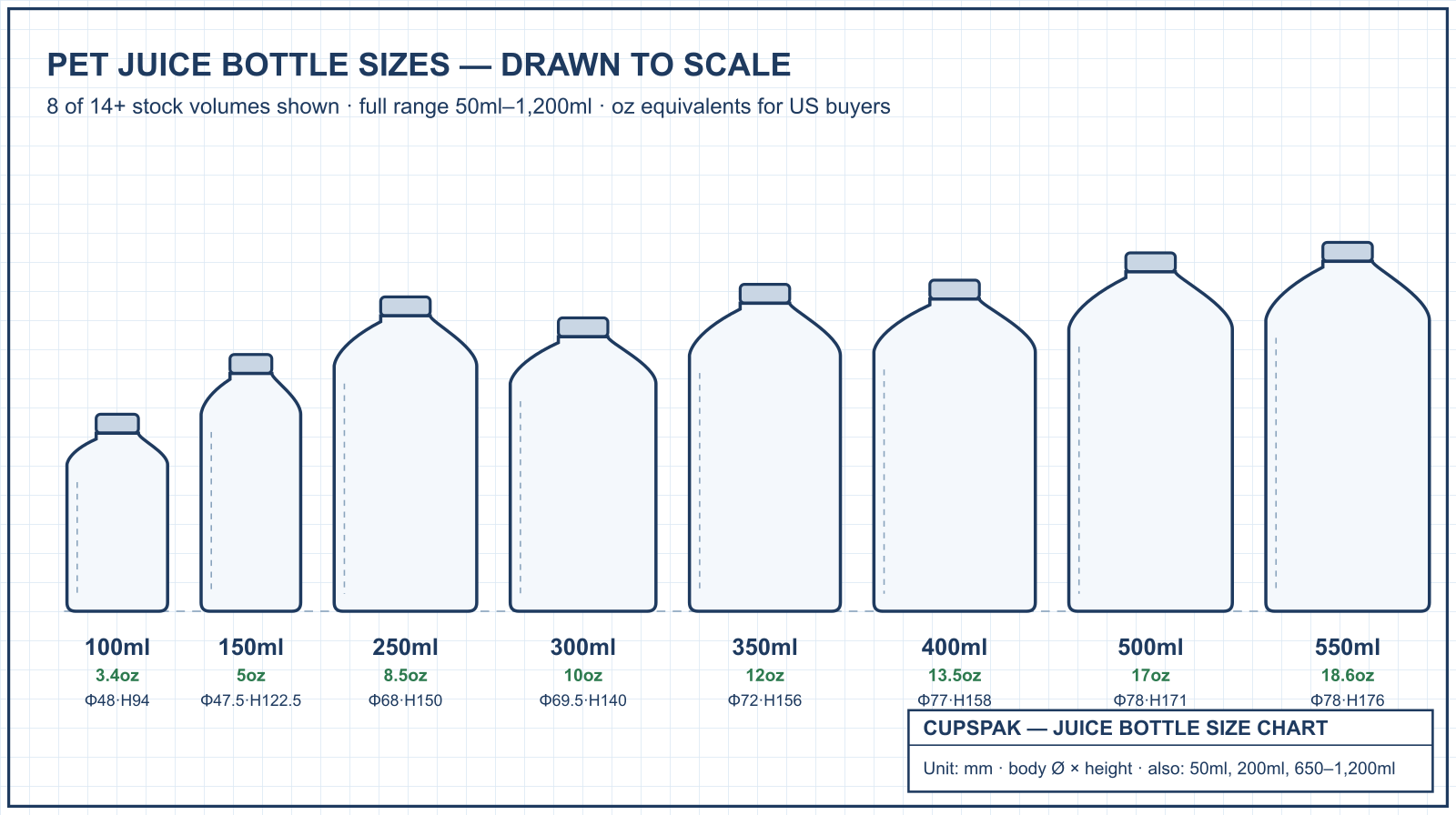
Three things worth noticing in that table. First, diameter does not climb in step with volume: the 200ml squat bottle is actually wider (Φ75) than the 350ml (Φ72), because it trades height for shelf presence in the kids’ aisle. Second, the 500ml and 550ml share the same Φ78 body diameter; the extra 50ml comes entirely from 5mm of height, which lets both run on the same labels with only a height check. Third, every dimension above is a sample from one build family: stock PET juice bottles come in round, square, and shaped ranges, so the same 350ml volume exists in more than one silhouette.
Across hundreds of client orders, the volumes that actually get ordered cluster hard: 350ml, 500ml, and 1,000ml carry most juice programs, with 50 to 100ml shots as the fastest-growing add-on.
Quick ml-to-oz conversion for juice bottles
If you only memorize one line from this article, make it this one: multiply ml by 0.0338 to get US fluid ounces, or just divide by 30 for a close-enough shelf estimate.
- 50ml = 1.7 oz (the classic “2 oz shot” is usually a 50 to 60ml bottle)
- 100ml = 3.4 oz
- 250ml = 8.5 oz
- 350ml = 11.8 oz, sold as 12 oz
- 500ml = 16.9 oz, sold as 17 oz, and often loosely called “16 oz” on menus
- 1,000ml = 33.8 oz, sold as 34 oz or “1 liter”
Notice the rounding direction. A “12 oz juice bottle” in most catalogs is a 350ml bottle, not a 355ml one. A “16 oz cold pressed bottle” is almost always 500ml, which is technically 16.9 oz. Nobody in the industry loses sleep over the 0.9 oz, but your label declaration has to state the real fill volume, so confirm ml, not oz, when you place the order. The same ml-first logic applies across drinkware; our paper cup size chart walks through the identical conversion trap for hot and cold cups.
What size is a standard juice bottle? The 16 oz to 12 oz shift
Ask this question five years ago and the answer was 16 oz (500ml), the size the first wave of cold-pressed juice brands built their businesses on. Ask it today and the honest answer is 12 oz (350ml), because the industry has been walking single-serve sizes down.
Why the shift? Three pressures stacked up:
- Price-point ceilings. Cold-pressed juice is expensive to make. A 12 oz bottle lets brands hold a shelf price customers accept, instead of pushing a 16 oz bottle past the psychological limit.
- Portion realism. 500ml of juice carries more sugar than many buyers want in one sitting. Smaller formats read as the more health-aware choice, which is the entire brand promise of a juice company.
- Margin math. Filling 350ml instead of 500ml cuts juice cost per unit by 30% while the bottle, cap, and label costs barely move. Per-bottle margin improves even at a lower shelf price.
The practical takeaway for a new juice brand: launch your core recipes in 350ml (12 oz), keep 500ml (17 oz) for smoothies and your highest-velocity flavor, and let the 2 oz shot do your premium-price work. Shots (typically the 50ml and 100ml formats) are the growth story of the past few years: they command the highest price per ml in the entire juice category, and a Φ45 × H71 bottle takes almost no cooler space.
Why the neck diameter, not the volume, decides your SKU
Here is the lesson that costs first-time buyers the most money: two bottles of identical volume with different neck diameters are two different SKUs. Different caps, different filling-line change parts, different torque settings. You cannot mix them in one production run, and a cap bought for one will not seal the other.
We teach the same pattern elsewhere in packaging: lids match cup rim diameter, not oz; paperboard is specified in GSM, not “thickness”. For bottles, the master spec is the neck finish. Volume tells you how much juice fits inside. The neck tells you everything else.
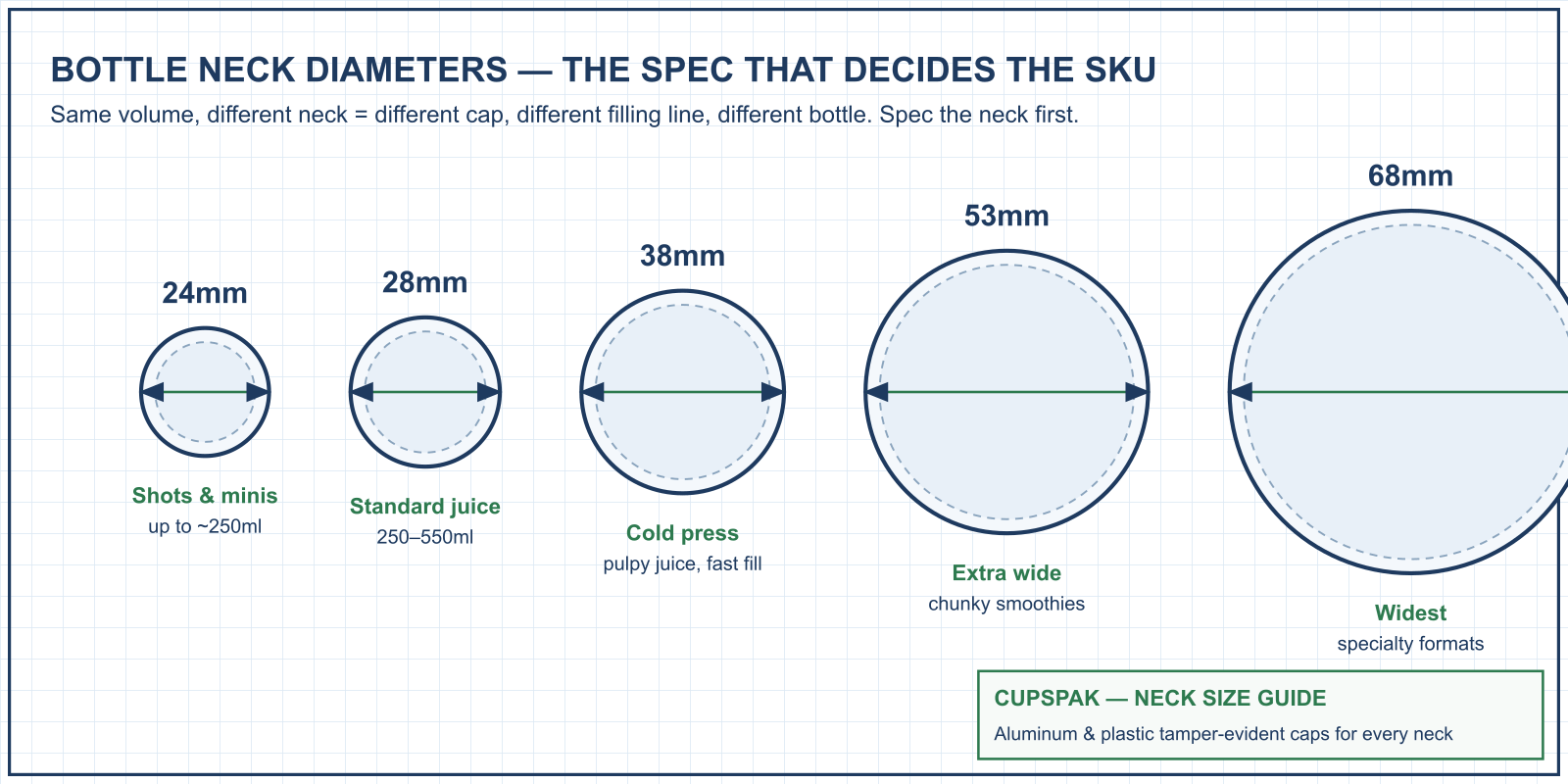
The five standard neck diameters
| Neck Ø | Typical volumes | What it’s for |
|---|---|---|
| 24mm | Up to ~250ml | Shots and small formats; smallest standard cap |
| 28mm | 250-550ml | The standard juice neck: the default for single-serve |
| 38mm | 300ml-1,200ml | Wide-mouth cold press; faster filling of pulpy juice |
| 53mm | 500ml+ | Extra-wide for chunky smoothies and add-ins |
| 68mm | Large formats | Widest specialty opening; spooned and scooped products |
How to choose between them in practice:
- Clear, filtered juice in single-serve sizes → 28mm. It is the cheapest cap ecosystem, every co-packer runs it, and replacement caps are available everywhere.
- Pulpy or fibrous cold-pressed juice → 38mm. The wider opening fills faster and clogs less on the line. If your juice has visible pulp, the 38mm neck pays for itself in filling speed alone.
- Smoothies with fruit pieces, chia, or coconut chunks → 53mm. Anything a straw struggles with, a 28mm neck struggles with more.
- Shots → 24mm. Keeps cap cost down on a bottle where the cap is a large share of total packaging cost.
One more insider note: when you switch neck sizes on the same volume (say, moving your 500ml from 28mm to 38mm for a pulpier recipe), treat it as a new product launch internally. New caps, new change parts, new torque validation. Budget the time.
What about the caps themselves?
Stock juice bottles ship with matching caps in two materials: aluminum screw caps and plastic screw caps, both available tamper-evident. Aluminum reads premium and photographs beautifully on cold-pressed lines; plastic costs less and shrugs off cooler condensation. Tamper evidence (the break-away ring or seal that shows the bottle has been opened) is standard practice for any retail juice and we recommend it on every SKU. Whichever material you choose, the cap must match the neck finish exactly, which is the whole point of the section above.
Cold-fill only: the temperature rule that shapes everything
Standard PET softens around 60°C, so these bottles are strictly cold-fill. Juice goes in at ambient or chilled temperature, which is exactly how cold-pressed, HPP-treated, and fresh-squeezed juice is filled anyway. That alignment is not a coincidence; it is why PET became the cold-pressed industry’s default bottle.
What it rules out: hot-filled recipes, in-bottle pasteurization, and pouring anything steaming into the bottle at your kitchen or co-packer. If your process heats the juice, cool it before filling or treat it after filling (HPP works on filled, capped PET bottles; that is one reason the format took over). If your product genuinely requires hot filling above 60°C, PET stock bottles are the wrong package, and it is better to know that before you order 10,000 of them.
Building a juice menu lineup: the three-tier size strategy
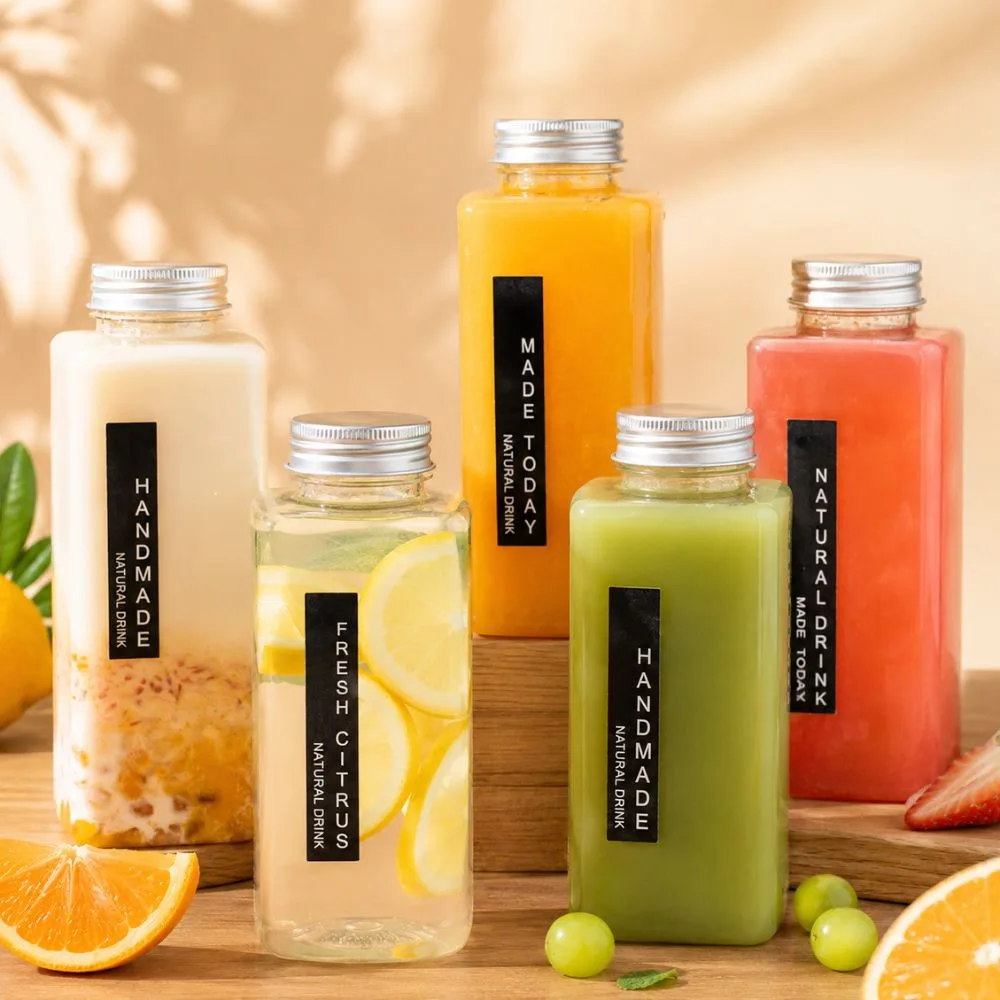
The strongest juice programs we see across client orders run a deliberate three-tier structure rather than one bottle size for everything.
Tier 1: Shots (50ml / 100ml). Highest price per ml in your range. Ginger, turmeric, wheatgrass: concentrated recipes customers buy on impulse at the register. The 50ml gourd-shaped bottle stands out in a cooler full of straight cylinders, and shaped stock molds (heart, star, and others) carry no tooling fee.
Tier 2: Single serve (350ml core, 500ml for smoothies). This is where your volume lives. 350ml (12 oz) for cold-pressed juices, 500ml (17 oz) for smoothies and blends where customers expect a bigger serve. Keeping both on Φ72 to 78 bodies means they merchandise cleanly side by side on the same shelf depth.
Tier 3: Family and program formats (1,000ml / 1,200ml). The 1-liter bottle is the workhorse of cleanse programs and home delivery: three recipes in 1,000ml bottles look like a program; the same juice in six 500ml bottles looks like inventory. The 1,200ml jug serves food-service and family retail.
A lean launch lineup needs only three SKUs: 100ml shot + 350ml single serve + 1,000ml family. That covers impulse, everyday, and program purchases with the minimum number of caps, labels, and MOQ commitments. Add 500ml when your smoothie sales justify a fourth SKU, not before.
If your lineup includes canned-style drinks alongside juice, note that ring-pull PET cans are a separate format family (120 to 650ml) with their own sealing equipment: a sister range to bottles, not a bottle with a different lid.
MOQ, sampling, and lead times for stock juice bottles
The numbers that matter when you plan an order:
- 5,000 pieces: MOQ for clear stock bottles, per size
- 10,000 pieces: MOQ for screen-printed bottles (up to 3 colors)
- 50,000 pieces: MOQ for a fully custom mold, with tooling taking about 20 business days before production starts
- Free stock samples: you cover only the shipping; request them via the sample request page
- Quotes within 24 hours of your inquiry
Two planning notes from experience. First, MOQs are per SKU, and after the neck-diameter section you know that a 350ml/28mm and a 350ml/38mm are separate SKUs, each needing its own 5,000. Design your lineup around shared necks where you can. Second, if you want a shape nobody else has, check the existing shaped-mold library before paying for custom tooling: bear, snowman, robot, star, heart, and gourd molds already exist with no tooling fee, and the full range is in the product catalog.
Juice bottle spec checklist: copy this into your quote request
Before you ask anyone for a price, lock these seven lines. A quote without them is a guess.
- Volume in ml (not oz: state 350ml, not “12 oz”)
- Neck diameter: 24 / 28 / 38 / 53 / 68mm
- Body shape: round, square, or shaped (name the mold)
- Cap material: aluminum or plastic; tamper-evident yes/no
- Decoration: none (labels applied your side) or screen print, ≤3 colors
- Quantity per SKU against the 5,000 / 10,000 / 50,000 MOQ tiers
- Fill process confirmation: cold fill only; flag it now if your juice is filled warm
Frequently Asked Questions
What sizes do juice bottles come in?
Stock PET juice bottles come in 13 volumes from 50ml (1.7 oz) to 1,200ml (40 oz): 50, 100, 150, 200, 250, 300, 350, 400, 500, 550, 650 to 750, 1,000, and 1,200ml. The most-ordered sizes are 350ml (12 oz) for single-serve juice, 500ml (17 oz) for smoothies, and 1,000ml (34 oz) for family and cleanse formats.
What size is a standard juice bottle?
For single-serve juice, 350ml (12 oz) is the current standard, and 500ml (17 oz) is the standard for smoothies and larger serves. The cold-pressed industry launched on 16 oz bottles but has shifted its core format down to 12 oz over recent years, driven by price points, portion expectations, and per-bottle margin.
Can you freeze juice in PET bottles?
Not recommended with standard PET juice bottles, and suppliers who wave this through are storing up complaints for you. Juice expands as it freezes, which stresses the bottle walls and can back the cap seal off; thawed bottles are the ones that leak. If your program genuinely needs freezing (batch prep, frozen delivery), say so at the quote stage so the bottle can be specced for it, and never fill past about three-quarters. For everyday chilled retail, standard PET is exactly right.
Can PET juice bottles go in the dishwasher or hold hot drinks?
No. PET softens from around 60°C, so dishwashers and hot filling will warp the bottle: this is the single most common complaint pattern in marketplace reviews of PET bottles, and it comes from asking a cold-chain material to do a hot job. Fill chilled or ambient, pasteurize-then-cool if your process needs heat treatment, and treat the bottles as single-use packaging rather than reusable drinkware.
Do the caps leak?
A properly matched cap doesn’t. And “matched” is the operative word. Leaks in the field almost always trace to a cap from one source on a neck from another. Our bottles ship with tamper-evident screw caps (aluminum or plastic) engineered to the same neck standard as the bottle, and the fix for any doubt is cheap: fit-test free stock samples with your actual juice, upside down, overnight, before bulk ordering.
How long does juice last in a PET bottle?
The process sets the shelf life; the bottle protects it. Fresh unpasteurized juice runs roughly 48 to 72 hours refrigerated regardless of packaging; HPP-treated juice reaches 30 to 60 days chilled; pasteurized products go further. What the bottle contributes: PET has the best oxygen barrier of the common bottle plastics, which helps flavor hold across that window, and the tamper-evident cap is what retail buyers will require. If shelf life is the constraint you’re fighting, work on the process first: no bottle fixes a process problem.
Which neck size do I need for my juice bottle?
Choose 28mm for clear, filtered single-serve juice: it is the industry standard with the widest cap availability. Choose 38mm for pulpy cold-pressed juice, because the wider mouth fills faster and clogs less. Go 53mm for chunky smoothies and 24mm for shots. Remember that the neck determines your cap and filling-line parts: two bottles of the same volume with different necks are different SKUs.
What is the MOQ for plastic juice bottles?
MOQ is 5,000 pieces per size for clear stock bottles, 10,000 for screen-printed bottles (up to 3 colors), and 50,000 for a fully custom mold, which adds about 20 business days of tooling time. Free stock samples are available before you commit: you pay only the shipping.
Ready to spec your lineup? Send your size list through the quote form (you’ll have pricing within 24 hours) or order free stock samples first and put the 350ml and 500ml side by side on your own shelf before you decide.
Ready to Source Eco-Friendly Paper Cups?
Request a free sample pack or get a wholesale quote tailored to your requirements.