
Austin — Product Manager · Reviewed by Henry, Head of Marketing
July 20, 2026 · 11 min read
Deli paper is a thin, food-safe sheet used to wrap sandwiches and burgers, line baskets and trays, interleave sliced cheese and meats, and hand over pastries at the counter. One SKU quietly covers more front-of-house jobs than almost any other paper product you buy. That is exactly why so many operators order the wrong size, the wrong format, or plain paper where they needed grease resistance.
This guide maps every real deli paper application to the format and size that fits it, explains the dry wax vs plain decision, and shows why custom printed deli paper is some of the cheapest branding real estate on your counter.
What is deli paper used for?
The short answer: deli paper’s uses fall into four jobs, wrapping, lining, interleaving, and presenting. Every application you have seen in a QSR, deli, or bakery is one of these four, and each job pulls the spec in a slightly different direction. Here is the full application map, with the size and material logic behind each.
Wrapping: sandwiches, burgers, and subs
This is the job most buyers picture first. A 12×12″ sheet handles a standard sandwich or burger: place the item diagonally, fold two corners over, tuck and roll. The wrap holds heat in, keeps sauce off hands and car seats, and gives the customer a natural “unwrap moment” where your print does its work.
Size discipline matters more here than anywhere else. A 12×12″ sheet around a footlong sub leaves the ends exposed and the middle bulging. Across hundreds of client orders, the pattern is consistent: sub shops, burrito concepts, and smash-burger brands running oversized builds spec 15×15″ sheets and stop fighting the wrap. If your staff routinely use two sheets per item, you are buying the wrong size, not too little paper.
For burger service specifically, dry wax is non-negotiable. A hot patty releases grease and steam within the first 60 seconds of wrapping; plain paper wicks it straight through to the customer’s hand. More on the dry wax decision below.
Lining: baskets and trays
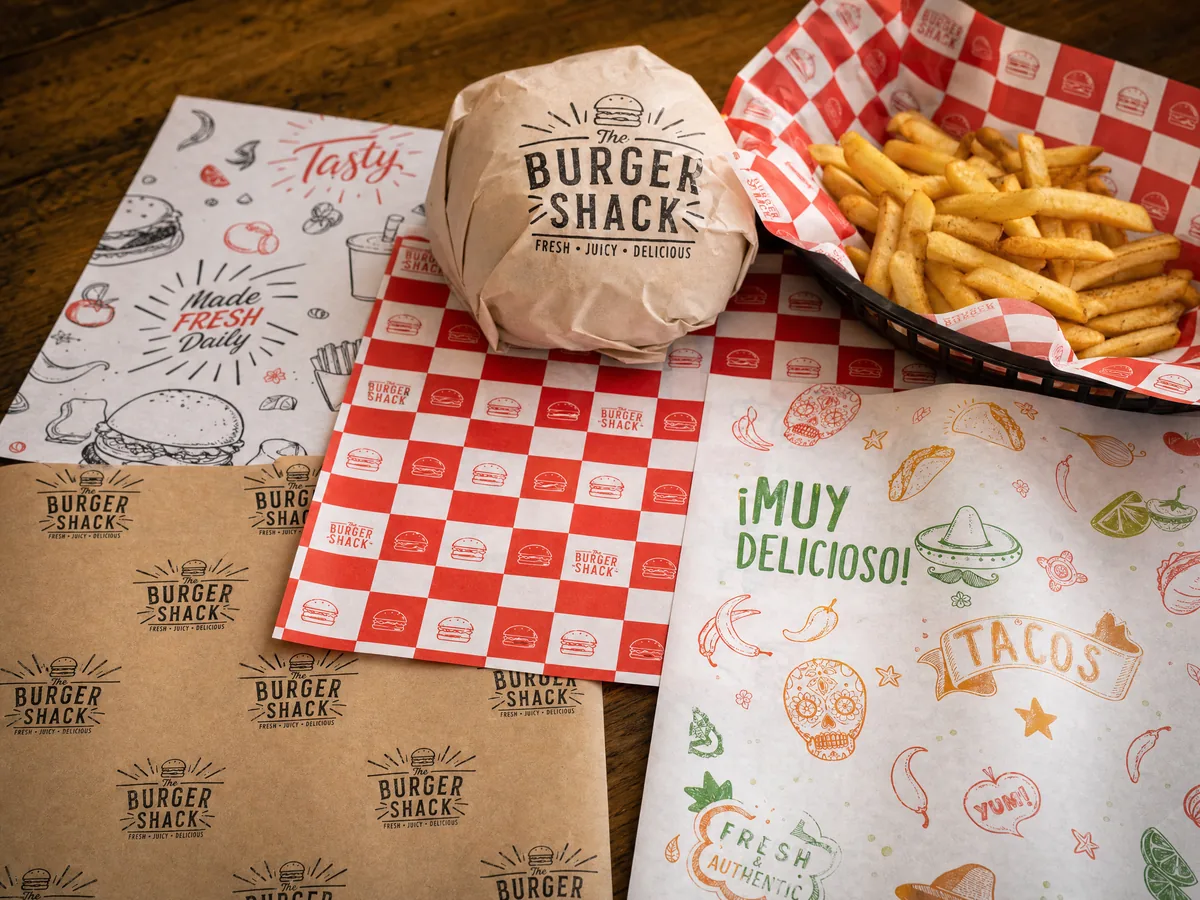
Basket lining is deli paper’s second-biggest job and the one with the best margin story. A red-checkered liner in a plastic or paper basket does three things at once: it protects the basket from grease, it cuts your wash-up labor, and it makes a $9 burger-and-fries combo photograph like a $14 one. The paper costs cents; the presentation upgrade is free after that.
The mechanics are simple. A 12×12″ sheet lines a standard oval or rectangular food basket with enough overhang to fold over the rim. For paper serving trays, match the liner to the tray footprint. Our paper food trays run #1 through #6 (100 to 1200ml), and a single 12×12″ liner covers the mid-range trays with room to spare. Liner plus tray is a natural pairing: the tray provides structure, the liner takes the grease hit, and the tray stays clean enough to look intentional.
Tray lining extends past baskets. Cafeteria trays, pizza-slice trays, and counter display trays all take the same sheet. Anywhere food touches a reusable surface, a deli paper liner is cheaper than the labor to properly wash that surface between uses.
Interleaving: cheese, charcuterie, and the deli case
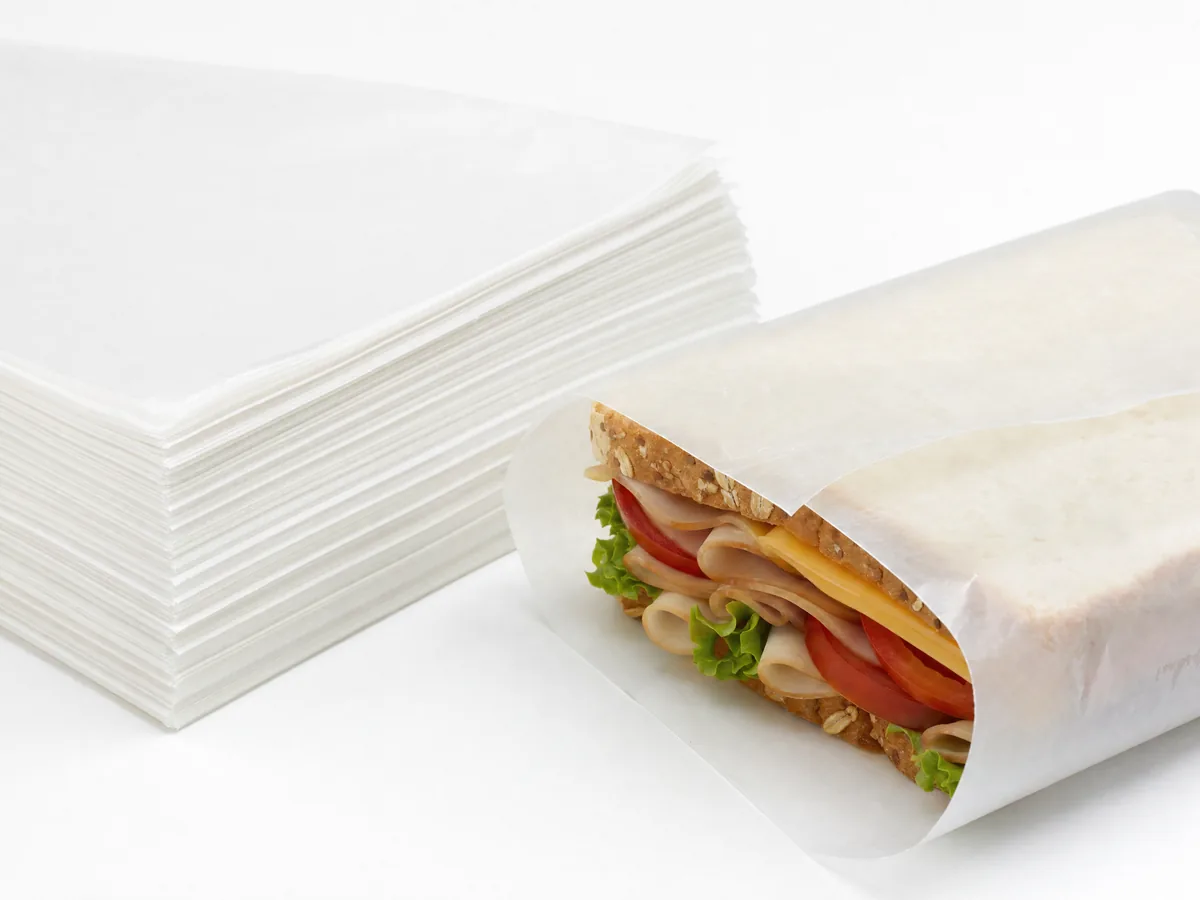
Here is the application most food service buyers overlook, and the one the product is literally named for. Behind the deli counter, sheets of deli paper separate slices of cheese and cured meat so they don’t fuse into a block, and they let staff pick up product without gloved hands touching it twice.
This is where the interfolded format earns its place. Sheets pop up one at a time from a dispenser box: one-handed, no fumbling, no peeling apart a stuck stack while a queue builds. The math is one sheet per order. A shop moving 200 sandwiches a day goes through 6,000 sheets a month from this one job alone, which is why the 12×10.75″ interfolded sheet is the high-volume workhorse of this category. It fits most commercial countertop dispensers and standard dispenser boxes.
Cheese interleaving specifically calls for dry wax. Plain paper sticks to moist cheese faces; dry wax releases cleanly and keeps slices intact for presentation on a charcuterie board or in a display case.
Presenting: bakery pickup sheets and fry cones
The smallest sheets do the front-of-counter work. A 10×10.75″ sheet is the classic bakery pickup: staff grab a pastry through the sheet, hand it over, and the same sheet becomes the customer’s plate. No tongs, no touching, no extra packaging. Cafés running counter pastry programs go through these fast, which again favors the interfolded dispenser format at the register.
Then there is the fry cone: a flat sheet rolled into a cone, filled with fries, and stood in a holder or cup. It is pure theater on a sheet of paper, and it costs less than any branded fry container. If your fry volume justifies dedicated packaging instead, paper snack cups in 8, 12, and 16oz are the structured alternative; plenty of operators run both, cones for dine-in presentation and cups for takeaway.
One more presenting job worth naming: the burger “half-wrap” or open-face presentation, where the sheet is wrapped around the bottom half of the item and the top stays visible. Fast-casual burger brands use it because the product sells itself and the paper keeps hands clean. Same sheet, different fold.
Flat sheets, interfolded, or rolls: which format fits your counter?
The short answer: flat sheets for wrap stations, interfolded for anything dispensed at speed, rolls for dedicated high-volume wrapping lines. Format is a workflow decision, not a product decision: the paper inside is the same.
Flat sheets ship in bulk packs and suit any station where paper is staged in advance: a wrap station with a stack next to the press, a basket-lining station at expo. They are the cheapest format per sheet and the most flexible, because a flat sheet does every job on this page.
Interfolded sheets are the dispenser format. Each sheet is folded into the next, so pulling one presents the next, the same mechanism as facial tissue. The payoff is one-handed dispensing: a deli clerk holding product in one hand pulls a sheet with the other. Interfolded packs fit most commercial dispensers, so they usually drop into whatever hardware is already on your counter.
Rolls serve wrapping stations that measure paper by the job, not the sheet. Butcher counters, sub shops with a wall-mounted roll cutter, and commissary lines all cut to length. Rolls eliminate size compromise entirely: a 6″ slider and an 18″ party sub come off the same roll. Rolls and custom sheet sizes are both available on the deli paper line.
Here is the size-to-format map we see across real orders:
| Size | Best format | Where it earns its keep |
|---|---|---|
| 12×12″ | Flat sheets | Standard sandwich and burger wrap, basket liner, tray liner, fry cones |
| 12×10.75″ | Interfolded | High-volume deli counters, cheese and meat interleaving, dispenser stations |
| 15×15″ | Flat sheets | Large subs, burritos and wraps, oversized burger builds, big basket liners |
| 10×10.75″ | Interfolded | Café pastry counters, bakery pickup, small dispenser stations |
| Custom / roll | Rolls | Wrapping stations, butcher-style counters, cut-to-length programs |
The blunt verdict: if the sheet is dispensed one at a time in front of a customer, buy interfolded. If it is staged at a prep station, buy flat and save the difference. If you cut to length, buy rolls.
Dry wax or plain: which deli paper do you actually need?
The short answer: dry wax for anything greasy, moist, or held longer than a minute; plain paper for dry, quick-contact jobs. Get this one wrong and no size or format choice will save you.
Dry wax deli paper has wax pressed into the paper fibers during manufacture rather than coated on top. The result is a sheet that resists grease and moisture without feeling waxy, transferring residue, or flaking onto food. It is the default spec for burger wrap, fry baskets, cheese interleaving, and anything involving sauce. Both come in white and kraft: white for print pop and a clean deli-case look, kraft for the craft-bakery and natural-positioning brands.
Plain deli paper is uncoated tissue. It is the right call for dry pastries, bread service, dry sandwich pickup, and separating dry goods: jobs where the paper touches food briefly and grease never enters the picture. It costs less than dry wax, and paying for grease resistance you don’t need is the most common overspec in this category.
What suppliers don’t always volunteer: “grease-resistant” is a spectrum, not a switch. Dry wax handles the burger-and-fries reality of QSR service, but it is not a deep-fry-oil barrier, and no deli paper is oven-safe (that is parchment’s job; see the FAQ below). Every sheet on our line carries documented food-contact compliance, and production runs under third-party-audited systems; if your program needs the paperwork, ask for it with your quote.
A simple sorting rule for your menu: walk your line and ask of each item, “would this leave a mark on a paper napkin in 60 seconds?” If yes, dry wax. If no, plain paper is fine and cheaper.
Custom printed deli paper: the cheapest branding real estate you’re not using
Here is the argument in one line: your customer stares at a deli paper sheet from a distance of 30cm for the entire time they eat, and most operators leave it blank. No sign, menu board, or social ad gets that dwell time. Custom sandwich paper turns a cost line you already pay into a branding surface.
Four print directions cover nearly every custom sandwich wrap paper program we see:
- Checkered: the classic red or blue gingham check on white. It is shorthand for “American diner” and “burger joint” worldwide, and because it is a simple repeating one-color pattern, it is the cheapest print to run.
- Logo stamp: your mark repeated in a step pattern across the sheet. The workhorse choice: whichever way staff fold the wrap, some part of the logo shows. This is the format that makes food photos work for you on social media, because a customer’s burger picture carries your name in it.
- Illustrated: hand-drawn ingredient sketches, mascots, story elements. Fast-casual and craft concepts use this to make the unwrap feel like part of the brand, not just packaging.
- Geometric: stripes, dots, and patterns in brand colors. The quiet option for cafés and bakeries where a logo repeat would feel loud.
The economics favor simplicity. A one- or two-color repeating pattern prints economically at this category’s volumes, and because the sheet is small and the pattern repeats, registration is forgiving: your artwork does not need to land in an exact spot the way a cup print does. Kraft base stock plus one dark ink is the budget-brand look that reads as deliberate; white stock plus one bright color is the diner look.
For QSR and fast-food operators, printed deli paper is usually the first branded item in the bag and often the last one budgeted. Our fast food and QSR solutions page shows how wraps, liners, cups, and carriers hold a brand look together across the whole order. The wrap is where most programs should start, because it is the piece the customer physically holds longest.
Where to buy deli paper custom-printed rather than off the shelf? Any program at real volume should go production-direct: orders start at 30,000 sheets per size, quotes come back within 24 hours, and a digital artwork proof follows in 3 business days. Below those volumes, restaurant supply distributors stock generic checkered and plain sheets, a fine bridge until your volume clears the custom threshold.
How do you spec deli paper for your operation?
Work through this checklist before you request a quote. It is the same sequence we walk buyers through, and it prevents the two classic mistakes (wrong size, wrong coating):
- List the jobs. Wrap, line, interleave, present: most operations need 1 or 2 SKUs, not 4. A 12×12″ dry wax sheet alone covers wrap + liner for a typical burger concept.
- Measure your biggest regular item. If any core menu item exceeds roughly 10″ across, spec 15×15″ for it or accept double-sheeting costs forever.
- Match format to workflow. Dispensed at a counter → interfolded. Staged at a prep station → flat sheets. Cut to length → rolls.
- Apply the napkin test for coating. Grease or moisture within 60 seconds → dry wax. Dry contact only → plain.
- Pick white or kraft to match the brand, not the price list. The difference is a look decision.
- Check your dispenser if buying interfolded: confirm the sheet size your hardware takes (deli paper interfolded packs fit most commercial dispensers, but “most” is not “all”).
- Decide on print now, not later. Custom print has an MOQ and a lead time; if branding is in this year’s plan, fold it into the first order instead of re-quoting in 6 months.
- Order samples before bulk. Paper weight and wax level are things you judge with your hands, not a spec sheet.
Frequently Asked Questions
What is deli paper?
Deli paper is a lightweight, food-safe paper sheet designed for direct food contact: wrapping sandwiches, lining baskets and trays, interleaving deli slices, and handling baked goods. It comes as flat sheets, interfolded dispenser packs, or rolls, in dry wax (grease-resistant) or plain versions, and in white or kraft. The name comes from its original job separating slices at the deli counter, but wrapping and lining are now the bigger uses.
Is deli paper grease-proof?
Dry wax deli paper is grease-resistant, not grease-proof, an honest distinction worth knowing. Wax pressed into the fibers resists the grease and moisture of normal service: burgers, fries in a basket, sauced sandwiches. It is not a barrier against pooled oil or long hot holding, and plain (uncoated) deli paper offers minimal grease resistance at all. For heavy-grease applications, pair the sheet with a structured container rather than asking the paper to do a container’s job.
What’s the difference between deli paper, parchment paper, and wax paper?
Three different tools. Deli paper is for cold-to-warm food contact: wrapping, lining, interleaving; dry wax versions resist grease but it is not oven-safe. Parchment paper is silicone-treated and heat-stable to roughly 220°C, which makes it the baking and oven liner, and also makes it roughly 2 to 3× the cost per sheet for a job deli paper does fine at the counter. Traditional wax paper carries a heavier surface wax coating that melts under heat and can transfer to food, which is why it stays in the pantry and off the grill line. If food is served, not cooked, on the sheet, deli paper is the economical answer.
Will interfolded deli paper fit my dispenser?
Interfolded deli paper is designed for pop-up dispensing and fits most commercial countertop and in-counter dispensers: sheets are folded into each other so each pull presents the next, one-handed. Compatibility comes down to sheet size: confirm the size your dispenser takes (the 12×10.75″ and 10×10.75″ interfolded sizes cover the common hardware) before ordering a pallet. If you are unsure, send us the dispenser model with your inquiry and it gets checked before the quote.
What’s the minimum order for custom printed deli paper?
Orders start at 30,000 sheets per size, with quotes returned within 24 hours and a digital artwork proof in 3 business days. Free stock samples are available (buyer covers shipping) so you can judge paper weight and wax level before committing; standard production runs 15 to 25 business days after artwork approval.
The fastest way to settle size, weight, and coating questions is to hold the paper. Request free stock samples (you cover shipping) through the sample request page, and grab the full catalog to see the deli paper range alongside the trays, cups, and bags it pairs with. Quotes on custom sizes and prints come back within 24 hours.
Ready to Source Eco-Friendly Paper Cups?
Request a free sample pack or get a wholesale quote tailored to your requirements.