Austin — Product Manager · Reviewed by Henry, Head of Marketing
August 14, 2026 · 11 min read
The short answer: on custom printed deli paper you are not choosing a print, you are choosing a surface. The grease barrier that keeps oil off your customer’s hands is the same surface your ink has to bond to, and that surface gets a vote on what artwork survives contact with a hot sandwich.
Most buyers get there backward. The artwork is finished first, the sheet is picked second, and the constraint shows up at the proof stage, when a designer who has never printed on wax is told the flood coat is a problem. By then the fix is a redraw rather than a setting.
Format (flat, interfolded, rolls) and the dry wax versus plain choice are settled in the deli paper uses guide. This article picks up after those decisions and covers the print itself, the grease spec that belongs on your purchase order, and the volume at which a custom run stops being a good idea. It is written for volume buyers, and the sort comes first: you will know inside 90 seconds whether production-direct is your route or a waste of your time.
Who Should Buy Custom Printed Deli Paper Production Direct, and Who Should Not
If you need a few thousand sheets, buy from a US short-run printer and stop reading here. If you burn tens of thousands of sheets per size a year, production-direct is where your money starts working.
The gap between a 250 sheet minimum and a 30,000 sheet minimum is setup cost, not supplier preference. Digital printing carries almost none, so minimums sit in the 50-250 range and a first design costs almost nothing to test. Offset and production runs carry plate and makeready cost that only amortizes across a big run. Per-unit price falls off a cliff on one side of that line, and the minimum sits high on the other.
Our number, plainly: 30,000 sheets per size, plain or printed. Print is not what triggers the minimum.
Per size is the part that catches people. A two-size program commits 60,000 sheets, not 30,000, and that arithmetic sinks more first orders than unit price does. Stock sizes and the full range sit on the deli paper page.
Vendor pricing pages put custom deli paper at roughly $0.03 to $0.05 per sheet. Treat that as an indicative market range rather than a CupsPak quote, and expect small-batch orders to land at the top of it.
| Your volume per size | Where to buy | What you trade |
|---|---|---|
| Under a few thousand sheets | US short-run digital printer | Higher per sheet, cheap to test a new design |
| A few thousand up to about 30,000 | Still short-run | Per-unit creep as your burn rate climbs |
| Tens of thousands per size | Production-direct | Lower per sheet, real 30,000 per size commitment |
One 2026 condition, named honestly: overseas unit prices look lower on paper, and tariffs plus lead time belong in the comparison.
The blunt version: if you are opening one location next month, custom printed deli paper is the wrong first purchase. A stock checkered sheet plus a logo sticker does the same job at the counter for a hundredth of the money.
Can You Print Edge to Edge on Deli Paper? What the Coating Does to Ink
Both answers on page one are partly right, and the deciding variable is the surface, not the printer. One supplier page tells you full background print is unavailable. Another sells edge to edge as a standard option. Neither states the mechanism, which is where your actual answer lives.
The wax problem comes first. A wax coating is soft, so ink keys to the coating rather than sinking into the fibers underneath. If the solvent in the ink liquefies that wax, wet ink ends up encapsulated instead of bonded to a stable surface. That is smear and offset: ink transferring onto whatever the sheet touches next, including the sheet below it in the stack and the food inside it.
The coverage problem comes second. With pigment inks the sheet behaves like a filter. Ink solids stay as a cake on the surface with the colorant exposed to mechanical stress, which is why heavy solid backgrounds crack and flake first while fine line work and a repeating one-color pattern survive the same handling.
Edge to edge is not forbidden. Ink coverage decides how the print ages, and a sheet crumpled around hot food is the worst possible test of a heavy flood coat.
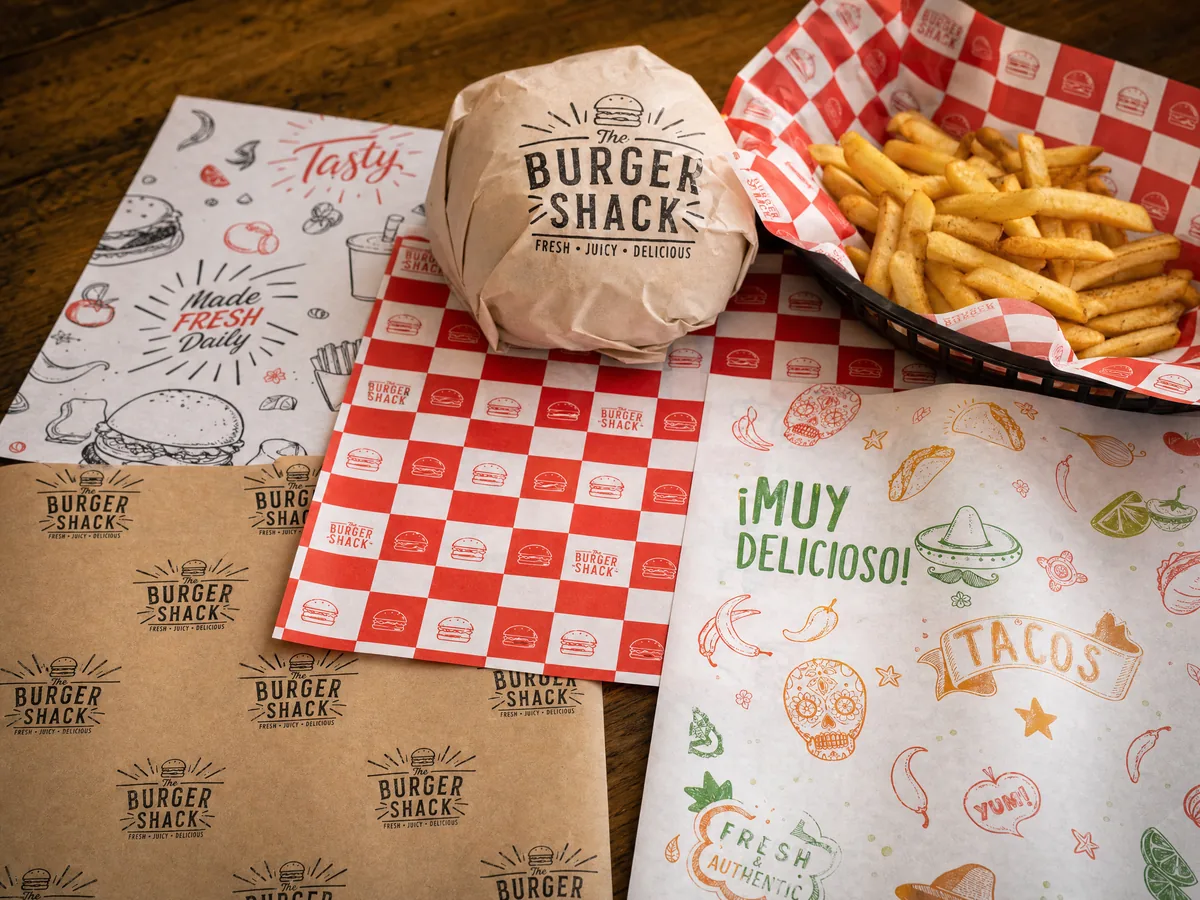
The way around it costs less than the flood coat anyway. A repeating pattern over a colored base stock reads as full coverage at arm’s length and puts a fraction of the ink on the sheet. Kraft base plus one dark ink is the same trick. Most of the food wrap you admire is two colors and a good pattern rather than a photograph.
Print method follows from the coating and the run size, not from a menu. Offset is the industry’s high-volume default on greaseproof stock, valued for cost and for run-to-run consistency. Toner-based laser printing is reported to work particularly well on greaseproof surfaces because the toner is heat-fused rather than absorbed. Digital is the short-run tool, which loops straight back to the volume split above.
On our own sheets all three run: flexo, offset and digital. Flexo is the volume default for spot color work, offset is what you specify when the artwork genuinely needs CMYK detail, and digital exists without often earning its place against a 30,000 sheet minimum. The wider print capability sits on the custom printing page. Ink formulation is a real constraint, not marketing language: food-contact inks are specified for what they may release into the food they touch, which limits what a printer can throw at a difficult surface.
Kit Level: The Grease Resistance Number That Belongs on Your Purchase Order
Grease resistance has a number. It runs 1 to 12, it is called the Kit level, and if it is not on your purchase order then grease resistance was never specified in the deal. Only paper weight was.
Increasingly aggressive oil and solvent mixtures are applied to the paper surface, and the highest-numbered mixture the sheet repels without staining for 15 seconds sets the level. Higher means a stronger oil barrier. That single number lets you compare two quotes that both say “grease-resistant” on the cover page.
GSM and Kit level are independent properties. A 70 gsm uncoated kraft can feel sturdy in the hand and still let hot oil wick straight through, while a lighter treated sheet holds. Thicker is not safer. They are two numbers, and you request both.
| What you are wrapping | GSM band | Kit level | Why |
|---|---|---|---|
| Pastries and baked goods | 25-40 | 1-3 | Dry contact, almost no oil |
| Deli sandwiches | 30-45 | 3-5 | Light grease unless mayo is heavy |
| Breakfast sandwiches | 40-55 | 5-7 | Egg makes steam, bacon adds grease |
| Burgers, wrapped | 40-60 | 6-8 | Warm fat plus sauce, held on the way home |
| Pizza slice liners | 40-60 | 6-8 | Cheese oil is aggressive, the sheet has to breathe |
| Fries liner | 35-50 | 7-9 | Vented or perforated cuts steam |
| Fried chicken, wings, fish | 50-70 | 8-10 | Heaviest oil load on any menu |
The wording to send a supplier: “What is the Kit level for this paper, tested per TAPPI T 559?” Get the number in writing, then put it on the purchase order next to the GSM band. TAPPI T 559 is a test method you ask a supplier to report against, not a certification anybody holds. A supplier who answers with a certificate instead of a number has answered a different question.
Our dry wax deli paper rates Kit 7. Read that against the table above rather than as a boast. Kit 7 clears pastries, deli sandwiches, breakfast sandwiches, wrapped burgers and pizza slice liners with room to spare, and it sits at the bottom edge of the fries band. It does not reach the 8-10 that fried chicken, wings and fish ask for. If your menu is built on the fryer, test hard before you commit, or buy a heavier barrier from someone who makes one.
Note what that sentence specifies and what it does not. Kit 7 is the dry wax sheet. The plain sheet is a different product with a different barrier, so it does not inherit that number, and you should ask for it separately rather than assume it. That is the same discipline this section asks you to apply to every other supplier.
Food-contact compliance is a chemical safety question about what the paper may release into food. Kit level is a physical performance question about whether oil gets through. A fully compliant sheet can still leak grease onto a customer’s shirt, and only one of those two boxes has a number you can hold a supplier to.
Why a Printed Sheet Does Not Perform Like the Flat Sample
The Kit level is measured on a flat, untreated sample. By the time the sheet reaches your counter it has been printed and folded, so treat that number as a starting point rather than a guarantee.
Two specifics matter. At a sharp crease the coating can crack, and a sheet rated Kit 8 flat can behave closer to Kit 5 right at the fold. That is exactly where a wrapped sandwich puts its weight and its grease. The middle of the sheet is not where wrappers fail.
The standard test also evaluates an untreated surface, so it tells you nothing about how the paper performs after printing, lamination or die cutting. Heavy ink coverage sits on top of the same surface your grease barrier depends on, which is where the two previous sections meet.
Kit does not measure heat resistance, wet strength or printability either. Heat matters here because a wax coating is heat-sensitive at around 50C, while a densified greaseproof sheet tolerates far more. That is a performance limit to test against your hottest item, not a reason to reopen a coating decision you have already made.
Which leaves one real answer. A physical pre-production sample matters more on deli paper than on almost anything else you buy, and the test that counts is your own greasiest, hottest menu item, wrapped by a member of staff folding the way staff actually fold, then left alone for the length of a real delivery. Check the fold line first. Not a flat sheet on a desk.
PFAS and Grease Coatings: What to Ask Before You Print Anything
If a coating menu offers you “fluoropolymer”, that is the PFAS family, whatever the surrounding page says about sustainability. In 2026 it is a purchasing risk rather than a feature.
It is on deli paper menus for a reason. 6:2 FTOH, a fluorotelomer alcohol, went onto deli wrap, popcorn bags and pizza boxes specifically because it blocks grease, the exact job this article is about. It worked well, which is why it lasted so long.
The timeline you are buying into:
- US manufacturers completed a phase-out of PFAS grease-proofing agents for food-contact paper by 2024.
- Roughly 20 states now restrict PFAS in paper food packaging in some form.
- Colorado, Connecticut, Maine, Minnesota, Vermont and Washington brought new disclosure or prohibition requirements into effect on January 1, 2026.
- Minnesota requires manufacturer product reports by July 1, 2026.
- New Jersey passed its own act in early 2026: manufacturer reporting from 2027, effect in 2028.
The state-by-state detail lives in the PFAS free packaging regulations guide.
The blind spot is closer to home than the statute book. Most operators cannot say what coating is on the paper they used this morning unless they ask their supplier. Whole Foods learned in 2018 that packaging it had bought for in-store use was PFAS-treated, and it surfaced through an outside investigation rather than through the supply chain. If it caught a buyer that size, it will catch a regional chain buying wrap on price.
Ask in writing before artwork, not after: what is the grease barrier chemistry, by name, and can I see the test report. A test report is what exists. There is no PFAS-free certificate, and a supplier offering one is describing a document that does not exist. Our deli paper is supplied dry wax or plain, in white or kraft, so the answer is a coating you can name out loud to a customer.
Sheet Size and Artwork: Matching the Print to What You Actually Wrap
Size the sheet to your biggest regular item, not your average one. Double-sheeting a burrito costs more on every single order than the larger sheet would have.
Four stock sizes, plus custom sizes and rolls: 12x12in, 12x10.75in, 15x15in and 10x10.75in. The 12x10.75 and 10x10.75 formats are dispenser-friendly and suit standard sandwiches and liner duty. 12x12 is the general-purpose wrap. 15x15 is what a loaded sub, a burrito or an oversized burger needs.
The minimum is per size, so two sizes of custom deli paper is 60,000 sheets. Consolidating onto one size is the cheapest decision available here, and across hundreds of client orders it is the one buyers wish they had taken earlier.
Three rules for a sheet nobody sees flat again:
- Design for the crumple, not the proof. Repeat a step pattern across the sheet. A single centered logo has roughly a one in three chance of facing outward once the wrap is folded.
- Keep type and line weights generous. Fine reversed-out type on a waxed or absorbent surface is where cheap printing looks cheap.
- Specify brand colors as Pantone references, not screen values. Check the design at arm’s length rather than at 100% on a monitor, because that is the distance your customer reads it from.
Pre-quote checklist:
- Biggest regular menu item measured, not estimated
- Sheet size chosen against that item
- One size or two, with the 30,000 per size minimum multiplied out
- GSM band and Kit level stated as separate numbers on the RFQ
- Grease barrier chemistry named in writing, test report requested
- Artwork built as a repeating pattern with generous line weights
- Pantone references supplied, 300 DPI minimum, fonts outlined
- Physical pre-production sample wrapped around the real menu item before bulk
For planning: quotes come back within 24 hours, a digital proof in 3 business days, and production in 15-25 business days after artwork approval and deposit.
Frequently Asked Questions
Can you print edge to edge on custom deli paper?
Coverage is the constraint, not a yes or no. Heavy solid flood coats crack and can offset onto whatever the sheet touches, while repeating patterns and line work hold. A pattern over a colored or kraft base reads as full coverage at arm’s length.
Why is the minimum 30,000 sheets per size?
Setup cost. Plate and makeready only amortize across a large run, which is why the minimum applies to plain sheets too. Print is not what triggers it. Per size means two sizes commits you to 60,000 sheets. Below that, use a short-run digital printer.
Does heavier paper mean better grease resistance?
No. GSM and Kit level are independent properties. A 70 gsm uncoated kraft can feel sturdy and still let hot oil wick straight through, while a lighter treated sheet holds. Request both numbers separately, and match Kit level to what you are wrapping, not to how the sheet feels.
Is custom printed deli paper worth it for a food truck or a single location?
Usually not yet, at production-direct volumes. The wrap is the packaging item your customer holds longest, so the branding argument is real. The arithmetic is not, until your burn rate per size clears the minimum. A short-run printer, or a stock sheet plus a logo sticker, buys the same effect for a fraction of the commitment.
How do I check a supplier’s deli paper for PFAS?
Ask what the grease barrier chemistry is, by name, and request the test report in writing. Treat any fluoropolymer option as the PFAS family whatever the materials menu calls it. What exists is a test report, not a certificate, so an offer of a PFAS-free certification tells you something about the supplier.
Settle this with your hands rather than on paper. Request free samples with your menu noted, wrap your greasiest item using a member of staff’s normal fold, leave it for the length of a real delivery, then look at the fold line and the ink. That answers the grease question and the print question at once, before 30,000 sheets go into an artwork file.
Ready to Source Eco-Friendly Paper Cups?
Request a free sample pack or get a wholesale quote tailored to your requirements.