
Austin — Product Manager · Reviewed by Henry, Head of Marketing
August 28, 2026 · 12 min read
Portion cups run from 0.75oz to 5.5oz across seven standard capacities. Here is the fact that matters more than any of them: those seven sizes sit on only three rim diameters, which means a sauce station carrying every size still stocks only three lids.
Almost every size chart you will find online lists ounces and a use case. Very few list the rim diameter, and that is the number your lid order depends on. Order by ounce label and you will eventually receive lids that do not fit cups you already own.
This is the chart with the dimensions filled in, in both inches and millimetres, because US catalogues quote one and factory specs quote the other.
The Complete Portion Cup Size Chart
Dimensions are top diameter, bottom diameter and height. The millilitre figure is a rounded conversion of the nominal ounce size, not a brim-full measurement.
| Size | ml | Top dia. | Bottom dia. | Height | Lid | Typical use |
|---|---|---|---|---|---|---|
| 0.75 oz | 22 ml | 1.77” / 45 mm | 1.24” / 31.6 mm | 1.00” / 25.4 mm | Φ45 mm | Single dip, wasabi, espresso shot |
| 1 oz | 30 ml | 1.77” / 45 mm | 1.24” / 31.4 mm | 1.26” / 32 mm | Φ45 mm | Ketchup, hot sauce, dressing sample |
| 1.5 oz | 44 ml | 2.44” / 62 mm | 1.93” / 49 mm | 0.93” / 23.5 mm | Φ62 mm | Shallow dip, tartare, chutney |
| 2 oz | 59 ml | 2.44” / 62 mm | 1.83” / 46.6 mm | 1.20” / 30.5 mm | Φ62 mm | Mayo, BBQ, ranch. The most ordered size |
| 3.25 oz | 96 ml | 2.91” / 74 mm | 2.12” / 53.8 mm | 1.44” / 36.5 mm | Φ74 mm | Salsa, guacamole, coleslaw side |
| 4 oz | 118 ml | 2.91” / 74 mm | 1.99” / 50.6 mm | 1.81” / 45.9 mm | Φ74 mm | Dessert topping, soup side, fruit cup |
| 5.5 oz | 163 ml | 2.91” / 74 mm | 1.98” / 50.3 mm | 2.35” / 59.7 mm | Φ74 mm | Deli portion, salad dressing, meal kit |
A note on the ounce label before you compare this against another supplier’s chart. The number describes the portion, not a brim-full volume. Fill any of these to the rim and you will get more than the label says, and you will also get sauce on the lid.
Seven Sizes, Three Lids: The Rule Nobody Prints
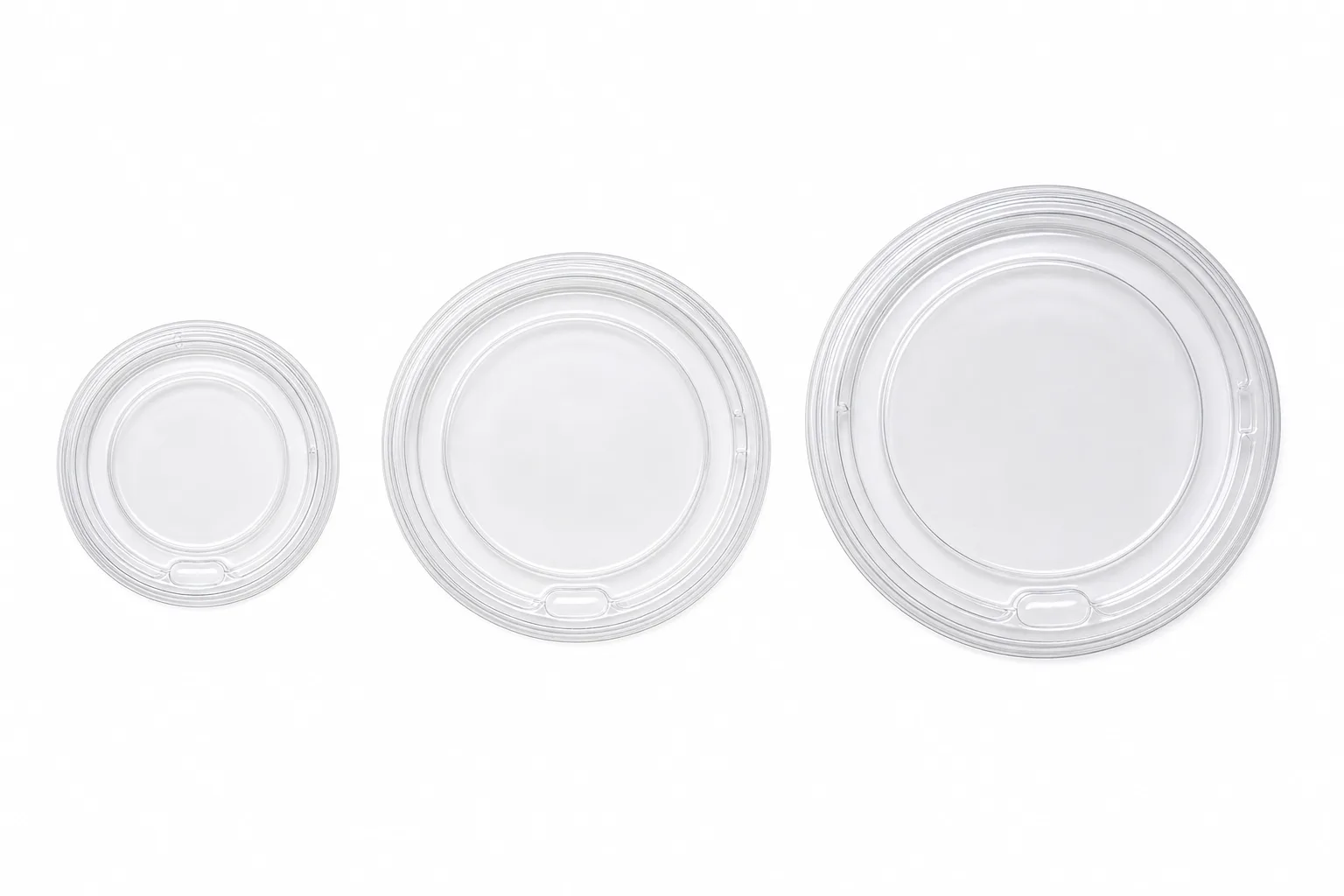
The ounce label names the portion. The rim diameter decides the lid. Because several capacities share a rim, the lid line is much shorter than the cup line.
- Φ45 mm covers 0.75 oz and 1 oz
- Φ62 mm covers 1.5 oz and 2 oz
- Φ74 mm covers 3.25 oz, 4 oz and 5.5 oz
Read that list again if you are about to place an order. Three lid SKUs cover seven cup SKUs. If your current supplier has you buying a separate lid for every cup, you are carrying inventory you do not need.
It also means you can change portion size without touching the lid line. Moving a customer from 3.25 oz to 4 oz to 5.5 oz is one rim the whole way. That is a genuinely useful thing to know when a menu changes in March and you have lids on the shelf until June.
The pairs are worth understanding too. The 1.5 oz is a shallow version of the 2 oz on the same rim: same opening, less depth. When an operator asks for “a shallower dip cup”, that is almost always what they mean, and it does not disturb anything downstream.
What Actually Fits in Each Size
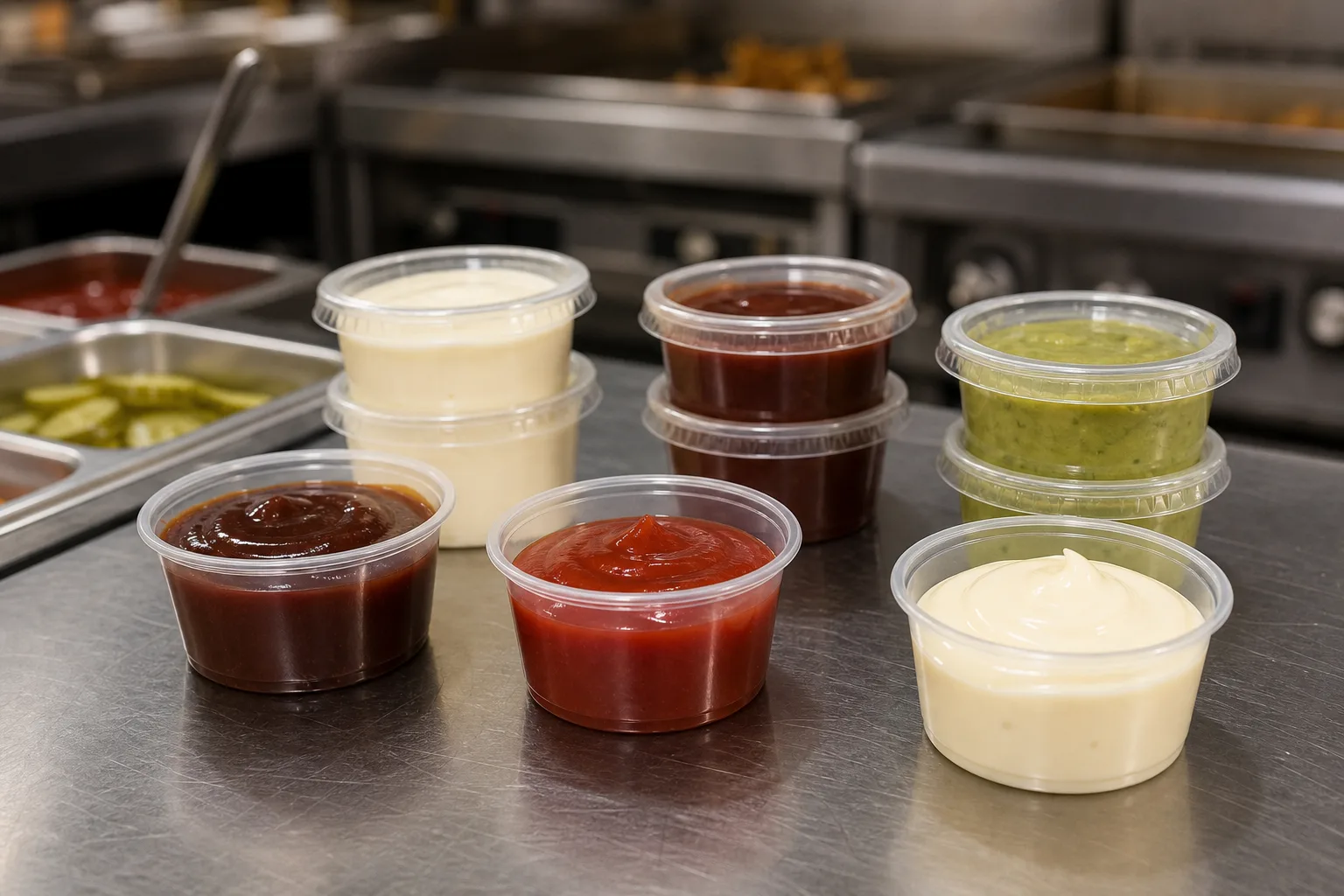
Ounces are abstract when you are standing at a sauce station. Here is the same chart in kitchen terms.
0.75 oz and 1 oz. One portion of a strong condiment. Wasabi, ginger, hot sauce, a single ketchup serve. Sushi and Asian takeaway run almost entirely on these two, usually two or three cups per order.
1.5 oz and 2 oz. The dipping range, and where most volume sits. A 2 oz cup holds roughly four tablespoons, which is the standard serve for mayo, BBQ, ranch and honey mustard. If you stock one size and only one, this is it.
3.25 oz and 4 oz. Chunky and wet. Salsa, guacamole, coleslaw, a soup side, a dessert topping. The step up from 2 oz is not really about volume, it is about what happens when the sauce has pieces in it and needs a wider opening.
5.5 oz. Pre-portioned rather than served alongside. Deli counters, meal kits, salad dressings portioned ahead of service. At this size the cup stops being an accessory and becomes a small container.
How to Stock Fewer Sizes Without Annoying the Kitchen
Most operations carry more portion cup SKUs than they need. Two sizes cover the majority of a QSR or deli menu: one dip portion and one dressing portion.
If you are cutting down, start here:
- Keep 2 oz. It draws more buyer demand than any other size in the range and covers most dips.
- Keep one of 4 oz or 5.5 oz depending on whether your larger serve is a side or a pre-portion.
- Drop 1.5 oz unless you have a specific shallow-dip use. It shares a rim with 2 oz, so removing it costs you nothing on the lid line.
- Drop 3.25 oz if you already stock 4 oz. Same rim, and the volume gap is small enough that most kitchens will not notice.
- Keep 1 oz only if you run sushi, Asian takeaway or a condiment bar where portion control is the point.
Two cup sizes on two rim diameters means two lid SKUs. That is a realistic target for most operations and it makes reordering dramatically simpler.
Cups and Lids Do Not Order One to One
Here is something suppliers rarely raise. Most operators need fewer lids than cups, because part of their volume is served open on a tray and never gets covered.
A sit-in dining room might lid one portion cup in five. A delivery-only kitchen lids almost all of them. If you order lids at a 1:1 ratio because that is how the quote was structured, you are buying lids that will sit in the stockroom.
Work out your actual split before you ask for a price, and ask for both lines to be quoted against it. Cups and lids are quoted separately in this format anyway, which makes the adjustment straightforward.
What They Are Made Of, and What That Rules Out
The standard build is an injection-moulded polypropylene cup with a PET lid.
PP is chosen for the cup because it takes heat and keeps its shape under a snapped-on lid, the same reason it runs through the wider PP cup range. PET is chosen for the lid because it is clearer than PP, which matters when the point of the cup is that staff can see which sauce is in it without opening it. A PP lid is available as an alternative and some operators prefer it, because it is more flexible and more forgiving to snap on at speed.
Two limits worth stating plainly.
The lid has a much lower heat tolerance than the cup. A lid should always come off before anything is heated. The same rule applies to paper cups in a microwave. This is the single most common cause of a “your cup melted” complaint, and the cup is rarely the part that failed.
Clear is the only colour in this format. There is no black, white or coloured version of the stock cup. Clear is what the market buys at this size for the reason above: you need to see the contents.
The Recycling Question, Answered Honestly
A cup and a standard lid are two different resins, PP and PET. The set cannot be described as recyclable as a unit. They have to be separated first.
Even separated, acceptance depends entirely on the local programme. Many kerbside systems in the US and EU do not capture rigid plastics under roughly 75 mm, because they fall through the sorting screens. Every size in the chart above is under that threshold at the base.
We would rather say that than put an eco label on a small plastic item. If a compostable format is a hard requirement for your programme, this product is not the right one and it is better to hear that now.
Case Packs, Minimums and What to Ask For
Portion cups pack 2,500 pieces per carton as standard, and the minimum order is 25,000 pieces per size. Lids are quoted as their own line, per lid diameter.
That minimum is per size, not per order. Two sizes is two lots. Mixed-size containers are usually workable as long as each individual size clears the minimum on its own.
Before you commit, put these questions to whoever is quoting:
- What is the rim diameter of each size, not just the ounce label?
- Which sizes share a lid, and how many lid SKUs am I actually buying?
- What is the case pack, and what are the carton dimensions?
- Is the minimum per size or per order?
- Are cups and lids quoted as separate lines, and can the ratio be adjusted?
- Is the food-contact documentation available for my destination market?
On that last point, our own position: food-contact compliant, test report available on request. Ask us to confirm documentation for your destination market before you specify.
Why Portion Cups Leak, and What the Lid Can Actually Do
A snap-on lid is not a seal. It holds sauce during normal handling and normal delivery, and that is the honest limit of it.
What a snap fit will not survive is a cup inverted for a sustained period, or a thin liquid under pressure in a bag that gets thrown into a footwell. Thick sauces are forgiving. Vinaigrettes, soy and thin hot sauces are not, and they are the ones that generate complaints.
Three things make the difference in practice:
Fill level. A cup filled to the rim pushes sauce into the lid channel, and the lid then has nothing clean to grip. Leave a few millimetres. This costs nothing and fixes more leaks than any spec change.
Matching the lid to the cup you actually bought. A Φ62 lid on a Φ62 cup snaps properly. A lid from a different supplier on the same nominal rim often does not, because rim profiles vary even when the diameter matches. This is the single most common cause of a batch that “does not fit” and it is why cups and lids should come from the same order.
Testing with your own product. Water behaves nothing like ranch dressing. If thin liquids travel in your programme, test that specific size and lid with that specific sauce before you commit to a run.
If you genuinely need leak-proof rather than leak-resistant, a portion cup is the wrong format. That job needs a heat-sealed container, and any supplier who tells you a snap lid delivers it has not tested it either.
Paper Portion Cups: When They Make Sense, and Why We Do Not Stock Them
Some suppliers offer a paper portion cup alongside the plastic one. It is a real product and worth understanding before you decide.
Paper portion cups are typically used open, without a lid, for dry or thick items at a counter: a nut portion, a pill cup, a sample at a food hall. They stack well and they read as less plastic on a tray. Where they fall down is wet sauce over time, because the barrier that keeps sauce off the board is doing a hard job in a very small cup.
We do not stock the paper version. Our range in this format is injection-moulded PP with a PET or PP lid, and we would rather point you elsewhere for paper than sell you something we have not put through our own inspection. If your requirement is specifically a fibre-based sauce cup with a lid, say so early and we will tell you straight away whether we can serve it.
For open-top fibre formats we do supply, paper snack cups start at 8oz and are built for fries and fried snacks rather than sauce.
What Actually Moves the Price
Portion cups are one of the simpler things to price because so little varies. There is no printing on the stock cup, the printable area at this size is too small to be worth the plate cost, and the resin is the same across the range.
That leaves four levers:
| Lever | Effect on unit cost | Notes |
|---|---|---|
| Size | Larger cup, more resin | The step from 2 oz to 4 oz is the biggest single jump in the range |
| Lid material | PET costs more than PP | PET buys clarity; PP buys flexibility and one-resin sorting |
| Lid ratio | Fewer lids, lower order cost | Most operations run below 1:1 and should quote it that way |
| Order quantity | Volume pricing above the minimum | The minimum is 25,000 per size; pricing improves beyond it |
What does not move the price much is the colour, because there is only one, and the print, because there is not any. If a quote you are comparing includes a printing charge on portion cups, ask what is being printed. At this size it is usually the lid, not the cup.
The blunt version: on portion cups the only decisions that carry real money are which sizes you stock, how many lids you take against them, and whether you consolidate seven SKUs down to two.
Frequently Asked Questions
What are the standard portion cup sizes?
Seven capacities are standard: 0.75 oz, 1 oz, 1.5 oz, 2 oz, 3.25 oz, 4 oz and 5.5 oz. The 2 oz size is the most ordered across foodservice, with 4 oz second. Most operations only need two of the seven.
What are the dimensions of a 2 oz portion cup?
A 2 oz portion cup measures 2.44” (62 mm) across the top, 1.83” (46.6 mm) across the base, and 1.20” (30.5 mm) tall, holding roughly 59 ml. It takes a Φ62 mm lid, which also fits the 1.5 oz cup.
What size lid fits a 4 oz portion cup?
A Φ74 mm lid, which also fits the 3.25 oz and 5.5 oz cups. Order lids by rim diameter rather than by ounce label, because three different capacities take this same lid.
How many tablespoons is a 2 oz portion cup?
About four tablespoons, or 59 ml. That is the standard single serve for dips such as mayo, ranch and BBQ, which is why 2 oz is the highest-volume size in the range.
Are portion cups and souffle cups the same thing?
Yes. Portion cup, souffle cup, condiment cup and sauce cup all describe the same product. The souffle name comes from the individual ramekin whose straight-walled shape it copies. When comparing quotes across suppliers, match on rim diameter and capacity rather than on the name.
Do portion cups come with lids included?
Not usually. Cups and lids are quoted and ordered as separate lines in this format, which is standard. It also works in your favour, because most operations need a lower lid ratio than cup ratio.
Working out which two sizes your menu actually needs? Tell us what goes in the cup and how it is served, and we will tell you which sizes cover it, including when one size would do the job of two. Free stock samples ship in 3 to 5 business days with cups and lids sent together so you can test the snap fit yourself. Full specifications are on the portion cups page, and the wider lid programme covers the drink cup range.
Ready to Source Eco-Friendly Paper Cups?
Request a free sample pack or get a wholesale quote tailored to your requirements.