
Henry — Head of Marketing · Reviewed by Austin, Product Manager
July 17, 2026 · 11 min read
The coating on a disposable paper plate (not its diameter) decides whether it survives a real meal. If you’re buying for a restaurant, caterer, or retail program: choose PE/varnish coating for greasy and hot foods (it handles up to 100°C), aqueous coating where recyclability is the commitment, and BOPP lamination when print quality is the priority. Then spend your remaining attention on paperboard weight, because a 250 to 300 gsm 9-inch plate will outperform a flimsy 10-inch one every service.
This guide covers how plates fail, how the three plate coatings actually differ, why GSM matters more than size, and what MOQs and lead times to plan around.
Why do paper plates fail, and why is it almost never the size?
When a buyer tells us “the plates were bad,” the complaint is almost always one of three specific failures. None of them has anything to do with diameter. Knowing which failure you’re seeing tells you exactly which spec was wrong, and what to demand next time.
Failure 1: Soak-through. Liquid or watery sauce penetrates the coating and the plate goes soft from the middle out. This is a coating failure: either the wrong coating for the food (aqueous under a pool of curry), or a coating applied too thin. In production, grease and moisture resistance is checked at raw material intake, mid-production, and pre-shipment precisely because a thin coating passes a visual check and fails a meal.
Failure 2: Cutting collapse. The customer picks up a knife and fork, presses down, and the plate folds or the rim gives way. This is a board failure, not a coating failure. It means the GSM was too low for the plate’s size, or the fluted rim (the embossed corrugation around the edge that gives a round plate its rigidity) was pressed too shallow. Deeper fluting plus heavier board is what separates a plate you can cut a schnitzel on from one you can’t.
Failure 3: Grease shadow. The plate holds up in use, but oil slowly migrates through the board and leaves a dark, translucent stain on the underside. It shows on tables, stacked plates, and customer hands. Food still stays put, but it photographs terribly and reads as “cheap” to every diner. Grease shadow is the slow-motion version of soak-through: a coating that resists for 5 minutes but not for 25.
Here’s what suppliers don’t usually volunteer: a plate can pass a quick water test at a trade show and still show grease shadow 20 minutes into a BBQ service. Water is the easy test. Hot oil over time is the real one. That is why we push buyers to test samples with their actual menu, not with a sink tap.
Which paper plate coating should you choose?
The short answer: PE/varnish for greasy, saucy, and hot foods; aqueous for recyclability commitments; BOPP lamination when the plate is a branding surface first. Paper plate coatings are not interchangeable, and picking by price alone is how you end up with failure modes one and three above.
One note before the details: if you buy paper cups too, don’t map cup logic onto plates. Cups use PE, PLA, or aqueous coatings. We compare those in our PE vs PLA vs aqueous guide. Plates use a different trio: PE/varnish, aqueous, and BOPP lamination. Same paperboard family, different barrier problems.
PE / varnish: the workhorse
PE (polyethylene) or varnish coating on the food-contact surface is the industry mainstream, and for good reason: it delivers the strongest grease and oil resistance of the three, handles hot foods up to 100°C, and carries the lowest MOQ at 30,000 pcs per size. Fried chicken, BBQ, pasta with sauce, anything that arrives glistening: this is the coating that survives it.
The honest trade-off: PE film reduces recyclability, and most municipal paper streams won’t take PE-coated plates. The varnish option within this tier recycles better than PE film, so if your program leans eco but your menu leans greasy, ask about varnish specifically at the quoting stage.
Aqueous: the recyclability play
Aqueous coating is a water-based dispersion with no plastic film at all, the same coating family we covered in depth for cups. On plates it delivers good grease and moisture resistance for standard food service: dry foods, sandwiches, pastries, light-moisture catering. It’s PFAS-free and fluorine-free by formulation, and aqueous-coated plates are accepted in most municipal paper recycling streams.
Where it isn’t the right call: heavily oily or saucy menus. For BBQ and fried items, PE/varnish provides the stronger barrier: an aqueous plate under pulled pork is a grease-shadow complaint waiting to be photographed. Aqueous plates also carry a higher MOQ at 50,000 pcs per size, because the coated board runs in larger batches. The full coating landscape across our range lives in the materials guide hub.
BOPP lamination: the print finish
BOPP (biaxially oriented polypropylene) is different in kind: it’s a film laminated to the outer surface of the plate, in glossy or matte finish, chosen for print vibrancy and premium presentation. The food-contact inner surface still uses PE or aqueous coating underneath. Retail-packaged plates and high-end event programs are its natural home: anywhere the plate sits on a shelf or a styled table before it holds food.
Know what you’re buying: BOPP-laminated plates are not recyclable in standard paper streams, and MOQ starts at 50,000 pcs per size. It’s a marketing upgrade, not a barrier upgrade.
The comparison, side by side
| PE / Varnish | Aqueous | BOPP Lamination | |
|---|---|---|---|
| What it is | Barrier coating on food surface | Water-based dispersion, no plastic film | Print-finish film on outer surface |
| Grease resistance | Strongest: fried, saucy, oily foods | Good: dry to light-moisture foods | Depends on inner coating (PE or aqueous) |
| Hot foods | Up to 100°C | Moderate | Moderate |
| Recyclable in paper streams | Limited (varnish better than PE film) | Yes, most municipal streams | No |
| PFAS-free | Yes | Yes | Yes |
| MOQ per size | 30,000 pcs | 50,000 pcs | 50,000 pcs |
| Best for | Restaurants, BBQ, QSR, heavy meals | Eco-committed brands, bakery, dry catering | Retail packs, branded events |
The blunt verdict: if your menu is greasy or hot, buy PE/varnish and stop second-guessing. Buy aqueous when a recyclability commitment is written into your brand, and accept its food limits. Buy BOPP when the plate needs to sell itself on a shelf.
Does GSM matter more than plate diameter?
Yes, and this is the spec most buyers skip entirely. GSM (grams per square meter) is the weight of the paperboard, and it’s what “heavy duty paper plates” actually means when the phrase means anything at all. The standard range runs 230 to 320 gsm: lighter board (230 to 280 gsm) for 7” and 8.5” dessert and snack plates, heavier board (250 to 300 gsm) for 9” and 10” meal plates, and 280 to 320 gsm for the largest oval platters.
Why it outranks diameter: rigidity has to scale with span. A 10-inch plate on 230 gsm board flexes like cardboard in the rain, while a 9-inch plate on 300 gsm board takes a knife-and-fork meal without complaint. When a quote comes in 20% below market, the paperboard weight is usually where that money came from: the plate looks identical in a photo and folds at the buffet.
Two structural details to check alongside GSM:
- The fluted rim. The embossed corrugation around a round plate’s edge distributes load across the surface. Heavier GSM plus deeper fluting equals a stiffer plate; a smooth, shallow rim on heavy board still bends.
- Dimensional tolerance. Standard tolerance is ±2mm on nominal dimensions. It sounds trivial until your plates need to nest in retail packaging or a dispenser.
Ask for GSM in writing on every quote. A supplier who answers “standard thickness” instead of a number is telling you something.
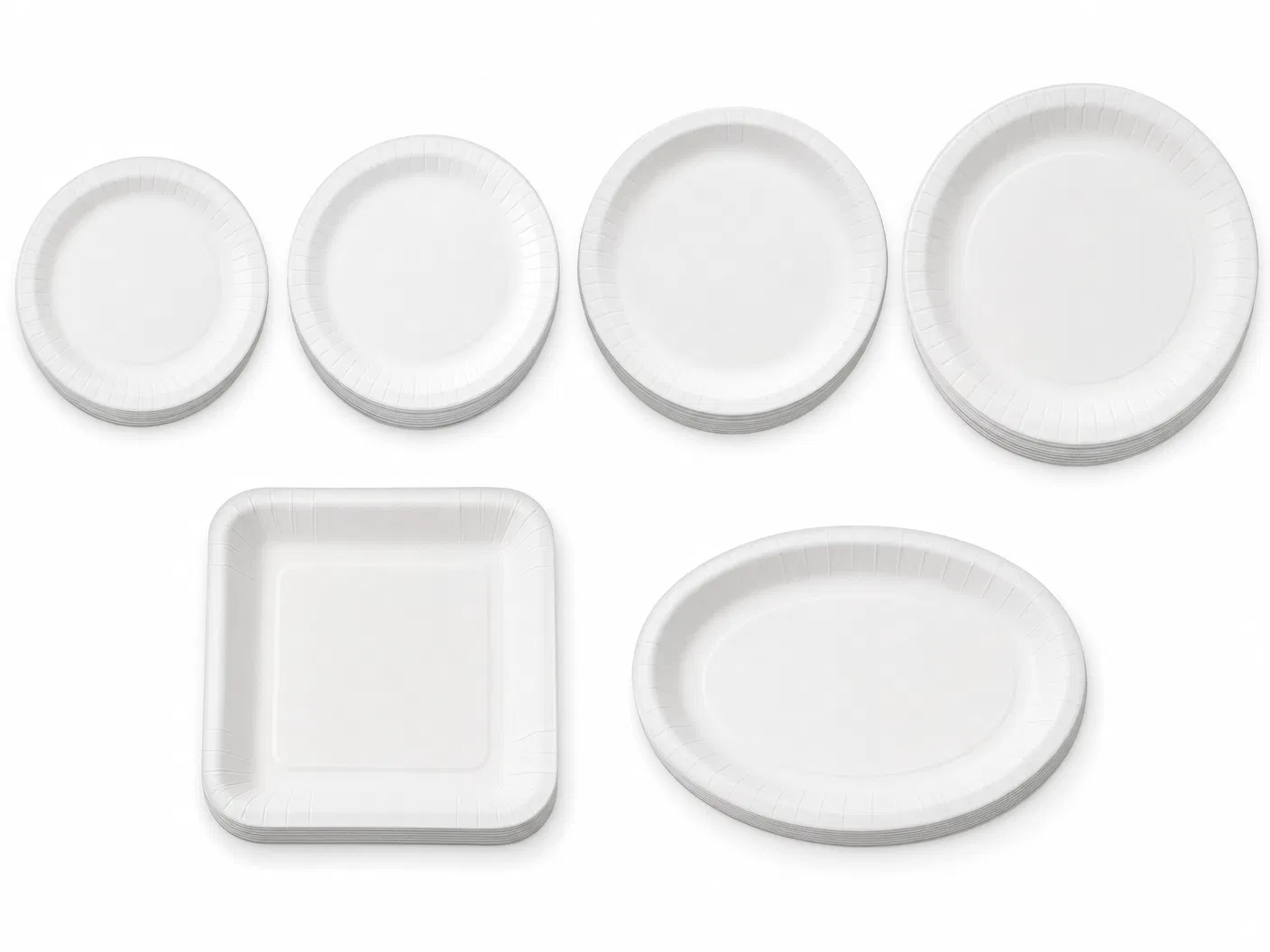
What sizes and shapes do B2B buyers actually order?
The workhorse of the category is the 9-inch round plate (Ø 229mm): standard lunch and dinner service for restaurants, schools, and institutional canteens. Around it, the standard range covers 8 SKUs across three shapes:
| Shape | Size | Board weight | Typical use |
|---|---|---|---|
| Round | 7” (Ø 178mm) | 230-280 gsm | Dessert, snacks, bakery |
| Round | 8.5” (Ø 216mm) | 230-280 gsm | Salads, side dishes |
| Round | 9” (Ø 229mm) | 250-300 gsm | Standard lunch/dinner |
| Round | 10” (Ø 254mm) | 250-300 gsm | Buffet, large servings |
| Rectangular | 240×240mm | 250-300 gsm | Square meals, catering |
| Rectangular | 200×130mm | 230-280 gsm | Snacks, appetizers |
| Oval | 270×200mm | 250-300 gsm | BBQ, grilled items |
| Oval | 300×220mm | 280-320 gsm | Large platters, sharing |
A sizing pattern worth stealing from experienced caterers: order two sizes, not four. A 7” for desserts and a 9” for mains covers most programs; the 10” earns its place only at buffets and sharing-style events where portion sprawl is real. Every extra SKU is a separate 30,000-piece MOQ commitment and a separate storage lane in your warehouse.
Full specifications, coating tabs, and current MOQs live on our paper plates page. If your program also runs fries, snacks, or street food, paper food trays share the same board and coating logic in an open-top format.
Are compostable paper plates a real option?
Straight answer: none of the three standard plate coatings (PE/varnish, aqueous, or BOPP) carries a compostable certification. Aqueous is the eco choice in this category, and its claim is recyclability in paper streams, not compostability. Those are different end-of-life routes, and mixing them up is the most common error we see in sustainability briefs.
If a search for “compostable paper plates” brought you here, translate the requirement before you buy:
- If the real requirement is “recyclable”: aqueous-coated plates answer it. No plastic film, accepted in most municipal paper streams.
- If the real requirement is “plastic-reduced”: varnish or aqueous both move you away from PE film.
- If the requirement is literally certified compostable: the standard plate coatings don’t carry that certification. Raise the requirement explicitly when you inquire, and you’ll get an honest answer about what the claim can and cannot say, not a stretched one.
Whatever the coating, all plate lines run board with documented food-contact compliance, and every coating is PFAS-free, verified by independent laboratory testing, with test reports available on request. FSC-certified paperboard is available on request for buyers with sustainability reporting requirements; documentation details are on our certifications page.
How do you order plates without getting burned?
The mechanics first, because they set your planning calendar. MOQ is 30,000 pcs per size for PE/varnish plates and 50,000 pcs per size for aqueous and BOPP lines; mixed-size orders combine at 50,000 pcs. Custom sizes start at 50,000 pcs per size. Stock (unprinted) plates ship in 7 to 10 business days; custom printed plates run 25 to 30 business days from artwork approval, with printing available in 1 to 6 flexographic colors on white or natural board, plus full-color digital for complex artwork. Every custom order includes a free digital proof before production.
Then the part most buyers skip: sample testing against your actual menu. Free samples arrive in 7 to 10 business days. Here’s the 15-minute protocol that catches the three failure modes before they reach a customer:
- The greasiest dish test. Plate your oiliest menu item hot. Wait 25 minutes, longer than any real table service. Flip the plate and check the underside for grease shadow.
- The knife-and-fork test. Cut something that resists: grilled chicken, a crusty roll. Watch the rim and the center for flex or fold.
- The sauce pool test. A ladle of your wettest sauce, left 30 minutes. Check for soak-through and softening at the center.
- The stack test. Load a plated meal, stack a second plated meal on top, carry both across the room. Catering staff do this hourly; your plate should survive it.
Copy-paste checklist: what to confirm before you order
Paste this into your next supplier email:
- Coating confirmed in writing: PE/varnish, aqueous, or BOPP, matched to our menu’s grease and heat profile
- GSM stated as a number for each plate size (not “standard thickness”)
- Rim type confirmed: fluted/embossed rim on round plates
- MOQ per size and combined MOQ for mixed-size orders
- FDA / LFGB food-contact documentation for the coated board
- PFAS-free test report available on request
- FSC-certified board needed? Flag it now, not at re-order
- Free samples of each size and coating: we’ll test with our actual menu before committing
- Lead time in writing: stock vs custom-printed, from artwork approval
- Production date coding on cartons for stock rotation
Frequently Asked Questions
What is the best coating for disposable paper plates?
PE/varnish coating is the best all-round choice for food service: it has the strongest grease resistance of the three plate coatings and handles hot foods up to 100°C. Choose aqueous coating when recyclability is a brand commitment and your menu is dry to light-moisture. BOPP lamination is a print-quality finish for the outer surface, not a food barrier.
What GSM should heavy duty paper plates be?
Look for 250 to 300 gsm on 9” and 10” meal plates, and 280 to 320 gsm on large oval platters. Lighter 230 to 280 gsm board is fine for 7” and 8.5” dessert and snack plates. GSM plus a properly embossed fluted rim is what makes a plate “heavy duty”: the phrase has no standard definition, so always ask for the number.
What is the minimum order quantity for wholesale paper plates?
MOQ is 30,000 pcs per size for PE/varnish-coated plates, and 50,000 pcs per size for aqueous-coated and BOPP-laminated plates. Mixed-size orders are available at a combined 50,000 pcs, and custom sizes start at 50,000 pcs per size. Custom printed plates follow the same coating-based tiers.
Are disposable paper plates recyclable or compostable?
Aqueous-coated plates are recyclable in most municipal paper streams because they contain no plastic film. PE-coated and BOPP-laminated plates are not recyclable in standard paper streams. None of the three standard plate coatings carries a compostable certification. If your program requires certified compostability, raise it explicitly with your supplier rather than assuming “paper” means compostable.
How long does a custom printed paper plate order take?
Plan for 25 to 30 business days from artwork approval for custom printed plates, plus 7 to 10 business days beforehand if you want samples first, which we recommend. Stock unprinted plates ship faster, within 7 to 10 business days of order confirmation.
Ready to put real food on real samples? Request a free sample pack of plates in your sizes and coatings. Samples ship in 7 to 10 business days, and the 15-minute test protocol above will tell you more than any datasheet.
Ready to Source Eco-Friendly Paper Cups?
Request a free sample pack or get a wholesale quote tailored to your requirements.