
Henry — Head of Marketing · Reviewed by Austin, Product Manager
July 10, 2026 · 12 min read · Updated July 11, 2026
First, let’s clear up the term itself, because “cup carrier” gets used for three different products: multi-cup drink carriers (the tray or box that holds 2 to 6 drinks for takeout), single-cup sleeves (the band that stops fingers burning), and bakery cup liners (a grease tray, nothing to do with drinks). This guide covers the first two, with most of the depth on multi-cup carriers, where the format and material choices genuinely change your cost per order.
Across hundreds of client orders, carriers run in four structural families: box-style with handle, arch handle, flat corrugated tray, and molded pulp tray, fitting standard cups from 8oz to 32oz, with stock MOQs from 5,000 pcs per size (custom printed from 10,000), half of what most custom cup programs require.
Which cup carrier format is right for my operation?
The short answer: box-style for delivery-heavy shops, arch handle for image-conscious cafés, flat tray for volume, molded pulp for eco-mandate programs. Here’s what each format actually is, because suppliers use the names loosely.
Box-style carriers with handle (2, 4 and 6-cup)
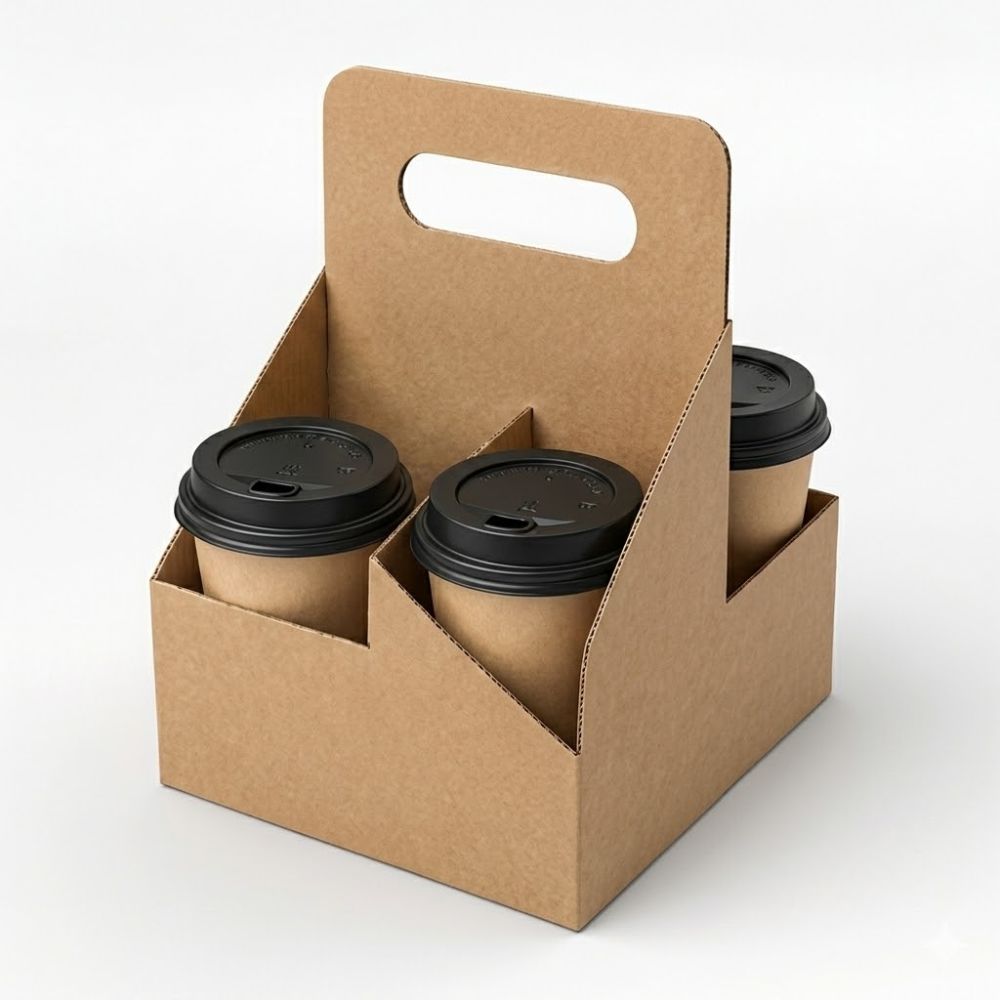
The box-style carrier is a die-cut arch or strap handle on top, cup pockets below, and large flat side panels around the drinks. The 2-cup version traditionally runs on solid kraft; the 4-cup and 6-cup versions run on corrugated board, which is what lets them take four large milk teas without the base bowing. Assembled handle-combo formats measure roughly 195×103×242mm (2-cup), 182×182×236mm (4-cup) and 300×200×240mm (6-cup): tall, because the handle stands above the cups and keeps the courier’s hand off the lids.
Two details buyers overlook. First, the pockets adjust across a 60 to 90mm cup wall diameter range, which is why one box carrier SKU can serve an 8oz espresso takeaway and a 32oz iced tea. Second, those big side panels are the cheapest branding space you will ever buy: a printed carrier travels through offices and lobbies in a way a cup never does.
Arch handle carriers (2-cup)
The arch handle carrier is a one-piece kraft die-cut that folds flat and pops open in seconds. It holds two cups side by side with a comfortable grip arch between them, covering cup diameters of 60 to 80mm. Specialty coffee shops and juice bars like it because it looks lighter and more considered than a box: a clean kraft or white-board arch reads “premium” without saying it.
The honest limit: two cups is the ceiling. A four-drink order means two carriers and an awkward handoff.
Flat tray holders (2, 4 and 6-cup)
The flat tray (the classic cup carrier tray from every drive-through window) is a corrugated board sheet with punched cup holes and no handle. It comes in 2, 4 and 6-cup configurations (a 4-cup tray runs about 225×225×48mm; the 6-cup about 310×210×65mm, often with a handle added), fits cups from 8oz to 24oz, and does one thing extremely well: keeping drinks upright on a flat surface: a counter, a car seat, or the bottom of a delivery bag.
Its weakness is structural: with no handle, the customer’s fingers go under the board, and a soggy or under-spec tray fails exactly there. That’s why board grade matters more on trays than on any other format. More on that below.
Molded pulp trays (2 and 4-cup)
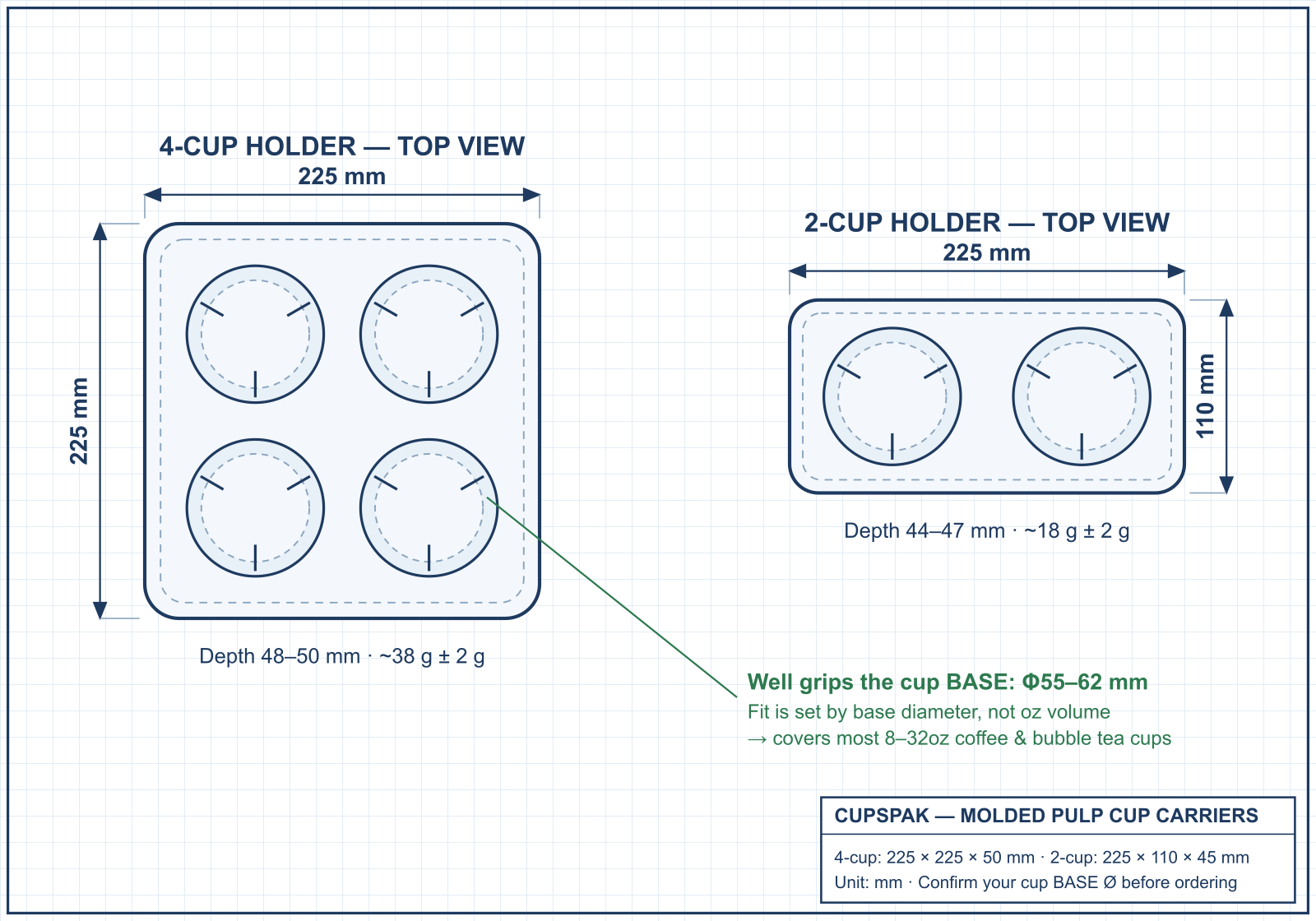
This is the format most buyers underestimate. A molded pulp holder isn’t die-cut from a sheet: it’s pressed in a mould from plant fiber slurry, which gives it something no folded board can match: deep, contoured wells that cradle each cup individually, with built-in flex tabs that grip the cup base. Standard stock specs:
- 4-cup holder: 225 to 235mm square × 48 to 50mm deep, ~38g (one size genuinely covers 8oz to 32oz cups)
- 2-cup holder: ~225×110×45mm, ~18g
- Tear-apart 4-cup: perforated down the middle, so one SKU splits into two 2-cup holders when the order is small: one inventory line instead of two
- A well-made pulp tray at ≥1.5mm wall thickness holds a 300ml+ hot drink stable; thinner budget pressings flex under exactly that load
And the fit rule that trips up more buyers than any other spec in this category: pulp trays fit by cup base diameter, typically Φ55 to 62mm, not by volume. Two 16oz cups from different suppliers can differ by 6mm at the base. Check the base, not the oz.
And the single-cup sleeve
The sleeve is technically a “carrier” in industry catalogs, so one paragraph for completeness: it’s a fan-shaped corrugated or kraft band sized to rim diameter plus cup height: an 8oz sleeve suits Φ80mm rims, a 12 to 20oz sleeve suits Φ90mm, and oversized 22oz+ cups (Φ100 to 110mm) need an extendable design. Corrugated sleeves run 2 to 2.5mm total thickness for insulation. Too loose slides off, too tight won’t slide on, which is why sleeves are speced to your exact cup, not bought generic. Full options are on our coffee cup sleeves page.
Box vs arch vs tray vs pulp: the comparison
Here’s the four-way comparison we walk buyers through. Read the “delivery suitability” row twice if third-party delivery is more than 20% of your orders.
| Box-Style w/ Handle | Arch Handle | Flat Corrugated Tray | Molded Pulp Tray | |
|---|---|---|---|---|
| Cups held | 2, 4 or 6 | 2 | 2, 4 or 6 | 2 or 4 (tear-apart option) |
| Fit basis | Cup wall 60-90mm | Cup wall 60-80mm | Hole punch 65-95mm | Cup base Φ55-62mm |
| Stability in transit | Best: pockets grip the cup wall | Good: cups held at mid-height | Good on flat surfaces | Best per-cup grip: contoured wells |
| Stack / storage | Flat-pack, self-assembles | Flat-pack, thinnest | Flat-pack, stacks densest | Nests, bulkier per pallet |
| Delivery suitability | Best all-round: handle + enclosed pockets | Fair: short hand-carry only | Best inside delivery bags | Very good: wells damp vibration |
| Custom print | Offset up to 7-color / flexo 5 | Offset up to 7-color / flexo 5 | 1-2 color | Embossed logo only |
| Sustainability story | Recyclable kraft | Recyclable kraft | Recyclable | Industrially compostable in 90-180 days |
| Typical buyer | Cafés, QSR, delivery-heavy | Specialty coffee, juice bars | Stadiums, catering, drive-through | Eco-mandate chains, delivery platforms |
The blunt verdict: if you only stock one format, stock the box-style. It covers hand-carry and delivery, takes the widest cup range, and carries your brand on four panels. Add flat trays when delivery bag volume grows, molded pulp when sustainability commitments (or local regulation) demand it, and arch handles only if the aesthetic genuinely matters to your brand. Full specs for all formats are on our cup carriers and holders page.
What materials are cup carriers actually made from?
Paper-based formats dominate this category, but “paper” spans four very different grades, and the grade, not the format, is what decides whether a loaded carrier survives a 25-minute moped ride.
Paperboard grades
- White cardboard (250 to 350gsm): smooth, print-friendly solid board. The default when the carrier is a branding piece: crisp multi-color print (offset up to 7 colors), clean die-cut edges. Most common on 2-cup arch and box formats for coffee chains.
- Kraft paperboard: the brown workhorse. Slightly lower print fidelity, better tear strength per gram, and reads “natural” without any coating. Recycles in standard paper streams.
- B-flute corrugated: two liners with a fluted wave between them, the same construction as a shipping box scaled down. The flutes add rigidity against bending and absorb road vibration, which is exactly the stress a loaded tray sees on a moped. Flat trays and 4/6-cup box carriers run corrugated as standard.
Molded pulp grades: where the real quality spread hides
Molded pulp looks uniform in photos. In production it splits into distinct grades, and the price difference between the bottom and top of this list is roughly 2×:
- Dry-press, recycled paper furnish: formed from waste paper slurry, then oven-dried without a hot press. Cheapest, with a slightly rough surface; air-dried budget versions can carry a papery odor and uneven drying. Fine inside a delivery bag, not a counter showpiece.
- Wet-press, bagasse or bamboo fiber: the wet preform is squeezed in heated metal moulds (~150 to 200°C), which compresses the fine virgin fibers into a smooth, dense, odor-free surface. This is the premium grade, and the direction the market is moving. It takes an embossed logo cleanly.
- Straw fiber (emerging): newer lines press wheat-straw fiber into ultra-light holders, a 2-cup at 10 to 13g versus the traditional 18 to 20g, a 4-cup at 25 to 30g versus ~38g. Same job, roughly a third less material, worth asking about if you buy carriers by the container.
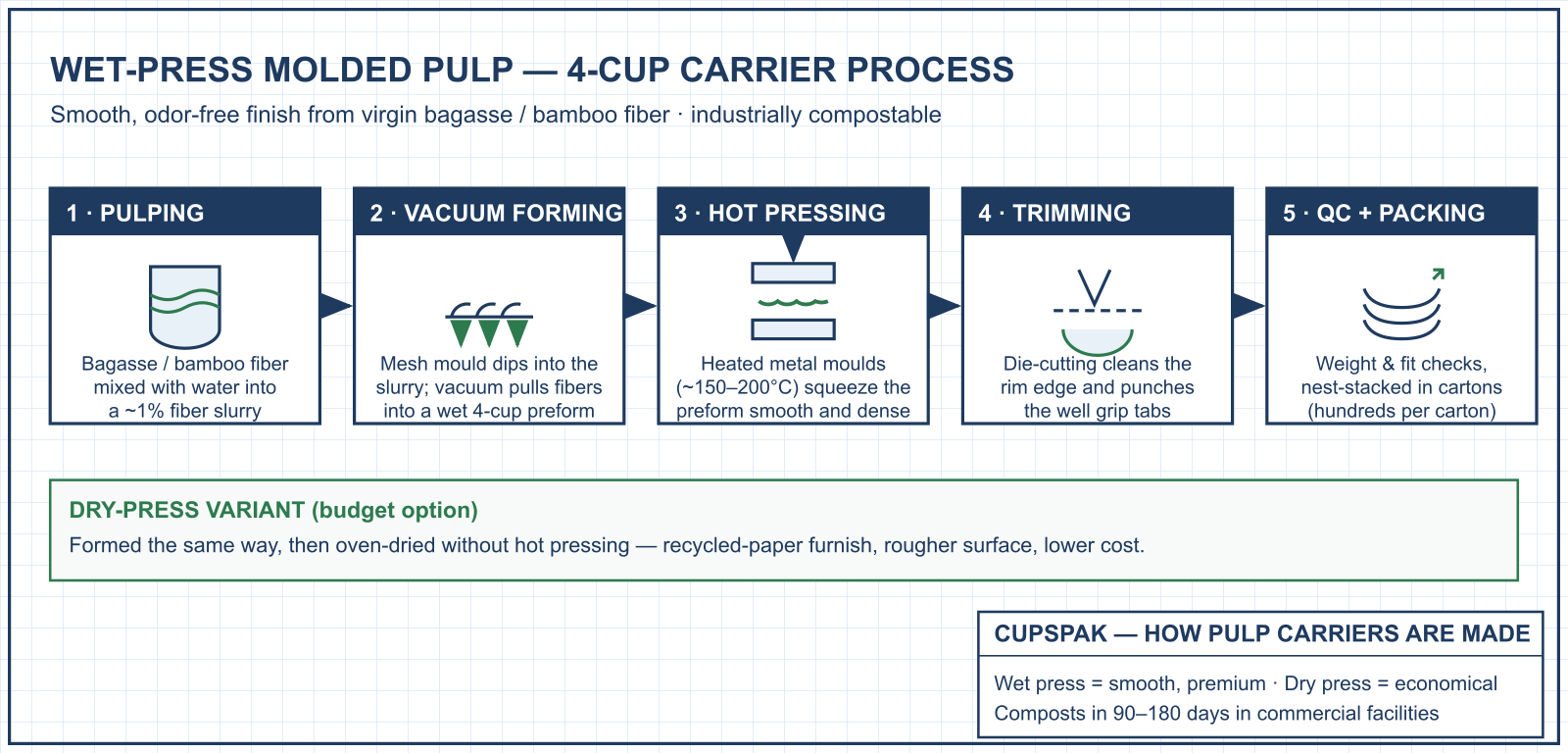
All pulp grades are industrially compostable, breaking down in 90 to 180 days in commercial facilities, supporting documents available on request.
The coating question, answered honestly
Here’s an insider detail worth knowing: drink carriers need no waterproof coating at all. Unlike cups, there’s no liquid contact, so a properly made carrier is plain food-grade board or bare pulp: no plastic film, no wax. That’s exactly what keeps kraft carriers recyclable and pulp trays compostable. A gloss varnish over print for scuff protection is normal; if a quote for a “water-resistant” carrier mentions PE lamination, ask why: you’re usually paying for a barrier the product doesn’t need, and giving up recyclability to get it. PFAS-free status is verified by independent laboratory testing rather than being a coating choice.
How do drink carriers perform in delivery bags?
This is where most carrier programs fail, so let’s be direct: a carrier that works at the counter can still fail in a delivery bag. The failure modes are different. At the counter, the load is vertical and brief. In a bag, drinks lean against the bag wall, ride vibration for 15 to 30 minutes, and sit under condensation the whole way.
Three things separate delivery-grade carriers from counter-grade ones:
- Base geometry. Flat trays and pulp trays sit square in a bag and stop cups migrating. Box carriers do too, with the bonus that the handle keeps the courier’s hand off the cups at handover.
- Structure that absorbs vibration. Corrugated flutes and molded pulp wells both damp road vibration instead of transmitting it to the cup: the difference between foam arriving on the drink and foam arriving on the lid.
- The lid, honestly. No carrier saves a badly fitted lid. Pair carriers with properly matched cup lids (a Φ90mm lid on a Φ90mm rim) before blaming spills on the board.
If delivery platforms drive a meaningful share of your orders, spec the carrier as part of the whole transit chain (bag, carrier, cup, lid), not as an accessory. Our food delivery and takeout solutions page covers how the pieces fit together.
The 4-part carry test: how we tell buyers to test cup carriers
Most carrier “testing” we see is an empty carrier flexed between two hands at a trade show. That tells you nothing: an empty carrier is a piece of cardboard. Load it. Here’s the protocol we suggest to every buyer switching carrier suppliers. It takes under 30 minutes and one round of drinks.
Test 1: Loaded weight, worst case
Fill the carrier with your largest cups, full. Four 16oz drinks weigh roughly 2kg with cups and lids; four 22oz cold drinks with ice push past 2.5kg. Lift the carrier by its handle and hold it at arm’s length for 60 seconds. Watch the handle root: the point where the die-cut arch meets the body. Any tearing, delaminating, or visible stretch at the die-cut edge is a fail. For pulp trays, watch the well rims instead: a quality wet-press tray stays rigid; an under-thickness pressing flexes visibly under four full cups.
Test 2: One-hand carry, real walking
Carry the loaded carrier one-handed for a full minute of actual walking: across the shop, out the door, around the block. Not standing still. Walking introduces the pendulum swing that pops cups out of shallow pockets. Then do it the way a real customer does: carrier in one hand, phone in the other, pushing a door open with a shoulder. If a cup lifts out of its pocket during the door push, your pockets are too shallow for your cup shape.
Test 3: Car cupwell fit
A surprising share of 2-cup carrier purchases end 40 seconds after handover, when the customer tries to drop cups into the car’s cupwells. Take a loaded 2-cup carrier to an actual car: most cupwells run 70 to 90mm across, sized for cups, not carriers. Check two things: does a single cup release from the pocket with one hand, without lifting the whole carrier? And does the empty carrier come apart flat so it isn’t wedged behind the handbrake for a week? If your core cups run wide (90mm bubble tea cups, for example), test with those, not with the 12oz sample cup the supplier sent.
Test 4: The 10-minute condensation test
This is the one that catches under-spec board. Fill the carrier with iced drinks, no sleeves, and let it sit for 10 minutes at room temperature. Condensation runs down the cup wall and pools exactly where the board touches the cup. Then repeat Test 2, the one-hand walk. Dry board that passed earlier can fail wet: solid kraft goes soft at the pocket edges, cheap corrugated delaminates where the liner meets the flute, and budget dry-press pulp wicks moisture into the well rim. If the carrier survives 10 minutes of condensation and still carries clean, it will survive your service window.
Run all four with your actual cups and your actual drinks. Carrier samples are cheap; a Monday morning of spilled four-drink orders is not.
What do cup carriers cost, and what’s the MOQ?
The numbers that matter for planning:
- Unit cost: plain kraft or corrugated carriers typically land around $0.06 to $0.10 per piece at volume; custom-printed and premium wet-press pulp formats run roughly $0.12 to $0.30 depending on format, print, and order size. (Sea freight moves these numbers: carriers are light but bulky, so ask for a landed quote, not an EXW one.)
- MOQ: 5,000 pcs per size for stock carriers, 10,000 pcs for custom printed, still well under the 20,000 pcs/size typical for custom cup programs, so carriers are often the first item buyers brand.
- Plain kraft ships in 7 to 10 business days; custom printed carriers run 20 to 25 business days after proof approval, with a digital proof back within 3 business days of receiving vector artwork.
- Printing: offset CMYK up to 7 colors (spot colors up to 4) or flexo up to 5 colors on box and arch formats; 1 to 2 colors on trays; embossed logos on molded pulp. Kraft brown or white base board.
- Storage math: board formats flat-pack, a pallet of flat carriers takes roughly 20% of the space of pre-assembled alternatives, and staff pop them open in under 3 seconds. Pulp trays nest instead, which stacks denser than assembled boxes but bulkier than flat board.
One planning tip from the coffee-shop programs we supply: order carriers on the same cadence as cups, at roughly one carrier per 2.5 to 3 cups sold, and revisit the ratio after your first month of delivery data. Cafés consistently underestimate multi-drink orders. See our coffee shop solutions page for how carrier volume typically scales with store count.
Which carrier setup fits your scenario?
| Scenario | Recommended setup | Why |
|---|---|---|
| Delivery-first, cost-controlled | Corrugated sleeve + box-style or flat tray 2/4-cup | Stable in bags, cheapest per order |
| Specialty café, brand-led | Printed white-card arch or box + kraft sleeve | Best print surface, premium hand-feel |
| Chain with eco commitments | Wet-press molded pulp trays + uncoated kraft | Compostable, regulation-proof, embossed branding |
| Stadiums, catering, volume | 4/6-cup corrugated flat trays | Densest stacking, fastest loading |
Buyer’s checklist: ordering cup carriers
Copy this into your next supplier email:
- Which formats do you run (box-style, arch handle, flat tray, molded pulp) and in which cup counts (2/4/6)?
- For board formats: confirm cup wall diameter fit range in mm; our cups are __mm at the point the pocket grips
- For pulp trays: confirm well fit range; our cup base is __mm
- Board spec in writing: white card (gsm), kraft, or B-flute corrugated
- For pulp: dry-press or wet-press, and which fiber (recycled paper / bagasse / bamboo)? Wall thickness?
- Confirm no plastic lamination, and recyclability or compostability with supporting documents
- Is FSC-certified paperboard available for this run?
- MOQ per SKU in writing
- Lead time: plain vs custom printed, and proof turnaround
- Print spec: number of colors, kraft or white base, dieline availability
- Send loaded-weight samples; we will run a 4-part carry test before approving
Frequently Asked Questions
What sizes of cups do carriers fit?
Standard carriers fit paper and plastic cups from 8oz to 32oz, but each format measures fit differently. Box-style carriers grip the cup wall at 60 to 90mm, arch handles at 60 to 80mm, flat trays punch holes at 65 to 95mm, and molded pulp wells grip the cup base at Φ55 to 62mm. If you run a non-standard cup (very wide bubble tea cups, for example), send the diameter at the grip point and a custom fit can be confirmed.
Are molded pulp carriers better than cardboard ones?
Different jobs. Pulp trays give the best per-cup grip and the strongest sustainability story (industrially compostable in 90 to 180 days), and one 4-cup pulp holder genuinely covers 8oz to 32oz cups. Board carriers print far better, flat-pack tighter, and the box-style adds a handle. Delivery-heavy eco-mandate operations often run pulp; brand-led cafés usually stay with printed board.
What’s the difference between wet-press and dry-press pulp carriers?
The process after forming. Wet-press squeezes the wet preform in heated metal moulds, producing a smooth, dense, odor-free surface from bagasse or bamboo fiber, the premium grade. Dry-press oven-dries the preform without hot pressing, usually from recycled paper: rougher, cheaper, and fine for inside delivery bags. Ask which one you’re being quoted; the price difference is real.
What is the minimum order quantity for custom printed cup carriers?
Stock carriers start at 5,000 pcs per size; custom printed carriers at 10,000 pcs. Custom printing supports offset CMYK up to 7 colors (up to 4 spot colors) or flexo up to 5 colors on box and arch formats, with a digital proof in 3 business days and production in 20 to 25 business days after approval.
Are cardboard cup holders recyclable or compostable?
Yes. Board carriers are plain food-grade kraft or white paperboard with no plastic coatings, so they recycle in standard paper streams in most markets. Molded pulp trays go further, industrially compostable in 90 to 180 days, and unprinted kraft versions are also compostable in commercial facilities. FSC-certified paperboard is available on request.
Which drink carrier is best for food delivery?
Flat trays, pulp trays, and box-style carriers. Trays sit square in delivery bags and stack efficiently; pulp wells grip each cup individually against vibration; box-style adds a handle and enclosed pockets for the handover. B-flute corrugated or wet-press pulp is the right spec when drinks ride 20+ minutes.
Do I need a 2-cup or a 4 cup carrier?
Stock the 4-cup as your base: a 4-cup carrier carries two drinks perfectly well, but a 2-cup carrier never carries four. In molded pulp, the tear-apart 4-cup solves this with one SKU that splits into two 2-cup holders. Add a dedicated 2-cup format (arch handle or 2-cup tray) once your order data shows two-drink orders dominating, which is typical for specialty coffee.
Ready to run the carry test yourself? Request free carrier samples in the formats and cup sizes you actually serve: load them, walk them, and let the board answer for itself. Samples ship in 7 to 10 business days; you only cover shipping. You can also request our catalog to see every carrier format next to its matching cups, lids and sleeves.
Ready to Source Eco-Friendly Paper Cups?
Request a free sample pack or get a wholesale quote tailored to your requirements.